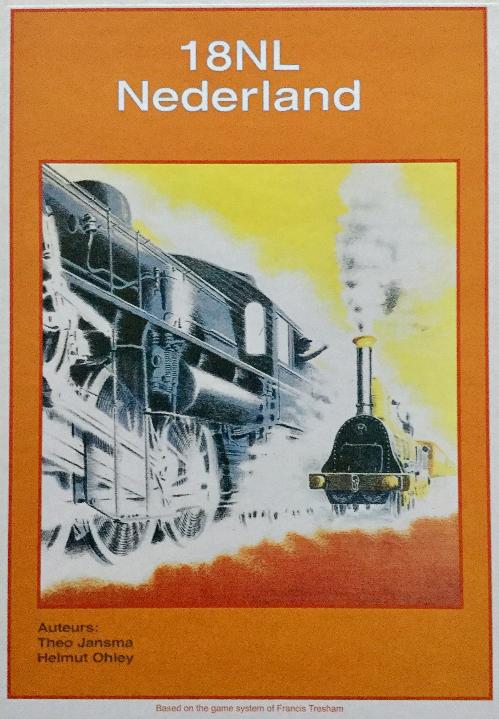
18NL
Designer: Helmut Ohley
1830 transplanted to the Netherlands, with the same classic spirit on a Dutch map.
18NL — Summary
Capitalization type
- Full capitalization: on floating (60% sold), the company receives all its capital (par price × 10) at once into its treasury — exactly like 1830, with no variant of its own.
Floating percentage and per-player share limits
- Floats once 60% of shares are sold (the default threshold, uniform across all corporations)
- No player may hold more than 60% (the default cap) of a single corporation, with no exceptions
- Certificate limit per player: 3 players — 22; 4 players — 18; 5 players — 14; 6 players — 12
Starting cash by player count
- 3 players: ƒ800 starting cash (certificate limit: 22)
- 4 players: ƒ600 starting cash (certificate limit: 18)
- 5 players: ƒ480 starting cash (certificate limit: 14)
- 6 players: ƒ400 starting cash (certificate limit: 12)
- The bank always starts with ƒ12,000, the same figure as 1830
End game triggers
- The bank runs out of money: immediate end (as in 1830)
- A company goes bankrupt and can't complete a mandatory train payment: immediate end
Number of phases
- 6 phases (2, 3, 4, 5, 6, D), triggered by the purchase of the first train of each type — the same scheme as 1830
Train list and prices
- 2 train — ƒ80 (6 available; rusts once the first 4-train is bought)
- 3 train — ƒ180 (5 available; rusts once the first 6-train is bought)
- 4 train — ƒ300 (5 available; rusts once the first Diesel is bought) — one more than in 1830, to supply the ninth company
- 5 train — ƒ450 (3 available; buying it closes the private companies)
- 6 train — ƒ630 (3 available) — one more than in 1830
- Diesel (D) — ƒ1,100 (unlimited) — allows trading in type-4, 5, or 6 trains for a ƒ300 discount each
List of private companies
- P1 — Amsterdamsche Omnibus-Maatschappij — ƒ20, revenue 0 — allows laying an extra tile at F5 with a ƒ40 discount; blocks F5 while owned by a player
- P2 — Geldersch-Overijsselsche Lokaalspoorweg-Maatschappij — ƒ40, revenue ƒ5 — allows laying a free token on a hex without track, no connection needed; blocks F17 and G16
- P3 — De Veluwe — ƒ70, revenue ƒ10 — can be exchanged for a 10% share of the DV (if the owner doesn't already hold 60% of it); blocks F9
- P4 — De Twentsche Electrische Tramweg-Maatschappij — ƒ110, revenue ƒ10 — the buyer immediately receives a free 10% share of the NCS; blocks F19
- P5 — Hollandsche Ijzeren Spoorweg-Maatschappij — ƒ160, revenue ƒ10 — the buyer receives the president's certificate (20%) of the HIS and sets its par price immediately; closes when the HIS buys its first train; blocks E4 and E6
- P6 — Spoorweg-Maatschappij Zuid Beveland — ƒ200, revenue ƒ15 — the buyer receives the president's certificate (30%, not the usual 20%) of the NFL and sets its par price immediately; closes when the NFL buys its first train; blocks J3 and K2
List of corporations
- Almelo-Salzbergen (AS) — home at E16
- Nederlandsche Centraal (NCS) — home at F13
- De Veluwe (DV) — home at G8
- Maatschappij tot Exploitatie van Staatsspoorwegen (MES) — home at J7
- Hollandsche IJzeren Spoorweg (HIS) — home at E6
- Nederlansche Zuid-Ooster (NZO) — home at H13
- Zuid-Hollandsche Electrische Spoorweg-Maatschappij (ZHE) — home at G2
- Nederlansche Rhijnspoorweg-Maatschappij (NRS) — home at E6
- Noord Friesche Lokaal (NFL) — home at B15; a ninth company on top of 1830's eight, with its own 8-share structure (30% president + 7 × 10%) instead of the usual 10 certificates
Game-specific mechanics
- An almost literal transplant of the 1830 system onto the Dutch railway network: 18NL's own rulebook states that "in principle, the rules of 1830 are valid"
- A ninth company (NFL) with its own share structure (30% president instead of 20%)
- Two "B&O-style" privates: P5 with a 20% director's share of the HIS, and P6 with a 30% director's share of the NFL
- Privates that convert directly into shares: P3 can be exchanged for 10% of the DV, and P4 comes with 10% of the NCS
- P1 pays no revenue and cheapens P2 by 5 guilders in the auction (the same quirk as 1830's SV&N, with its own numbers)
- Custom tiles with "X" and "Z" type cities (values 20/50/70) replacing some of 1830's pieces
Emergency sell
Matches the 1830 baseline exactly, with no overrides of any kind: treasury pays first, then the president's personal cash, then a forced sale of the president's personal shares of any corporation at market price if still short.
Comparison with 1830
1. The same 1830 system, transplanted literally to the Netherlands
Unlike every other game in this catalogue, 18NL doesn't reinterpret 1830: its own rulebook opens by saying
"in principle, the rules of 1830 are valid." It's a direct transplant of the map, companies and privates onto
the Dutch railway network (Almelo-Salzbergen, Nederlandsche Centraal, De Veluwe...), without adding any new
subsystem (no loans, no mergers, no incremental capitalization): every change is small and concrete.
2. A ninth company on top of 1830's eight
1830 has eight operating companies. 18NL adds a ninth, the Noord Friesche Lokaal (NFL), the smallest company
in the game (only 2 starting station tokens, same as the ZHE and the NRS).
3. The NFL floats with a 30% president's certificate, not 20%
In 1830 a director's certificate is always worth 20%, for any company. In 18NL, private no. 6 comes bundled
with a 30% Director's certificate of the NFL (instead of the usual 20%), and this private closes when the NFL
buys its first train — the same pattern as 1830's B&O, but with a higher president's stake that breaks the
standard.
4. Two "B&O-style" privates, not just one
In 1830 only the B&O is tied from the start to a company's president certificate. In 18NL this pattern is
doubled: private no. 5 comes with a 20% Director's certificate of the HIS (closes when the HIS buys its first
train) and private no. 6 with a 30% Director's certificate of the NFL (closes when the NFL buys its first
train).
5. Privates that convert directly into company shares
Besides the two "B&O-style" privates, private no. 3 (70 Gulden) can be converted into a 10% share of De
Veluwe (DV), and private no. 4 (110 Gulden) comes bundled with a 10% share of the Nederlandsche Centraal
(NCS). None of 1830's six original privates does anything like this.
6. A private that pays no revenue at all, and cheapens the next one
Private no. 1 (20 Gulden) pays no dividend whatsoever (0 Gulden), and as a direct consequence private no. 2
starts 5 Gulden cheaper in the auction. 18NL's own rulebook explicitly describes this as "similar to the SV&N
in 1830" — that is, it's not a new mechanic, but the same 1830 quirk recreated with new numbers.
7. Certificate limits adjusted to compensate for the ninth company
Since there's one more company than in 1830 (and therefore more certificates in play), 18NL raises the
per-player certificate limit compared to 1830's standard limits.