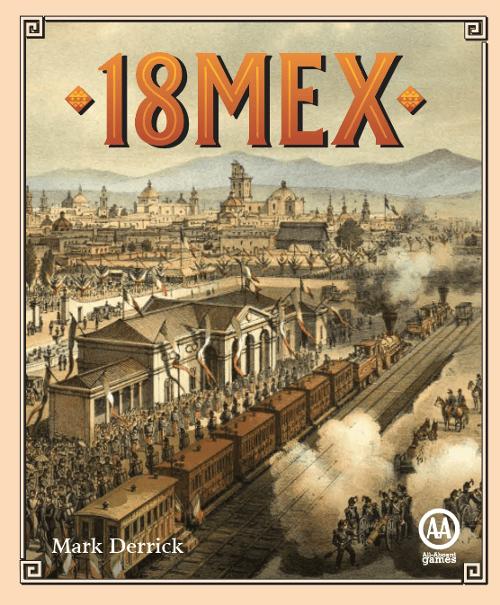
18MEX
Designer: Mark Derrick
Classic 18xx based on Tresham's 1829: mail contracts, a national railroad formed by merger, and delayed train obsolescence.
18MEX — Summary
Capitalization type
- Full capitalization: on floating (50% sold), the company receives all its capital (par price × 10) at once into its treasury.
Floating percentage and per-player share limits
- Major corporations float once 50% of shares are sold; the minors (A, B, C) have no shares and therefore never float
- No player may hold more than 60% (the default cap) of a single major corporation
- Certificate limit per player: 3 players — 19; 4 players — 14; 5 players — 11
Starting cash by player count
- 3 players: $625 starting cash (certificate limit: 19)
- 4 players: $500 starting cash (certificate limit: 14)
- 5 players: $450 starting cash (certificate limit: 11)
- The bank always starts with $9,000, regardless of the number of players
End game triggers
- The bank runs out of money: ends once the current operating round is finished
- A share price reaches the marked end-game space ($200) on the stock chart: ends once the current operating round is finished
- A company goes bankrupt: immediate end
Number of phases
- 8 phases (2, 3, 3½, 4, 5, 6, 6½, 4D), triggered by the purchase of the first train of each type
- Phase 3: privates can now be bought in by corporations
- Phase 3½ (triggered by the first "3'" train): all three minors close at once and their owners each receive a share of the corresponding major; the NdM becomes tradeable on the stock market
- Phase 5: all remaining privates close and the possible "NdM Merger" is triggered
Train list and prices
- 2 train — $100 (9 available; rusts once the first 4-train is bought)
- 3 train — $180 (4 available; rusts once the first 6-train is bought) — buying it makes privates buyable by corporations
- 3' train — $180 (2 available, same price as the 3-train; rusts once the first 6-train is bought) — buying it closes all three minors and opens NdM trading on the stock market
- 4 train — $300 (3 available; becomes obsolete —but isn't removed yet— once the first 6' train is bought)
- 5 train — $450 (2 available) — buying it closes all remaining privates and can trigger the "NdM Merger" (an existing major may voluntarily merge into the NdM)
- 6 train — $600 (1 available)
- 6' train — $600 (1 available, same price as the 6-train)
- 4D train — $700 (7 available) — the last available type; pays double revenue for each city/off-board stop visited
List of private companies
- Mexico City-Acapulco Railroad (MCAR) — $20, revenue $5 — no special abilities
- Compagnie Du Boleo (CdB) — $30, revenue $5 — free extra token at Santa Rosalia; only present with the optional "Baja" variant; can be bought in for $15-$30 from phase 2
- Kansas City, Mexico & Orient Railroad (KCMO) — $40, revenue $10 — allows laying the non-upgradeable Copper Canyon tile at F5 for $60 (instead of $120); closes once used
- Interoceanic Railroad (A) — $50, revenue $0 — the owner controls minor A (starts at Tampico); can't be sold; at phase 3½ the minor closes and the owner receives a 5% NdM share
- Sonora-Baja California Railway (B) — $50, revenue $0 — the owner controls minor B (starts at Mazatlán); can't be sold; at phase 3½ it closes and the owner receives a 5% NdM share
- Southeastern Railway (C) — $50, revenue $0 — the owner controls minor C (starts at Oaxaca); can't be sold; at phase 3½ it closes and the owner receives a 10% UdY share
- Mexican International Railroad (MIR) — $100, revenue $20 — comes with a 10% share of the Chihuahua Pacific Railway (CHI); blocks hexes K11 and J12
- Mexican National Railroad (MNR) — $140, revenue $20 — comes with NdM's president's certificate; the owner sets its par price immediately; can't be sold to any corporation; closes once NdM buys its first train
List of corporations
- Chihuahua Pacific Railway (CHI) — home at E6
- National Railways of Mexico (NdM) — home at O10; special share split 20/10/10/10/10/10/10/5/5/10 (two 5% certificates reserved for minors A and B, plus a 10% reserved for a major's merger); +1 to train limit; can buy and sell trains with other corporations at face value
- Mexican Central Railway (MC) — home at I8
- Pacific Railroad (FCP) — home at B3; can never be merged into the NdM
- Texas-Mexican Railway (TM) — home at I12; can never be merged into the NdM
- Mexican Railway (MEX) — home at P13
- Southern Pacific Railroad of Mexico (SPM) — home at O8
- United Railways of Yucatan (UdY) — home at Q14
- 3 starting minors: Interoceanic Railroad (A) — Tampico/M12; Sonora-Baja Railway (B) — Mazatlán/K6; Southeastern Railway (C) — Oaxaca/S12 (all close and merge at phase 3½)
Game-specific mechanics
- Mail contract: every major with at least one train automatically receives, at the start of its turn, the revenue of its home city, on top of whatever its routes earn
- NdM Merger: buying the first 5-train may trigger an existing eligible major (all except FCP and TM) to voluntarily merge into the NdM, which inherits its stations, trains, and treasury
- Simultaneous closure of all three minors at phase 3½, trading them in for shares of the corresponding major
- Two-stage obsolescence: an obsolete train can still operate until after its owner's next dividend step
- Dividends for shares still unsold (in the Initial Offering) go into the company's own treasury instead of being lost
- Sequential purchase (with an option to bid) of privates and minors at the start of the game, instead of a classic auction
- Final scoring values privates and minors at face value, not market value
Emergency sell
Matches the 1830 baseline closely: treasury, then the president's personal cash, then a forced sale of any shares the president holds, stopping once enough is raised. The one added restriction is that a corporation forced to buy during an emergency can only do so from the bank or depot, never from another corporation's train stock.
Comparison with 1830
1. Comes from 1829, not 1830
18MEX (Mark Derrick and John David Galt, 2001-2005) is explicitly based on Francis Tresham's 1829 system, not
on 1830. It's for 3-5 players and always uses a fixed $9,000 bank.
2. Mail contract: a fixed income just for owning a train
Every major company has a "mail contract" with its home city: if it owns at least one train at the start of
its turn, the bank automatically pays it the revenue value of its home city, on top of whatever its routes
earn. This passive income doesn't exist in 1830.
3. A national railroad formed by merging existing majors
In 1830, public companies can never merge with each other. In 18MEX, buying the first 5-train triggers the
"NdM Merger": players may voluntarily merge their major companies (only certain companies are eligible) into
the NdM (National Railways of Mexico), which receives all of their stations, trains, and cash.
4. Delayed train obsolescence, not immediate
In 1830, a train is removed from the game the instant the train that makes it obsolete is bought. In 18MEX,
once 4-trains become obsolete, they can still be used until after their owner's dividend step on their next
turn — only then are they removed. It grants a buffer turn that doesn't exist in 1830.
5. Dividends for unowned shares go to the treasury instead of being lost
If a company pays dividends while it still has shares in the "Initial Offering" (unsold), that portion of the
dividend isn't lost: it goes into the company's own treasury. In 1830, dividends for shares nobody owns simply
aren't paid to anyone.
6. Sequential purchase of privates and minors, not a classic auction
At the start, each player may buy the cheapest available private or minor at face value, or bid on it; if
anyone bids, an auction is triggered only among those who bid. 1830's initial private auction is simpler and
doesn't allow this "buy directly at face value" option.
7. The winner is calculated using the face value of privates/minors, not market value
To determine the winner, major company shares count at market value, but the privates and minors a player
owns count at their face (par) value, not what they'd cost on the market. 1830 has no such distinction in
final scoring.
A term you do not recognise? They are all explained in the 18xx glossary. Glossary →