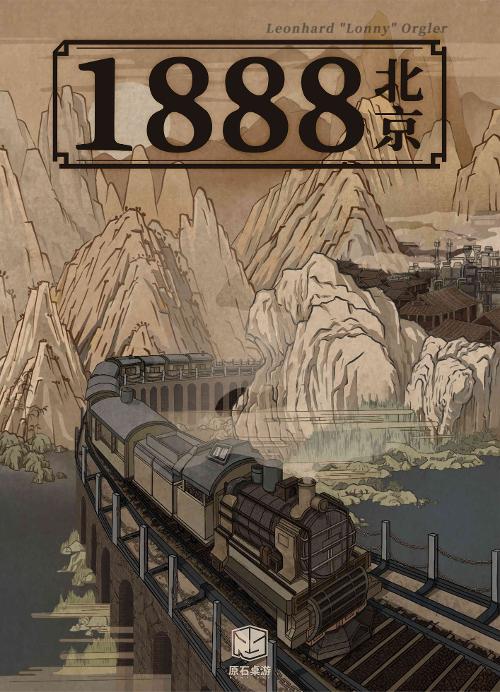
1888-N
Designer: Leonhard "Lonny" Orgler
Northern China (the Beijing area): the first of a Chinese trilogy (1888-N, E and S) that can be combined to expand the map and companies.
1888 — Summary
(North Map variant)
Capitalization type
- Full capitalization: upon floating (50% sold), the company receives its entire capital (par price × 10) into the treasury at once.
Floating percentage and per-player share limits
- Floats at 60% of shares sold (single threshold for all corporations)
- No player may hold more than 60% (6 out of 10 certificates) of a single corporation
- Certificate limit per player: 2 players — 20; 3 players — 20; 4 players — 16; 5 players — 13; 6 players — 11
Starting cash by player count
- 2 players: ¥1,200 starting cash
- 3 players: ¥800 starting cash
- 4 players: ¥600 starting cash
- 5 players: ¥480 starting cash
- 6 players: ¥400 starting cash
- The bank starts with ¥9,000
End game triggers
- The bank runs out of money: the current full operating round set is finished
- A company goes bankrupt: immediate end
Number of phases
- 6 phases (2, 3, 4, 5, 6, D), triggered by the purchase of the first train of each type
- Brown tiles unlock in Phase 5 and gray tiles in Phase D
Train list and prices
- 2 train — ¥80 (7 units; rusts with the first 4-train)
- 3 train — ¥180 (6 units; rusts with the first 6-train)
- 4 train — ¥300 (5 units; rusts with the first Diesel)
- 5 train — ¥500 (3 units; buying it closes the private companies)
- 6 train — ¥630 (2 units)
- Diesel (D) — ¥900, unlimited; allows trading in an old train for a ¥200 discount
- 2, 3, and 4-trains are also "non-permanent": they're removed after a set amount of time, on top of the usual purchase-triggered rusting
List of private companies
- Kaiping Tramway (KT) — ¥25, revenue ¥5 — no special power
- Terracotta Army (TA) — ¥50, revenue ¥10 — allows placing the red Xi'an tile with no connection required
- Heng Shan (HS) — ¥75, revenue ¥15 — allows placing the mine on hex C5; any train reaching it adds ¥40 to the treasury
- Great Wall of China (CW) — ¥100, revenue ¥20 — allows placing up to two free yellow tiles on the Great Wall hexes
- Yanda Railway Ferry (YRF) — ¥125, revenue ¥25 — places the special ferry tiles at Dalian and Yantai
- Forbidden City (FC) — ¥150, revenue ¥30 — can be exchanged during a stock round for a share (IPO or market) of a company with a token in Beijing
List of corporations
- Jingha Railway (JHR) — home at C9 (city 1) — destination D12 (+30)
- Shenshan Line (SSL) — home at B18 — destination C13 (+20)
- Changda Line (CDL) — home at A19 — destination E17 (+20)
- Hanji Railway (HJR) — home at F6 — destination G9 (+20)
- Taijiao Line (TJL) — home at E3 — destination H4 (+20)
- Lanyan Railway (LYR) — home at F16 — destination H14 (+20)
- Jingzhan Railway (JZR) — home at C9 (city 0) — destination B6 (+40)
- Zidong Railway (ZDR) — home at G11 — destination F12 (+40)
Game-specific mechanics
- Floats at 50% (not 60%)
- Revenue bonus when a single route connects a company's home city and its designated destination city
- Public companies can only buy privates from Phase 3 onward, at 50%-150% of face value
- Harbour at hex H16: mandatory terminus for any route using it, but doesn't count toward train range
- Mine at hex C5 (via the Heng Shan private): adds ¥40 to any route reaching it
Emergency sell
Note: on the online 18xx server this is the "North" map variant of a single game called 1888, not a separate title. The funding order matches 1830 — treasury, then the president's cash, then a forced sale of any shares the president holds — but two things differ: a corporation must always hold a train, not just when a route needs one, so emergency funding is triggered far more often; and it can only ever buy from the bank or depot, never from another corporation's train stock.
Comparison with 1830
1. Setting and map
1830 covers the northeastern US. 1888 moves the action to the Beijing area of northern China, with distinctive
local geography that has no equivalent in 1830: Great Wall hexes, an off-board area at Xi'an, a mandatory
harbour at hex H16, and a sea connection between Dalian and Yantai.
2. Privates with active map-tied powers, not just flat income
In 1830 most privates simply pay a fixed income, with the odd exception. In 1888, five of the six privates
grant an active power tied to a specific hex: the Terracotta Army allows a bonus tile placement at Xi'an
without needing a connection, Heng Shan lets its owner place a mine on hex C5 that adds ¥40 to any route
reaching it, the Great Wall of China grants free yellow tile placements along the wall hexes, and the Yanda
Railway Ferry places a special blue ferry tile connecting Dalian and Yantai.
3. The priciest private converts into a founder's share of any company with a Beijing token
In 1830, the B&O is a private tied specifically to one single company (itself). In 1888 the most
expensive private (Forbidden City, ¥150) can be exchanged for a share (IPO or market) of any company that has
a station token in Beijing, chosen by the owner at the moment of exchange.
4. Private purchases restricted in both timing and price
In 1830 a public company can buy a private at any point in the game, for any agreed price at or above face
value, with no upper limit. In 1888 these purchases can only happen from Phase 3 onward, and the price must
fall between 50% and 150% of face value.
5. A lower floating threshold
In 1830 a company floats once 60% of its shares are sold. In 1888, 50% is enough.
6. A bonus for connecting a company's home city and destination city
In 1830 every city simply contributes its printed value, with no special relationship to who owns the route.
In 1888 a company earns extra revenue when a single route connects both its home city and its designated
destination city.
7. Two obsolescence clocks running at once
In 1830 a train only rusts once the next type is bought. In 1888, on top of that usual mechanism, the early
trains (2, 3, and 4) are also "non-permanent": they're removed once a set number of operating rounds has
passed, even if nobody has bought the next train type yet.
8. A harbour as a mandatory terminus that doesn't count toward train range
1830 has no equivalent hex. In 1888 the harbour at hex H16 must always serve as one end of any route that uses
it, but, unusually, it does not count toward the train's range limit.