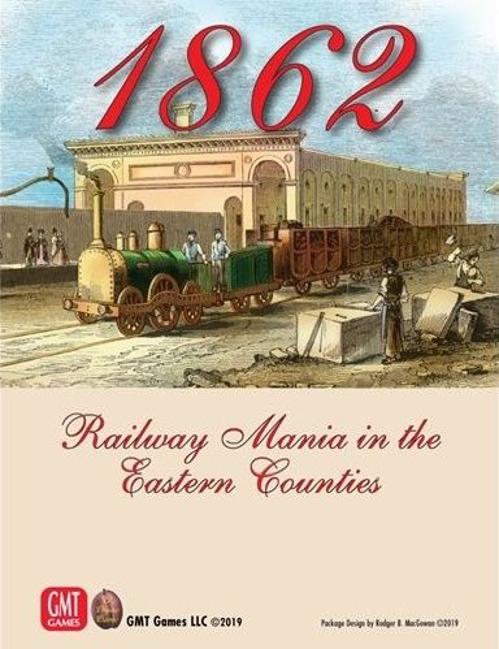
1862: Railway Mania in the Eastern Counties
Designer: Mike Hutton
British East Anglia flips classic 18xx conventions with three train types and subsidy maneuvers.
1862 Railway Mania in the Eastern Counties — Summary
Capitalization type
- Full capitalization (like 1830): when it floats, a corporation immediately receives the proceeds of all its shares at the par price. How this happens, though, is different: during the "Parliament round" (the equivalent of the initial auction), players bid to auction off the right to found each corporation (the "charter auction"). Whoever wins the bid pays that extra amount to the bank and becomes president with a "charter": the corporation automatically receives 3 tokens at £60 each (£180 total), and the president is obligated to complete this before the next stock round, on pain of a fine equal to 5 times the corporation's par price. If nobody bids on a corporation, it can still be founded without a "charter" (as "incremental cap" capitalization): in that case the corporation itself must buy between 2 and 7 tokens (8 with the "8 tokens" optional rule) at £40 each.
Floating percentage and per-player share limits
- Floats once 50% of its shares are sold (same threshold for every corporation)
- No real per-player ownership limit: the maximum ownership percentage per corporation is 100% of its shares (i.e., unrestricted)
- Certificate limit per player: 2 players — 25; 3 players — 18; 4 players — 13; 5 players — 11; 6 players — 10; 7 players — 9; 8 players — 8
Starting cash by player count
- 2 players: £1,200 starting cash
- 3 players: £800 starting cash
- 4 players: £600 starting cash
- 5 players: £480 starting cash
- 6 players: £400 starting cash
- 7 players: £345 starting cash
- 8 players: £300 starting cash
- The bank always starts with £15,000, regardless of player count
End game triggers
- A corporation reaches the end-game (orange) zone of the stock market: the game ends at the end of the current operating round
- The bank runs out of money (and the LNER hasn't formed yet): the current full operating round set is finished
- The LNER forms: buying the first H-type train (phase H) triggers the event; the LNER actually forms at the end of that operating round set, and one more stock round plus one more full set of operating rounds is played before the game ends
- A player goes bankrupt: immediate end (the engine's default rule, not overridden by this game)
Number of phases
- 8 phases (A through H): phase A is the starting phase, and each of the following ones (B, C, D, E, F, G, H) is triggered by the purchase of the first train of the matching type
- Train limit: 3 per type (local/goods/express) in phases A-D, drops to 2 per type in phases E-F, and goes back to 3 in phases G-H but counted in total across the three types
- Available tiles: yellow only in phase A; green from phase B onward; brown from phase D onward
- The value used for off-board exits and ports changes with the phase: the first value is used in phases A-B, the middle value in phases C-D, and the last value in phases E-H
- Phase H triggers the event that leads to the LNER forming at the end of that operating round set
Train list and prices
- A train — £100 — rusts when phase C begins — 6 or 7 copies depending on the "Short Length" optional rule
- B train — £200 — rusts when phase E begins — 5 or 6 copies
- C train — £280 — rusts when phase F begins — 4 or 5 copies depending on the "Long Length" optional rule
- D train — £360 — rusts when phase G begins — 3 or 4 copies
- E train — £500 — never rusts — fixed at 3 copies
- F train — £600 — never rusts — fixed at 2 copies
- G train — £700 — never rusts — fixed at 1 copy
- H train — £800 — never rusts — unlimited copies; buying the first one triggers the formation of the LNER
- Each type (A-H) is sold in three variants at the same price, according to the "permit" randomly assigned to each corporation at the start of the game: local, goods or express; a corporation can only ever use the variant matching its own permit for the whole game
List of private companies
- 1862 has no traditional private companies: there is no private with a purchase price or its own revenue.
- Instead, every corporation automatically generates a "Parliamentary Obligation" marker, with no value or revenue of its own, representing the commitment taken on by the player who wins the Parliament round auction for that corporation.
- This obligation sits with the winner until the corporation finishes buying its 3 starting tokens (£180 total); if the player doesn't do so in time, they pay a fine equal to 5 times the corporation's par price (or sell their own shares to cover it if they don't have enough cash).
List of corporations
- 20 corporations available in total, each with 8 shares (a 30% president's share plus seven 10% shares) and a fixed home city. Some are randomly removed before the game starts: 4 with 2-6 players, 3 with 7 players and 2 with 8 players.
- Ely & Huntingdon (E&H) — C8
- Eastern Counties Railway (ECR) — D13
- East Norfolk Railway (ENR) — F3
- East Suffolk Railway (ESR) — F11
- Eastern Union Railway (EUR) — E12
- Felixstowe Dock & Railway (FDR) — G12
- Ipswich & Bury Railway (I&B) — D9
- Lynn & Dereham Railway (L&D) — D5
- Lynn & Ely Railway (L&E) — C6
- Lynn & Hunstanton Railway (L&H) — C4
- Norwich & Brandon Railway (N&B) — E8
- Northern & Eastern Railway (N&E) — B13
- Norfolk & Suffolk, Joint Railway (N&S) — H7
- Yarmouth & Norwich Railway (Y&N) — H5
- Newmarket and Great Chesterford Railway (NGC) — C10
- Colchester, Stour Valley, Sudbury & Halstead (SVR) — D11
- West Norfolk Railway (WNR) — E2
- Wells & Fakenham Railway (W&F) — E4
- Waveney Valley Railway (WVR) — G8
- Wisbech, St Ives & Cambridge Junction Rwy (WStI) — B5
Game-specific mechanics
- Parliament round with a "charter auction" to found each corporation: winning the auction isn't the only path, since a corporation can also be founded with no winning bid, using "incremental cap" capitalization.
- Three train types (local, goods and express) randomly assigned to each corporation at the start of the game; goods trains must connect "end to end" with other goods trains in the same combined network.
- "George Hudson maneuver": local trains generate a subsidy (£10 for every track hex not shared with another local train from the same corporation) that can be declared as revenue to push the share price up.
- Optional mergers between corporations during the operating round.
- Off-board exits to London require the corporation's own token at B15 or D15 before a train can reach them.
- When the LNER forms, "chartered" corporations still holding IPO shares transfer them to the market and the LNER absorbs the whole group; corporations that never floated are simply removed from the game.
Emergency sell
A sharp departure from 1830: the president never spends personal cash and never sells personal shares. When a trainless corporation can't afford one, the acting player instead chooses between two corporate-level options — selling the corporation's own treasury shares onto the pool (dropping its own share price a step per share sold), or "refinancing" by folding the corporation into a larger one through the game's merger system. If neither raises enough, the corporation goes bankrupt outright: its cash reverts to the bank, its tokens come off the map, and shareholders get cash compensation from the bank based on a reduced "effective price."
Comparison with 1830
1. Setting and map
1830 covers the northeastern US with a fixed map. 1862 takes place in the English county of East Anglia,
during the British "railway mania", and according to many experienced players it's one of the most different
18xx experiences of all, to the point of flipping many of the genre's usual assumptions.
2. Three train types, not just one
In 1830 all trains work the same: they visit cities and add up revenue. In 1862 each corporation gets a
randomly assigned "permit" for one of three train types: local (which visit cities and towns and can use
subsidies to inflate revenue), goods (which run "end to end", where each new train must continue from where
the previous one finished) or express (which ignore towns, similar to the classic trains in 1830).
3. The "George Hudson maneuver": subsidies turned into revenue
A mechanic with no equivalent in 1830: corporations with local trains can declare part of their subsidy money
as revenue, which can help push the share price up even if the actual network isn't generating that much
money.
4. Founding by parliamentary auction, not a simple par price
In 1830 all companies capitalize the same way (×10 of the par price upon floating) and the founder simply
picks the par price. In 1862, during the "Parliament round", each corporation is founded through an auction:
whoever wins the bid becomes a "chartered" president with 3 tokens already paid for (£180) but must complete
the process quickly on pain of a fine, while a corporation with no winning bid still floats as "incremental
cap", and must buy its own 2 to 7 tokens itself.
5. Optional mergers
Unlike 1830, where companies never merge, 1862 allows optional mergers between corporations that want to
combine their networks to grow faster.
6. Mandatory train purchase with no safety net
In 1830, if a company can't pay for a mandatory train, the president advances the money, or the company can
go bankrupt with certain share-selling mechanisms as mitigation. In 1862, a forced train purchase can't be
resolved by selling shares or putting in personal money: the corporation must face it with its own means,
which makes treasury pressure even more direct.
A term you do not recognise? They are all explained in the 18xx glossary. Glossary →