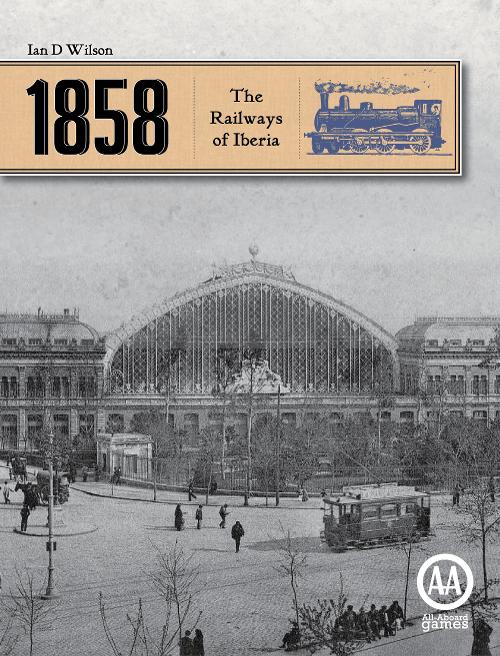
1858: The Railways of Iberia
Designer: Ian D. Wilson
The Iberian Peninsula with 22 privates that eventually convert into shares of the operating companies, dual track gauge, and both 5- and 10-share companies.
1858 — Summary
Capitalization type
- Incremental capitalization: the company collects the money for each share as it's actually sold, not all at once when floating.
- Every public company starts out with only 5 shares (40%/20%/20%/20%) and automatically converts into a 10-share company once the first 5E or 4M train is bought.
Floating percentage and per-player share limits
- Floats once 40% of shares are sold (the same threshold for every corporation)
- No player may hold more than 60% of a single corporation
- Certificate limit per player: 2 players — 21; 3 players — 21; 4 players — 16; 5 players — 13; 6 players — 11
Starting cash by player count
- 2 players: Pt500 starting cash (bank has Pt8,000) — played with a restricted board
- 3 players: Pt500 starting cash (bank has Pt12,000)
- 4 players: Pt375 starting cash (bank has Pt12,000)
- 5 players: Pt300 starting cash (bank has Pt12,000)
- 6 players: Pt250 starting cash (bank has Pt12,000)
End game triggers
- The bank runs out of money: the game ends at the conclusion of the current operating round (no need to wait for a full set)
- There is no bankruptcy in this game: BANKRUPTCY_ALLOWED is false
- Before the game ends, a Final Exchange Round is played in which the usual per-company ownership limit can be exceeded
Number of phases
- 6 phases (2, 3, 4, 5, 6, 7), triggered by the purchase of the first train (broad or metre gauge) of each level
Train list and prices
- 2H — Pt100 (or the metre-gauge 2M variant, added alongside the 4H train); becomes "wounded" (half revenue) once the first 6H is bought, is retired once the first 6E is bought
- 4H — Pt200 (metre variant 2M at Pt100); buying it unlocks the green privates; becomes wounded once the first 6E is bought, is retired once the first 7E is bought
- 6H — Pt300 (metre variant 3M at Pt200); is retired once a set number of "grey" trains (7E/6M/5D) have been bought: 3 units with 2 players, 5 with more players
- 5E — Pt500 (metre variant 4M at Pt400); buying it converts all 5-share companies into 10-share companies, and the privates close at the end of that operating round
- 6E — Pt650 (metre variant 5M at Pt550)
- 7E — Pt800 (metre variant 6M at Pt700)
- 5D — Pt1,100 (available from phase 7)
- The quantity of each train type depends on the number of players (fewer units with 2 players)
List of private companies
- H&G (P1) — Pt30, revenue 10 — cannot be exchanged for shares or found a company
- B&M (P2) — Pt115, revenue 23→35 (phase 3), home O8 — founds a company in Barcelona
- M&A (P3) — Pt125, revenue 25→38, homes H11/H13 — founds a company in Madrid
- P&L (P4) — Pt110, revenue 22→33, homes B9/B11 — founds a company in Porto
- V&J (P5) — Pt100, revenue 20→30, home L13 — founds a company in Valencia
- R&T (P6) — Pt60, revenue 12→18, home N9 — cannot found a company
- L&C (P7) — Pt90, revenue 18→27, homes A14/B13 — founds a company in Lisboa
- M&V (P8) — Pt120, revenue 24→36, homes G8/G10/H11 — founds a company in Madrid or Valladolid
- M&Z (P9) — Pt95, revenue 19→29, homes I10/J9/K8/L7 — founds a company in Zaragoza
- C&S (P10) — Pt105, revenue 21→32, homes E18/F17/G18 — founds a company in Sevilla or Córdoba
- SJ&C (P11) — Pt70, revenue 14→21, homes E18/E20 — founds a company in Sevilla or Cádiz
- Z&P (P12) — Pt80, revenue 16→24, homes K4/K6/L7 — founds a company in Zaragoza
- C&B (P13) — Pt75, revenue 15→23, home I2 — founds a company in Bilbao
- C&M (P14) — Pt85, revenue 17→26, homes G18/G20 — founds a company in Córdoba or Málaga
- M&C (P15) — Pt70, revenue 14→21, homes K18/L19 — founds a company in Murcia
- A&S (P16) — Pt80, revenue 16→24, homes G4/H3 — founds a company in Santander
- B&CR (P17) — Pt65, revenue 13→20, homes D15/E14/F15 — cannot found a company
- S&C (P18, green) — Pt100, revenue 30, homes C2/C4 — founds a company in La Coruña
- M&S (P19, green) — Pt90, revenue 27, home F9 — cannot found a company
- CM&P (P20, green) — Pt135, revenue 40, homes D13/E12/F13/G12/H11 — founds a company in Madrid
- O&V (P21, green) — Pt110, revenue 33, homes B5/C4 — founds a company in Vigo
- L&G (P22, green) — Pt120, revenue 36, homes F1/F3/F5 — founds a company in Gijón
List of corporations
- A - Andalucian Railway
- AVT - Almanza, Valencia and Tarragona Railway
- MZA - Madrid, Zaragoza and Alicante Railway
- N - Northern Railway
- RP - Royal Portugese Railway
- TBF - Tarragona, Barcelona and France Railway
- W - Western Railway
- ZPB - Zaragoza, Pamplona and Barcelona Railway
- None of the 8 has a fixed home in the rulebook: each one is founded either by exchanging a private railway with a city (taking that private's home), or, from phase 5 onward, by starting directly and choosing any open city
Game-specific mechanics
- Dual track gauge: broad (from the start), metre (from phase 3), and dual (from phase 5); no route can combine both gauges
- Two independent train ladders, one per gauge (H/E for broad, M for metre)
- Privates have no treasury of their own: the owner pays out of pocket for construction on the private's home hex
- Privates with a city convert into the founding shares of a public company; the rest just generate income and eventually close
- Ongoing private auctions throughout the game, not only at the start
- Two-stage obsolescence: "wounded" (half revenue) first, then fully retired
- There is no bankruptcy in this game
Emergency sell
There's no emergency sell here in the usual sense, because owning a train is never compulsory: a corporation that can't afford one simply keeps operating without it (and without route revenue) instead of being forced into a purchase. No president cash and no forced share sale ever happen for this reason.
Comparison with 1830
1. Setting, map and number of players
1830 covers the northeastern US for 2-6 players. 1858 moves the action to the Iberian Peninsula (Spain and
Portugal), following the region's historical railway development, for 3-6 players (a 2-player variant exists
with a restricted board), in games lasting around 4 hours.
2. Privates with a city convert into shares instead of being bought out and closed
In 1830 a private is bought by a public company for cash and permanently removed from the game. In 1858, if a
private's home hex has a city on it, the private itself transforms into the founding shares of a public
company: it doesn't disappear in exchange for money, it converts directly into capital. Privates without a
city, on the other hand, never convert: they only generate income and eventually close.
3. Private auctions continue throughout the game, not just at the start
In 1830 the six privates are auctioned once, at the very start of the game. In 1858 privates keep coming up
for auction during stock rounds throughout the whole game, and both founding a new company and putting a
private up for auction use up a player's single buy action for that turn.
4. Dual track gauge, with two separate train ladders
Something that doesn't exist in 1830, with its single track gauge: 1858 has broad gauge (from the start),
metre/narrow gauge (from phase 3), and dual gauge (from phase 5), with dedicated trains for each gauge —
2H/4H/6H for broad gauge and 2M through 6M for metre gauge — that develop independently of each other. No
route can ever mix a broad-gauge stretch with a metre-gauge one.
5. Trains get "wounded" before fully rusting
In 1830 a train type rusts in one step and is removed the moment the next type is bought. In 1858
obsolescence happens in two stages: a train is first "wounded," earning only half its normal revenue, and
only later is it fully retired.
6. Game end only from the bank, plus a Final Exchange Round
In 1830 the game can end either from the bank running dry or from the last train of the last type being
bought. In 1858 the only trigger is the bank running dry; right before the game stops, there's a dedicated
Final Exchange Round in which the usual 60% per-company ownership limit can be exceeded — something that
never happens in 1830.