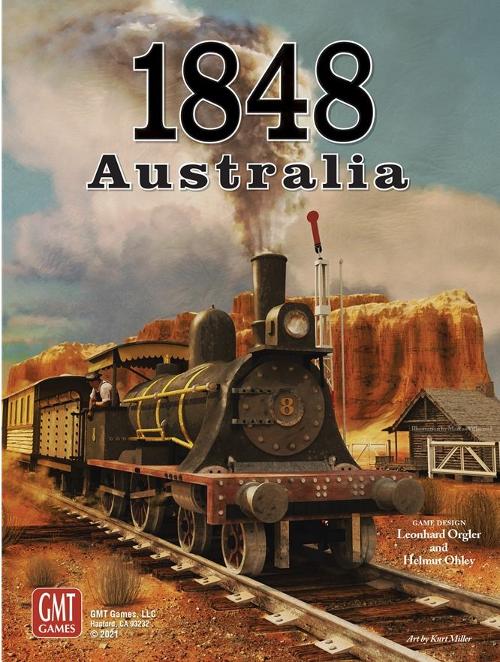
1848: Australia
Designer: Helmut Ohley, Leonhard "Lonny" Orgler
Australia with three track gauges and the Bank of England as a public company that bails out railways in receivership.
1848 — Summary
Capitalization type
- Full capitalization: when it floats, the company receives its entire capital (par price × 10) in the treasury at once.
Floating percentage and per-player share limits
- Floats once 60% of shares are sold (the standard threshold, no per-corporation exceptions)
- No player may hold more than 60% (6 of 10 certificates) of a single corporation
- Certificate limit per player: 3 players — 20; 4 players — 17; 5 players — 14; 6 players — 12
Starting cash by player count
- 3 players: £840 starting cash
- 4 players: £630 starting cash
- 5 players: £510 starting cash
- 6 players: £430 starting cash
- The bank starts with £10,000, plus £2,000 more reserved for the Bank of England
End game triggers
- The bank runs out of money: the current full operating round set is finished
- A share price hits the highest (rightmost) column of the stock market chart: the current set is finished
- The Bank of England has issued 16 or more loans: the current set is finished
- A fifth corporation enters receivership: the current set is finished
- There is no "last train bought" trigger
Number of phases
- 6 phases (2, 3, 4, 5, 6, 8), triggered by the purchase of the first train of each type
Train list and prices
- 2 train — £100 (6 units; 2+ variant at £120; rusts once the first 4-train is bought)
- 3 train — £200 (5 units; 3+ variant at £230; rusts once the first 6-train is bought; unlocks loans, a second tile lay per turn, and buying trains between corporations)
- 4 train — £300 (4 units; 4+ variant at £340; rusts once the first 8-train is bought)
- 5 train — £500 (3 units; 5+ variant at £550; buying it closes the private companies)
- 6 train — £600 (2 units; 6+ variant at £660; lets the COM operate without a Sydney-Adelaide connection)
- 8 train — £800 (unlimited; Diesel variant at £1,100, 20 units, with a discount when trading in 4/4+ trains)
- 2E train "The Ghan" — £200 (unlimited, available from Phase 5); only runs a short, fixed route to Alice Springs; doesn't count toward the mandatory train-ownership rule or against the train limit
List of private companies
- P1 - Melbourne & Hobson's Bay Railway — £30 (sells for 1-40), revenue 5, no special ability
- P2 - Oodnadatta Railway — £70 (sells for 1-80), revenue 10, allows laying a discounted free tile on a desert hex; the power doesn't expire once 5/5+ trains appear
- P3 - Tasmanian Railways — £110 (sells for 1-140), revenue 15, allows placing the special Tasmania tile as an extra build
- P4 - The Ghan — £170 (sells for 1-220), revenue 20, grants a one-time £100 discount on buying the 2E train; the power doesn't expire once 5/5+ trains appear
- P5 - Trans-Australian Railway — £170, revenue 25, the owner instantly receives a 10% share of the QR; cannot be sold to a corporation
- P6 - North Australian Railway — £230, revenue 30, the owner directly receives the CAR's director's certificate (which starts at a £100 par price); cannot be sold to a corporation; closes when the CAR buys its first train
List of corporations
- BOE - Bank of England — a ninth entity, with no home of its own; a bank-like corporation jointly held by all players from the start of the game
- CAR - Central Australian Railway — home at E4
- VR - Victorian Railways — home at H11
- NSW - New South Wales Railways — home at F17
- SAR - South Australian Railway — home at G6
- COM - Commonwealth Railways — no fixed home; can only start operating once Sydney and Adelaide are connected, at which point it places tokens in both cities at once
- FT - Federal Territory Railway — home at G14
- WA - West Australian Railway — home at D1
- QR - Queensland Gov't Railway — home at B19
Game-specific mechanics
- Three track gauges marked by each hex's background color, with gauge-change markers counting as a zero-value station
- Bank of England: a ninth shared corporation, with a rising minimum dividend by phase and a share price that only moves through loans
- Receivership: corporations whose price hits bottom pass under Bank of England control, which compensates shareholders and keeps their flipped tokens as an income source
- £100 loans that are never repaid, shifting the borrower's price down and pushing the Bank's own price up
- Stacking K-K bonus (£50/100/150/200) for touching 2, 3, 4, or 5 "K" cities on a single route
Emergency sell
A sharp departure from 1830: the president is never asked for personal cash, and shares are never forced onto the market. Once the treasury runs dry, the corporation instead takes one or more loans from the Bank of England — a special player-like entity — each one dropping the corporation's own share price further while raising the Bank of England's. If the Bank of England's loan supply runs out before the train is paid for, the corporation's price is driven into the receivership zone, and it becomes state-administered: the Bank of England collects the revenue under its tokens from then on, paying it out to its own shareholders. The 2nd and 5th corporation forced into receivership this way also removes the next permanent train from the game, as if it had just been bought.
Comparison with 1830
1. Setting, map and number of players
1830 covers the northeastern USA for 2-6 players. 1848 covers the whole of Australia and is designed for 3-6
players (no 2-player option like 1830), organized around the historical rivalry between the Australian
colonies and their three different track gauges.
2. Three track gauges and gauge-change markers
A mechanic absent from 1830: on the 1848 map, each hex's background color signals one of three track gauges
(narrow, standard, broad). Whenever a route crosses the border between two gauges, a white gauge-change disk
is placed between the hexes, counting as a zero-value station within the train's range.
3. The Bank of England as an institutional safety net, not direct bankruptcy
In 1830 bankruptcy falls directly on the company or its president. In 1848 there's a ninth entity, the Bank
of England, jointly held by all players from the start: when a company's share price bottoms out, the Bank
takes it over (compensating shareholders, removing trains, keeping the tokens as its own income source)
instead of simply letting the company collapse.
4. Loans that move the Bank of England's own share price, not just the borrower's
Starting with the sale of the first 3/3+ train, a company can take out £100 loans from the Bank of England
(which are never repaid): each loan shifts the borrowing company's price left, while also pushing the Bank of
England's own price up. It's a two-sided mechanic 1830 doesn't have.
5. One company with a double bar to floating
In 1830 any company floats and starts operating as soon as 60% of its stock is sold. In 1848 the Commonwealth
Railways needs the usual 60% sold plus a notional infinite-range train able to travel from Sydney to
Adelaide: until that second condition is also met, the company stays dormant even if fully subscribed.
6. A permanent train that only reaches one single off-board point
1830's Diesel is just a bigger standard train. 1848's 2E train, "The Ghan" (permanent, unlimited supply), can
only run a two-station route: from one of the company's own tokens to the off-board Alice Springs location.
It doesn't count toward a company's mandatory train-ownership requirement or against its train limit.