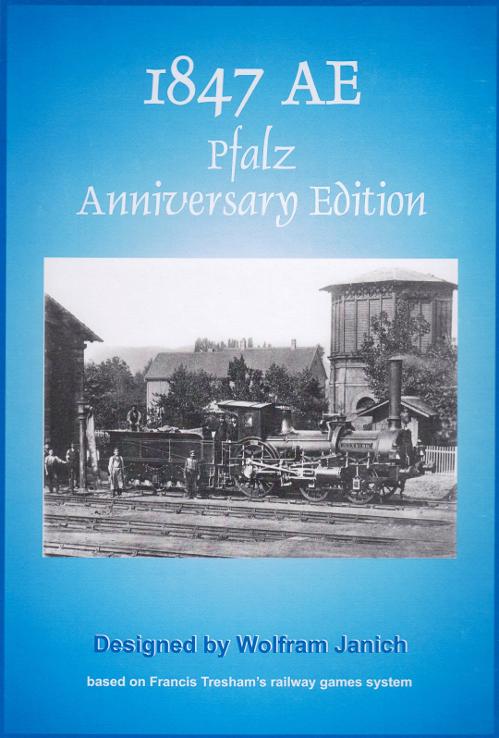
1847: Pfalz
Designer: Wolfram Janich
The German Palatinate (Pfalz) on one of the smallest 18xx maps (52 hexes), in the 25th-anniversary edition of Wolfram Janich's original design — the same designer behind 18Rhl.
1847 AE — Summary
Capitalization type
- Incremental capitalization: the company floats once 50% of its shares are sold (not the classic 60%), and the treasury only receives the money actually paid so far, not the full par value.
Floating percentage and per-player share limits
- Floats once 50% of shares are sold for every railway company, except LFK (Locomotive Firm Krauss & Co., the private company turned into a "corporation"), which floats at 100%
- No player may hold more than 100% of a single corporation (there's no real ownership cap)
- Certificate limit per player: 3 players — 16; 4 players — 12; 5 players — 9
Starting cash by player count
- 3 players: 500M starting cash
- 4 players: 390M starting cash
- 5 players: 320M starting cash
- The bank always starts with 8,000M, regardless of player count
End game triggers
- A player goes bankrupt (after exhausting every other option: inter-company train purchase, the director's personal cash, selling just enough of their own shares): immediate end, no exceptions
- The bank runs out of money during an operating round: the current OR set is finished
- The bank runs out of money during a stock round: the round continues normally, and a full extra set of operating rounds is played before the game ends
Number of phases
- 8 phases (3, 3+3, 4, 4+4, 5, 5+5, 6E, 6+6), triggered by the purchase of the first train of each type
Train list and prices
- 3 train — 150M (3 units; rusts once the first 4+4-train is bought)
- 3+3 train — 300M (2 units; rusts once the first 5+5-train is bought)
- 4 train — 300M (2 units; rusts once the first 6+6-train is bought; on appearing, restricts corporations to a single yellow tile per turn, except on each company's very first operation)
- 4+4 train — 500M (1 unit; never rusts)
- 5 train — 450M (2 units; never rusts)
- 5+5 train — 550M (1 unit; never rusts; buying it forces all remaining investor privates to be exchanged at the next stock round)
- 6E train — 550M (1 unit; never rusts; only counts cities and off-board destinations, but can reach any number of towns for free)
- 6+6 train — 700M (9 units; never rusts)
- There's no 2-train at all; the progression starts directly at type 3
List of private companies
- PLP - Pfälzische Ludwigsbahn presidency — 172M — comes with two shares of L; closes immediately (a mechanism to distribute L's presidency)
- SPR - Saarbrücker Private Railway — 190M, revenue 15 — comes with Saar's director's certificate; can never be sold to a corporation; closes when Saar buys its first train
- LFKC - Locomotive Firm Krauss & Co. — 130M — comes with the president's certificate of the "corporation" LFK, which is really this same private represented as if it traded on the stock market
- R - Rammelsbach — 150M, revenue 30 (resellable to a corporation for 100 to 200M) — revenue rises to 50M once a tile is laid at E9; never closes
- K - Königsbach — 110M, revenue 5 (resellable to a corporation for 15 to 40M) — the owning corporation may close it to lay a free yellow tile on a mountain hex; otherwise closes in Phase 6E; comes with a share of L
- H - Hochstätten — 160M, revenue 15 (resellable to a corporation for 40 to 120M) — same power as Königsbach; comes with a share of L
- W - Weidenthal — 135M, revenue 10 (resellable to a corporation for 25 to 75M) — the owning corporation may close it to place a token at half price; comes with a share of L
- MNR - Main-Neckar-Railway — 90M, revenue 20 — exchangeable for an investor share of HLB from Phase 3+3 onward; mandatory exchange at the first stock round of Phase 5+5; never sold to a corporation
- SCR - Saarland Coal Mines — 75M, revenue 15 — exchangeable for an investor share of Saar under the same conditions as MNR
- VIW - Völklinger Iron Works — 85M, revenue 20 — exchangeable for an investor share of Saar under the same conditions as MNR
List of corporations
- LFK - Locomotive Firm Krauss & Co. — no home; a fictitious "corporation" representing the private company of the same name, trading on the stock market
- L - Pfälzische Ludwigsbahn — home at F18
- Saar - Saarbrücker Eisenbahn — home at H6
- HLB - Hessische Ludwigsbahn — homes at D18 and C21 (two starting stations)
- NDB - Neustadt-Dürkheimer Bahn — home at G15 (can't be founded until HLB floats)
- M - Pfälzische Maximiliansbahn — home at H16 (can't be founded until HLB floats)
- N - Pfälzische Nordbahn — home at F12 (can't be founded until HLB floats)
- RNB - Rhein-Nahe-Bahn — home at C13 (can't be founded until HLB floats)
Game-specific mechanics
- Krauss & Co. (LFK) is a private that trades on the stock market as if it were operating
- Investor shares that count as sold for floating purposes even though no one owns them, until exchanged
- A player can own up to 100% of a company, but at 70% or more they can force nationalization: buying the remaining shares from another shareholder at 150% of market price
- Flat route bonuses: +40M for connecting destinations A and B, +70M for connecting a coal hex (G7 or H6) to destination Z
- An initial draft round instead of a classic private-company auction
- Several corporations can't be founded until a specific other corporation has already floated
Emergency sell
Matches the 1830 baseline: company treasury pays first, then the president's personal cash, then — if that's still not enough — a forced sale of the president's own shares in any corporation they hold, onto the open market, ignoring the normal stock-round-only and pool-limit restrictions.
Comparison with 1830
1. Setting, map and number of players
1830 covers the northeastern USA for 2-6 players. 1847 AE moves the action to the Palatinate (Pfalz), in
southwestern Germany, a territory the historical 1847 divided among three states (Bavaria — the so-called
"Pfalzbahnen" — Prussia, and Hessen-Darmstadt). It's one of the smallest maps in the genre: the original 1990
edition was for 3 players only, and this 25th-anniversary edition adds a seventh corporation to bring it up
to 5.
2. Krauss & Co., a private that trades like a share
This is the game's strangest exception: Krauss & Co. has its own marker on the stock market (starting at
100M), and every time a corporation buys its first train, it pays the owner of Krauss & Co. a dividend worth
10% of that train's purchase price, moving its marker up or down just like an operating company's. Nothing
like this exists among 1830's privates.
3. The Saarbrücken Private Railway, tied to the director's certificate
This private is always sold bundled with the 20% director's certificate of the Saarbrücker Eisenbahn, can
never be resold to another player or a corporation, and closes when the Saarbrücker Eisenbahn buys its first
train. It's the same concept as 1830's B&O (a private inseparable from the president's certificate).
Interestingly, Wolfram Janich, this edition's designer, reused the same idea years later in 18Rhl, already
featured in this catalogue.
4. Investor shares stand in for absent shareholders
In 1830 every sold share always has an active owner. In 1847 AE some companies include "investor shares" that
count as sold for floating purposes even though no player owns them, and which only materialize once a player
exchanges a specific private for them (mandatorily, after the first 5+5 train is bought). It's a way of
introducing "passive" capital that 1830 doesn't need.
5. You can own 100% of a company, but nationalization is a risk
In 1830 no player can exceed 60% ownership of a company. In 1847 AE there's no such cap: a player can reach
100%. But if anyone reaches 70% or more, they can "nationalize" the company and force any other shareholder
to sell them their shares at 150% of the current market price — a forced buyout that doesn't exist in 1830.
6. Flat route bonuses that don't exist in 1830
Beyond the value of cities and towns, 1847 AE adds flat bonuses: +40M if the route connects destinations A
and B (long-distance bonus) and +70M if it connects a coal hex to destination Z (coal bonus). The 6E train
only counts the value of cities and off-board destinations, but it can still receive the long-distance bonus
(not the coal one).