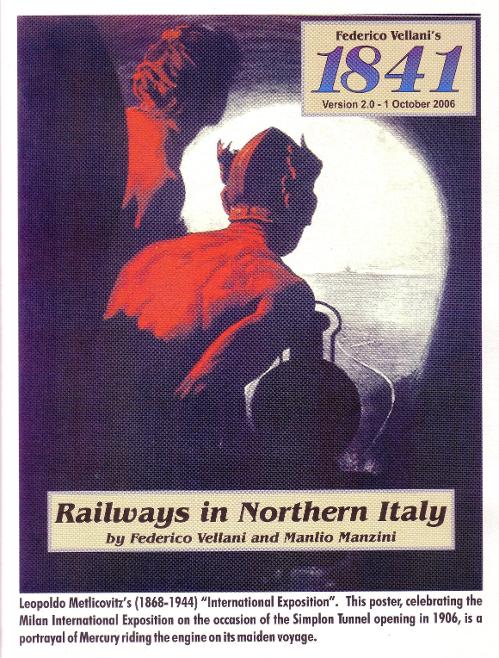
1841: Railways in Northern Italy
Designer: Federico Vellani, Manlio Manzini
Northern Italy with the most intricate stock market in the genre: companies can invest in other companies, and even found new ones.
1841 — Summary
Capitalization type
- Incremental capitalization: the corporation doesn't receive its full capital at once when it floats (unlike 1830); instead it collects the par price share by share, as each certificate is actually sold, both during the IPO and in later share issues.
Floating percentage and per-player share limits
- Majors float at 20% of shares sold (except SFTC and SFL, which float at 40% when playing map version 1); minors float at 40%
- No player may hold more than 60% (6 of 10 certificates) of a single corporation, no exceptions
- Certificate limit per player: 3 players — 21; 4 players — 16; 5 players — 13; 6 players — 11; 7 players — 10; 8 players — 9
Starting cash by player count
- 3 players: L.1,120 starting cash
- 4 players: L.840 starting cash
- 5 players: L.672 starting cash
- 6 players: L.560 starting cash
- 7 players: L.480 starting cash
- 8 players: L.420 starting cash
- The bank always starts with L.14,400, regardless of the number of players
End game triggers
- A player goes bankrupt: immediate end
- The bank runs out of money: ends at the end of the next operating round
- A corporation reaches the end-game cell on the stock market: ends at the end of the current operating round turn or the end of the current stock round
- All offboards (the revenue boxes at the edge of the map) become connected to some city: ends at the same point as the previous case
Number of phases
- 7 phases (2, 3, 4, 5, 6, 7, 8), triggered by the purchase of the first train of each type
- Phase 2: yellow tiles only, 1 operating round; regional borders can't be crossed and each home base only receives a single tile
- Phase 3: green tiles are added, 2 operating rounds, generic corporations can now be founded, maximum 2 tiles per home base
- Phase 4: 2 operating rounds; all unused concessions are discarded and the first wave of border changes arrives (in the full game, the IRSFF splits into two corporations and the Tuscan corporations merge into one)
- Phase 5: brown tiles are added, 3 operating rounds, only 1 tile per round, and the second wave of border changes arrives
- Phases 6 through 8: still 3 operating rounds and 1 tile per round; the per-corporation train limit keeps shrinking (majors drop from 4 to 3 in phase 4, then from 3 to 2 in phase 6; minors drop from 2 to 1 in phase 6)
Train list and prices
- 2 train — L.100 — 8 copies — rusts once the first 4-train is bought
- 3 train — L.200 — 6 copies — rusts once the first 5-train is bought
- 4 train — L.350 — 4 copies — rusts once the first 7-train is bought; buying it closes any concession still unused
- 5 train — L.550 — 3 copies — rusts once the first 8-train is bought
- 6 train — L.800 — 2 copies — never rusts
- 7 train — L.1,100 — 2 copies — never rusts
- 8 train — L.1,450 — 7 copies — the last available type, never rusts; the most expensive train in the game and, with 7 copies in circulation, also one of the most plentiful
List of private companies
- All eight privates (called "concessions") cost L.50 each; seven of them grant the right to found a specific historical corporation, and the eighth (Bayard) grants no concession at all
- Bayard — L.50, revenue L.20 — a classic private with no attached concession; pays L.20 to its owner at the end of every stock round
- Strada Ferrata da Lucca a Pistoia (SFLP) — L.50 — concession to found the minor corporation SFLP
- Strada di Ferro da Torino a Cuneo (SFTC) — L.50 — concession to found the SFTC corporation (major under the standard rules, minor under the "Version 1" variant)
- Società per la Strada Ferrata Maria Antonia (SFMA) — L.50 — concession to found the minor corporation SFMA
- Strada di Ferro da Torino a Novara (SFTN) — L.50 — concession to found the major corporation SFTN
- Società per la Strada Ferrata Leopolda (SSFL) — L.50 — concession to found the major corporation SSFL
- Strada Ferrata da Torino a Genova (SFTG) — L.50 — concession to found the major corporation SFTG
- Imperial Regia Strada Ferrata Ferdinandea (IRSFF) — L.50 — concession to found the major corporation IRSFF
List of corporations
- Seven historical corporations are activated through their matching concession: SFMA (minor, home R14), SFLP (minor, home P12), SSFL (major, home Q11), IRSFF (major, home either F8 or F16), SFTG (major, home either H4 or J6), SFTN (major, home H4), and SFTC (major, home M3)
- Four further historical corporations are never founded through a concession: they appear automatically through game events tied to border changes and mergers — SFLi, which appears when the IRSFF splits in two; SFL; SB (or SFV under the "Version 1" variant); and a special "Tuscan Merge Holding" corporation that absorbs the merged Tuscan corporations
- Fourteen generic corporations, with no historical name or home, choose their home city when founded: eleven majors (AFI, ATFA, CFCC, CGTF, CTDA, CTS, ICSF, IFAI, ILTF, RATF and RSFS) and three minors (CTLP, FTP and SLDV)
Game-specific mechanics
- Corporations can buy shares of other corporations, found new ones, and control them directly, up to a maximum of 5 certificates of other corporations per corporation
- "Major" corporations (president at 20%) and "minor" ones (president at 40%, with every ordinary certificate of a minor paying double the dividend per share of a major's certificate)
- Mergers between operating corporations if their networks connect without crossing an active regional border
- Forced emergency share sale (EMR) out of the company's own treasury before touching the president's personal cash
- A stock market grid with different ceilings depending on type: minors have their own maximum price they can't exceed until they merge and become major, and there's an additional ceiling affecting every corporation until phase 8 is reached
- Two structural variants selectable at setup: "Version 1" (the original rules, where SFTC and SFL are minors) and "lite" mode (smaller map, bank, and train roster for a shorter game); the figures above describe the standard rules (Version 2, full game)
Emergency sell
Formally called EMR (Emergency Money-Raising), and it runs in the opposite order from 1830's baseline: the corporation's own remaining treasury shares are force-issued onto the market first, at half their current price, before anyone's personal cash is ever touched. Because 1841 lets corporations own and control other corporations, this sweep climbs the whole ownership chain — a subsidiary's shortfall pulls from its own treasury, then its parent corporation's treasury, then that parent's own controlling player — before it ever reaches a human player's personal cash. If even that isn't enough, the controlling player may sell their own shares in any corporation they hold, again at half market price rather than full price, to cover the rest.
Comparison with 1830
1. Setting, map and number of players
1830 has a fixed map for 2-6 players. 1841 moves the action to Northern Italy during the unification era: the
map's regional borders shift automatically twice over the course of the game (at phases 4 and 5), redefining
which hexes are playable. It also only supports 3 to 8 players — unlike 1830, 1841 has no 2-player
variant.
2. Companies can own shares of other companies, and even found them
In 1830 only players own shares. In 1841 any operating corporation can buy shares of another corporation — up
to a maximum of 5 outside certificates — and can even found a brand-new one and control it directly, creating
webs of cross-ownership between companies that simply don't exist in 1830.
3. Two families of companies: historical ones needing a concession, and freely founded generic ones
1841 has eight privates ("concessions"), all costing L.50, that grant the right to found a specific
historical corporation — except Bayard, a classic private with no concession attached. Beyond that there are
fourteen generic corporations with no historical name, which choose their home city when founded, plus a
handful of further historical corporations that are never founded through a concession at all but simply
appear on their own through game events. In 1830 every company is simply founded by picking its par price,
with no concept of a concession whatsoever.
4. "Major" and "minor" corporations with different control thresholds
In 1830 it always takes two shares (20%) to become president. In 1841 that threshold only applies to major
corporations; minors require 40%, and every ordinary certificate of a minor pays double the dividend per
share of a major's certificate. On top of that, on the stock market grid minors have their own price ceiling
they can't exceed until they merge and become major — a distinction 1830 doesn't have at all.
5. Mergers between operating companies, tied to geography and politics
In 1830 companies can never merge with each other. In 1841 two corporations can merge if their networks
connect without crossing an active regional border, and once phase 4 hits, certain historical corporations
automatically split or merge following the map's shifting borders (for instance, the IRSFF splits into two
independent corporations).
6. Forced emergency share sales to pay for trains
In 1830, if the president can't cover a mandatory train, personal cash goes in. In 1841 the mechanism first
goes through an automatic, forced sale of shares out of the company's own treasury (EMR) to raise the missing
capital, before anyone's personal money is ever touched.
7. Extremely expensive trains, with a rust schedule that skips whole generations
1841's 8-train costs L.1,450, well above 1830's priciest train, the Diesel ($1,100). On top of that, each
train type doesn't rust when the very next type appears — it survives several types further (a 2-train lasts
until the first 4-train shows up; a 5-train, until the first 8-train does), and the three priciest types (6,
7 and 8) never rust once bought at all. That means a train bought under emergency conditions can go from
perfectly fine to completely worthless the moment someone buys a train far higher up the ladder, with no
warning in between.
8. Noticeably longer, denser games
A full game of 1841 typically runs around five hours, considerably longer than a typical 1830 game, due to
the extra layers of cross-ownership, mergers, and shifting borders players have to manage.