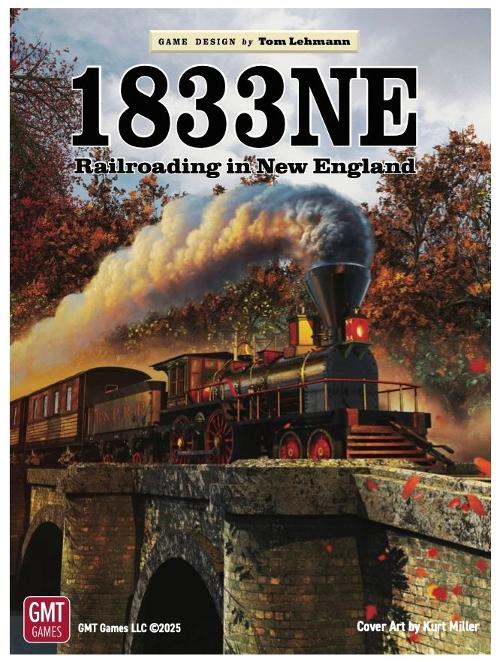
1833NE: Railroading in New England
Designer: Tom Lehmann
New England and Montreal using Tom Lehmann's own 1846 financial system, with interconnection bonuses that shift by phase, ferries, and a Takeover mode where railroads acquire one another — for 3-5 players.
1833NE — Summary
Capitalization type
- Incremental capitalization: when a corporation is launched, the president pays twice its initial stock price into the treasury for the 20% certificate, and the other eight 10% shares stay in the treasury. Every share a player buys afterwards pays the current stock price to the corporation (there is no fixed par value).
- The corporation may issue treasury shares to the Stock Market to raise cash, or redeem them; shares still in its treasury collect dividends.
Floating percentage and per-player share limits
- A corporation is launched (and operates) as soon as someone buys its 20% president's certificate, choosing an initial stock price between $40 and $150
- No player may buy or own more than 60% of a corporation, with no exceptions
- Certificate limit in the Standard game: 3 players — 24; 4 players — 18; 5 players — 14. It depends on how many corporations are in play: it drops when one closes and, in the Takeover game, with every takeover (with 14 corporations it is 35/26/21). Private companies count towards it, but not those owned by corporations
- At most 50% of a corporation may be in the Stock Market, and a president's certificate can't be sold there
- Until a corporation has operated for the first time, only its president may sell its shares
Starting cash by player count
- 3 players: $600 starting cash
- 4 players: $450 starting cash
- 5 players: $400 starting cash
- The bank starts with $10,000; the $1,000 notes are set aside and only added once the bank runs out, so the game can be finished
End game triggers
- The bank runs out of money: the current round sequence (a stock round plus its two operating rounds) is completed
- All players but one go bankrupt: immediate end (very rare). A bankrupt player is out, but the game goes on
- The winner is the player with the most cash plus shares at final stock prices; corporate treasuries don't count, and privates held by players only count (at list price) if the game ends before phase III
Number of phases
- 5 phases (I, II, III, IV and V), triggered by the purchase of the first train of the next phase
- Always two operating rounds per stock round; the very first one of the game is played in reverse stock price order
- Train limit in the Standard game: 3 in phases I-III and 2 in phases IV-V (Takeover game: 3 in I, 3 in II, 2 in III and 1 in IV-V, plus 1 for each takeover the corporation has made)
- Phase I: yellow tiles only; corporations may buy private companies
- Phase II: green tiles; in the Takeover game, Variable Start corporations may be launched and takeovers begin
- Phase III: phase I trains are phased out; privates held by players and P1-P2 are removed, and P3-P6 are flipped (no more income, but they keep their ability); off-board and bonus values change
- Phase IV: brown tiles; phase II trains are phased out and phase I trains removed; privates P3-P5 and all ferries are removed, and city spot reservations end
- Phase V: phase III trains are phased out and phase II trains removed; phase V off-board and bonus values apply
Train list and prices
- Each train card in phases I-IV is double-sided with two train types; the buyer picks one side and it can't be changed afterwards
- Phase I — 2-train ($75) or 2+1-train ($100) — 8 cards; phased out in phase III and removed in phase IV
- Phase II — 3/5-train ($180) or 2+2-train ($140) — 5 cards; phased out in phase IV and removed in phase V
- Phase III — 4/7-train ($320) or 3+3-train ($230) — 6 cards; phased out in phase V
- Phase IV — 6/9-train ($750) or 5+3-train ($640) — 3 cards (5 in the Takeover game, where some takeovers remove one); permanent
- Phase V — 7+3-train ($1,000) — effectively unlimited; permanent
- An N/M train visits up to M locations and counts N of them (at least one with its own token); an N+s train counts N locations plus up to s small cities
- A phased-out train doesn't count against the train limit and can't be sold to another corporation, and it is removed right after its owner next runs routes
List of private companies
- P1 Granite Railway — $15, income $5 — blocks H23 until bought by a corporation; no special ability
- P2 Lowell Merchants — $40, income $10 — blocks Lowell (G20); the corporation that buys it may lay a free tile there in that same round. Until a corporation buys it, the Boston & Lowell can't lay track in phase I, and can't run routes in phase I or afterwards while Boston hasn't been upgraded
- P3 Champlain & St. Lawrence — $50, income $10 — blocks C4 and C6; lets its corporation lay two extra free tiles there, connected to each other and with the C4 tile connected to Montreal, without needing to reach them from its own tokens
- P4 Ogdensburg Railroad — $60, income $15 — the corporation may lay track and run routes from the A6 off-board area as if it had a token there, and in phases I-III it doubles the bonuses for routes from A6 to Boston
- P5 Luxury Ferry Service — $70, income $15 — doubles the value of one of its corporation's ferries, including any "New" or "Last" ferry bonus; it can't be reassigned
- P6 Delaware & Hudson RR — $80 (plus $40 to the bank when bought by a corporation), income $30 — the corporation may lay track and run routes from the A12 off-board area as if it had a token there; permanent ability. Only that corporation may run to A12, which is worth $40/$70/$80 by phase if the route goes to or through Montreal, and $0 otherwise
- Corporations may buy privates from players during phases I and II for anywhere between $1 and list price
List of corporations
- Boston & Worcester (B&W) — home in Boston (G22); has a reserved spot in Worcester until phase IV, and its token there always costs $40
- Boston & Providence (B&P) — home in Providence (F25); has a reserved spot in Boston (once its green tile is laid) until phase IV
- Boston & Lowell (B&L) — home in Boston (G22)
- Fitchburg Railroad (FRR) — home in Fitchburg (E20)
- Hartford Railroad (HR) — home in Hartford (C24)
- Rutland Railroad (RR) — home in Rutland (C12)
- Central Vermont Railroad (CV) — home in St. Albans/Burlington (C8)
- St. Lawrence & Atlantic (StL&A) — home in Montreal (B3)
- Atlantic & St. Lawrence (A&StL) — home in Portland (I14); shares with the StL&A a joint token that is placed for free in Sherbrooke once anyone lays its yellow tile
- Each corporation uses 4 tokens, but two of them mark its stock price and earnings: it only has 2 stations, its home and one more costing $80
- Takeover game: adds 5 Variable Start corporations, which can be launched from phase II in any vacant, non-reserved city spot that isn't the home of another available corporation, paying for their home token ($80 in a gray hex or a hex without track; otherwise $120, with an initial stock price of at least $60)
Game-specific mechanics
- Linear stock market from $0 to $730, using the financial system Tom Lehmann later used in 1846
- Corporations issue and redeem their own shares
- Full, half or withheld dividends, with the stock price moving according to the payout relative to the current stock price
- Direct connection and interconnection bonuses between Boston, Montreal, Portland and the off-board areas, which change a lot from one phase to the next
- Five ferries ($40) that add value to routes, with a "New" ferry bonus that always moves to the latest ferry bought; ferries are removed in phase IV
- Double-sided trains (N/M or N+s) that get phased out instead of rusting outright
- Each round, one yellow tile plus either a second yellow tile or an upgrade; every tile lay or upgrade costs at least $20, plus the cost of any bridge, tunnel or pass it completes
- Only two stations per corporation (its home and one more at $80)
- Small cities gain value when upgraded
- A corporation closes if its stock price falls to $0
- Optional Takeover game, with corporations acquiring one another
Emergency sell
A corporation must buy a train if it has none after running routes and removing phased-out trains. Unlike 1830, it doesn't go straight to the president's cash: it first spends its whole treasury and then must issue shares up to the normal limit, but on worse terms — its stock price drops one column for each share issued and it receives one value below the new price (and it can't issue shares that would drop its price below $20). Only then does the president put in personal cash and, if that's not enough, sell their own shares, without causing a presidency change in or the closure of the operating corporation, and stopping as soon as the amount is raised. If the corporation can afford one of the two available train types but not the other, it can't use the president's cash to buy the more expensive one. If there's still not enough, the player goes bankrupt and is out, but the game continues: the cash they raised goes to the corporation, their remaining shares are sold to the Stock Market without moving prices (even if that puts more than 50% or a president's certificate there) and, if this changes the presidency, the new president must buy the train.
Comparison with 1830
1. Setting, scale and two games in one
1830 covers the northeastern USA on a large scale for 2-6 players. 1833NE focuses on New England and Montreal at a
much more regional scale, for 3-5 players and 3-5 hours. It includes a Standard game with nine historical
corporations and a Takeover game that adds five more and allows takeovers (adding 1-2 hours). Tom Lehmann
designed it before 1846, even though it was published later: 1846 was created precisely as a simpler game to
introduce this financial system.
2. Launching at 20% with a free price and incremental capitalization
In 1830 a company floats with 60% sold, at a par price between $67 and $100, and receives its whole capital at
once. In 1833NE buying the 20% president's certificate is enough, at an initial price chosen between $40 and
$150, and the corporation starts operating right away. The remaining shares stay in its treasury and the
corporation collects the current stock price every time a player buys one.
3. Corporations issue and redeem shares
In 1830 a company can't touch its own shares. In 1833NE, every operating round, it may issue shares to the Stock
Market (up to the number held by players minus those already in the market) for one value below its stock price,
or redeem shares from the market for one value above it. Since treasury shares collect dividends, investing in a
rival corporation often just means it issues one share fewer.
4. A linear market and dividend-driven stock prices
1830 uses a two-dimensional grid where every share sold pushes the price down. 1833NE has a single line of prices:
if a corporation pays out less than half its stock price, it moves left; between half and the stock price, it
stays put; at least the stock price, it moves one column right, two if the payout reaches double, and up to three
if it reaches triple and the price is already $165 or more. Half payouts are also allowed. Only sales by the
president lower the price (by a single column, however many shares are sold), and at the end of a stock round
corporations with shares in the Stock Market drop while those 100% held by players rise. If the price hits $0,
the corporation closes.
5. Double-sided trains that get phased out instead of rusting
In 1830 each train has a single type and rusts outright when the train that kills it arrives. In 1833NE each card
in phases I-IV can be bought as an N/M train (visits M locations and counts the best N) or as an N+s train
(counts extra small cities), at different prices. When the phase advances, older trains are phased out: they no
longer count against the limit, but still run routes one last time before being removed.
6. Interconnection bonuses and ferries
1830 has nothing like this. In 1833NE routes linking certain pairs of locations earn direct connection bonuses
(for example, Boston and Montreal: $150 in phases I-II and $200 in III-IV), and a route may extend beyond what the
train allows, along track not used by any of the corporation's other routes and even through blocked cities, to
collect an interconnection bonus. These bonuses appear and disappear by phase. On top of that, until phase IV,
corporations may buy five ferries that add value to routes reaching their city.
7. Bankruptcy doesn't end the game
In 1830 a bankruptcy ends the game immediately. In 1833NE the bankrupt player is out, their shares are dumped into
the Stock Market and everyone else keeps playing. The game only ends (unless a single player is left) after
completing the stock round and two operating rounds during which the bank ran out of money.
8. Takeover game: takeovers instead of mergers
In 1830 companies never combine. In 1833NE's Takeover game, from phase II and after the second operating round of
each pair, every corporation with at least one non-phased-out train and a track connection to another's token may
attempt to take it over, redeeming all its outstanding shares with cash or its own shares. The target may refuse
unless it has no trains or only phased-out ones. The acquirer inherits its trains, treasury, ferries, privates and
tokens, and gains one extra train of limit.