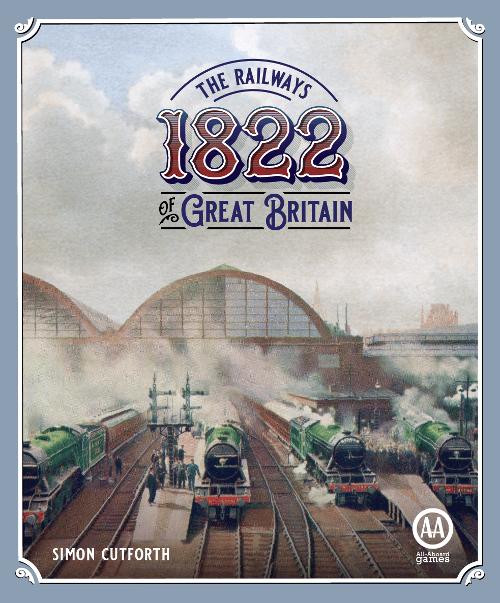
1822: The Railways of Great Britain
Disseny: Simon Cutforth
L'1822 complet: tota Gran Bretanya en subhasta constant de privades, minors i concessions de majors.
1822: The Railways of Great Britain — Resum
Tipus de capitalització
- Capitalització incremental per defecte: la companyia va cobrant el preu de sortida cada vegada que es ven realment una acció seva.
- A partir que es compra el primer tren de tipus 6 (fase 6), les majors que floten a partir d'aleshores passen a capitalització plena (reben tot el capital de cop; les 5 accions restants de la tresoreria van directament al mercat).
Flotació i límits d'accions per jugador
- Les minors floten amb el 100% de la seva única acció venuda; les majors floten amb el 20%, excepte la London and North Western Railway (LNWR), que ja comença amb accions col·locades i flota amb només el 10%
- Cap jugador pot tenir més del 100% d'una minor, ja que només té una acció; a les majors s'aplica el límit clàssic del 60% per defecte
- Límit de certificats per jugador: 2 jugadors — 33; 3 jugadors — 26; 4 jugadors — 20; 5 jugadors — 16; 6 jugadors — 13; 7 jugadors — 11
Quantitat de diners segons número de jugadors
- 2 jugadors: £900 inicials
- 3 jugadors: £700 inicials
- 4 jugadors: £525 inicials
- 5 jugadors: £420 inicials
- 6 jugadors: £350 inicials
- 7 jugadors: £300 inicials
- El banc sempre comença amb £12.000, independentment del nombre de jugadors
Final de partida (end game triggers)
- El banc es queda sense diners: s'acaba la ronda d'operacions completa en curs (o la propera ronda d'operacions, si passa durant una ronda de borsa)
- El preu d'alguna acció arriba a la casella marcada "e" del mercat (700e): s'acaba al final de la propera ronda d'operacions
- Si a la primera ronda de borsa ningú ven cap acció: final immediat (salvaguarda excepcional)
- La fallida està desactivada en aquest joc (BANKRUPTCY_ALLOWED = false): no és un mecanisme de final de partida
Número de fases
- 7 fases (1 a 7), activades per la compra del primer tren de cada tipus
- Límit de trens diferent per a minors i majors a cada fase (per exemple, a la fase 1: 2 per minor, 4 per major)
- Fase 2: es poden convertir concessions en companyies majors
- Fase 5: en comprar el primer tren 5, totes les concessions no convertides tanquen sense compensació i les majors pendents passen a flotar al 50%
- Fase 6: en comprar el primer tren 6, les majors que floten a partir d'ara reben capitalització plena
- Fase 7: en comprar el primer tren 7, les privades P15 i P20 (renda ×fase) es tanquen si encara no han estat adquirides
Llista de trens i preus
- Tren L — £60 (22 unitats; es rovella amb el primer tren 3); es pot convertir en tren "2" per £80 abans que es rovelli (variant pròpia, distància 2, £120, disponible des de la fase 1, es rovella amb el primer tren 4)
- Tren 3 — £200 (9 unitats; es rovella amb el primer tren 6)
- Tren 4 — £300 (6 unitats; es rovella amb el primer tren 7)
- Tren 5 — £500 (3 unitats; la seva compra tanca totes les concessions pendents)
- Tren 6 — £600 (3 unitats; la seva compra activa la capitalització plena per a noves majors)
- Tren 7 — £750 (il·limitats; variant expressa "E", distància il·limitada, multiplicador ×2, £1.000; la seva compra tanca les privades de renda per fase si encara no s'han adquirit)
- Trens especials atorgats per privades (no es compren al mercat): 2P (tren 2 permanent, gratuït, 2 unitats), LP (tren L permanent, gratuït, 1 unitat), 5P (tren 5 addicional, £500, 1 unitat), P+ (vagó Pullman que converteix un tren en "+", gratuït, 2 unitats)
Llista de privades
- 21 privades (P1-P21), sense preu fix: es guanyen en una subhasta simultània amb fitxes de puja limitades (bidding tokens), no es compren per un preu fixat d'entrada.
- P1 (tren 5 normal), P2 (elimina una petita estació, tanca en usar-se), P3 i P4 (trens 2 permanents), P5 (fitxa gratuïta al Canal de la Mànega), P6 i P7 (contractes de correu, +50% del valor de les estacions d'un tren), P8 (descompte a muntanya/turó, o fitxa gratuïta de terreny difícil), P9 (declara el doble de l'efectiu en mà per a l'ordre de torn, o renda variable si la té una companyia), P10 (descompte i fitxes gratuïtes a rius/estuaris), P11 (avança l'accés a la següent tessel·la de color), P12 (tessel·la extra o millora addicional), P13 i P14 (vagons Pullman), P15 (renda ×10 per fase, es tanca a la fase 7), P16 (Tax Haven: mai s'adquireix, compra accions pel jugador propietari sense afectar el límit del 60%), P17 (mou una carta de la pila de concessions/minors/privades), P18 (intercanvia una fitxa d'intercanvi per una de disponible), P19 (tren L permanent, des de fase 1), P20 (renda ×5 per fase, es tanca a la fase 7), P21 (construcció gratuïta del pont Grimsby-Hull)
Llista de corporacions
- 10 companyies majors (10 accions cadascuna), cada una fundada convertint una "concessió" (C1-C10) guanyada en subhasta: London and North Western Railway (LNWR) — Londres/M38; Great Western Railway (GWR) — Londres/M38; London, Brighton and South Coast Railway (LBSCR) — Londres/M38; South Eastern & Chatham Railway (SECR) — Londres/M38; Caledonian Railway (CR) — Glasgow/E6; Midland Railway (MR) — J29; Lancashire & Yorkshire Railway (LYR) — G22; North British Railway (NBR) — Edimburg/H5; South Wales Railway (SWR) — H33; North Eastern Railway (NER) — L19
- Fins a 24 companyies "minor" (M1-M24, i fins a 30 amb l'expansió 1822+), d'una sola fitxa i 2 accions cadascuna, guanyades també en subhasta i repartides per tot el mapa (Aberdeen, Highlands, Edimburg, Newcastle, Darlington, Barrow, Warrington, Sheffield, Grimsby, Birmingham, Peterborough, Ipswich, Maidstone, Londres, Southampton, Bournemouth, Cardiff, Pontypool, Merthyr Tydfil, Exeter, Cornualla, Swansea, Norwich, Hull, i amb l'expansió també Glasgow, Carlisle, Mid Wales i Plymouth). Les minors poden acabar fusionant-se dins d'una major.
Mecàniques específiques
- Cada ronda de borsa comença amb una subhasta simultània de privades, minors i concessions de majors, amb fitxes de puja limitades per jugador que obliguen a triar en quines subhastes competir
- El preu de sortida d'una minor no el tria el fundador: en fase 1 és fix (50); a partir de fase 2 surt de la puja guanyadora (fins a 200 de tresoreria / 100 de par)
- Les minors es poden fusionar dins d'una major (havent operat com a mínim un cop), aportant el seu track ja construït; el pagament pot ser en accions de tresoreria i/o efectiu
- L'ordre de prioritat de les rondes de borsa el determina la quantitat de diners en mà de cada jugador, no un ordre de torn fix
- Trens "L" inicials (una sola estació) convertibles a trens 2 per £80 abans de rovellar-se
Venda d'emergència (emergency sell)
A diferència del 1830, aquí quedar-se sense opcions no acaba en fallida, sinó en deute. S'apliquen quatre nivells en ordre estricte: primer la tresoreria de la pròpia companyia; després els diners personals del director; si això tampoc no basta, la Recaptació de Diners d'Emergència —el director ha de vendre les seves pròpies accions (de qualsevol companyia que posseeixi, en l'ordre que vulgui, al preu de mercat de l'inici d'aquest torn) fins a reunir els diners necessaris, tot i que el seu propi certificat a la companyia que es finança mai no es pot vendre—; i només si això també falla, el director demana un préstec al banc per la resta, amb un interès del 50% (arrodonit a l'alça), que continua acumulant-se cada ronda de borsa i li impedeix comprar accions o pujar fins a retornar-lo. Un matís més: si la companyia es veu obligada a comprar un tren a una altra companyia en comptes de al banc, el director no pot aportar-hi res de diners personals —la companyia s'ho ha d'empescar sola.
Comparació amb 1830
1. Ambientació i mapa
El 1830 cobreix el nord-est dels EUA. El 1822 es desenvolupa a tota Gran Bretanya (Anglaterra, Gal·les i
Escòcia), amb un mapa molt extens i una xarxa de ciutats molt més densa, pensat per a partides de fins a 7
jugadors.
2. Tot es compra en subhasta: privades, minors i "concessions" de majors
Al 1830 només les privades surten a subhasta inicial; les companyies majors es funden lliurement després. Al
1822, en cada ronda de borsa, es subhasten simultàniament privades, companyies "minor" (2 accions) i
"concessions" per fundar companyies majors, amb fitxes de puja limitades per jugador.
3. El preu de sortida d'una minor depèn de la subhasta, no es tria
Al 1830 el fundador tria lliurement el preu de sortida. Al 1822, en fase 1, una minor sempre surt a un preu fix
de 50, sigui quina sigui la puja guanyadora. A partir de la fase 2, els diners de la puja guanyadora van a la
tresoreria de la minor i en determinen el preu de sortida.
4. Les minors es fusionen amb les majors per crear-les o fer-les créixer
Al 1830 no existeix aquest concepte. Al 1822, una minor ha d'haver operat com a mínim una vegada abans de poder
ser absorbida per una major; el pagament a l'accionista de la minor es pot fer amb accions de la tresoreria de
la major i/o diners en efectiu. Així, moltes majors "neixen" absorbint la infraestructura ja construïda per una
minor.
5. Trens "L" inicials i conversió a 2-trens
Al 1830 la primera generació de trens ja és el tren de 2 ciutats normal. Al 1822 la partida comença amb trens
"L" especials (d'una sola estació, cost £60) que es poden convertir en trens 2 per £80 abans que es tornin
obsolets. Aquest pas inicial no té equivalent al 1830.
6. Ordre de prioritat per diners en mà, no per torn
Al 1830 la prioritat de compra a la ronda de borsa passa cíclicament cap a l'esquerra del comprador anterior.
Al 1822, l'ordre de prioritat de les rondes de borsa el determina la quantitat de diners que té cada jugador,
cosa que premia haver gastat molt en subhastes anteriors.
7. Moltes més companyies en joc simultàniament
Entre privades, minors i majors disponibles per subhasta a cada ronda, el 1822 sosté moltes més entitats
actives alhora que el 1830, amb un ritme d'expansió molt més gradual i escalonat.
Hi ha algun terme que no et sona? Els tens tots explicats al glossari 18xx. Glossari →