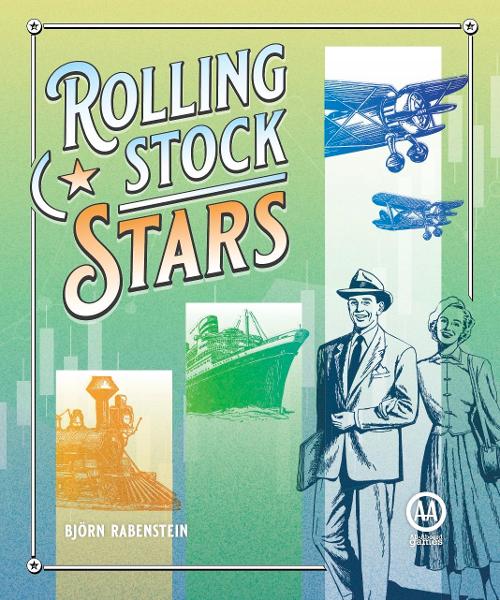
Rolling Stock Stars
Designer: Björn Rabenstein
A standalone reimplementation of Rolling Stock, with variable-power companies and valuation abstracted into stars, spanning from Prussian railroads to airports.
Rolling Stock Stars — Summary
Capitalization type
- Same as the original Rolling Stock: no classic IPO. A Corporation is founded by handing over an already-owned "Company" card as its first asset.
- The share price is never chosen: it's automatically recalculated by comparing the corporation's "star count" (cash/10 + the level of every owned Company) against what's printed on its current price card.
Floating percentage and per-player share limits
- The floating threshold varies by corporation: Junkyard Scrappers and Synergistic float at 40%; Overseas Trading and Stock Masters at 50%; Prussian Railway and Doppler AG at 60%; Stars, Inc. and Vintage Machinery at 70%
- No real cap: a player may hold up to 100% of a single corporation, across all 8 corporations
- Certificate limit per player: 99 (inherited from Rolling Stock), the same regardless of player count — in practice this imposes no functional limit
Starting cash by player count
- 2 to 6 players: the same starting cash in every case (inherited from Rolling Stock: $30, or $25 with 6 players)
- The bank starts with $10,000; the Foreign Investor starts with $4 and gets an extra $5 every income phase
End game triggers
- A corporation reaches the 75-coin price while buying a share: immediate end
- That 75-coin price is still in use when phase 7 (End Card) begins: end
- Phase 7 begins with the end card already flipped from a previous turn: end
- No trigger is tied to trains, because the game has none
Number of phases
- There are no train phases like in 1830: every full turn runs through 7 fixed steps: Investment, Closing, Acquisition, Closing Companies, Income, Dividends and End Card, followed by Issue Shares and IPO (unlike the original Rolling Stock, there's no separate Foreign Investor step here).
- The "Cost of Ownership" rises in level as higher-level Companies are revealed from the deck (5 levels instead of the original game's 6).
Train list and prices
- Not applicable: Rolling Stock Stars has no board, hexes, tiles, or trains. Its conceptual equivalent remains the "Cost of Ownership," which reduces the income of Companies of whichever color/level is active each turn.
List of private companies
- 36 "Company" cards across five levels, each printed with a face value, a fixed income, a star count and a list of synergies; the thematic arc runs from 1830s Prussia (level 1) to modern ports and airports (level 5):
- Level 1 (early Prussian railways, $1-$8): 6 companies, e.g. BME, BSE, KME, AKE, BPM, MHE
- Level 2 (Germany, $11-$19): 8 companies, e.g. WT, BY, BD, OL, HE, SX, MS, PR
- Level 3 (Europe, $20-$29): 8 companies, e.g. DSB, KK, NS, SBB, B, PKP, SNCF, DR
- Level 4 (bigger companies and early airports, $30-$43): 7 companies, e.g. SZD, SJ, FS, RENFE, BR, BSR, E
- Level 5 (modern ports and airports, $45-$60): 7 companies, e.g. HH, HA, HR, MAD, FRA, LHR, CDG
- Newly revealed Companies take a full turn before they can be auctioned; any left over are automatically bought at face value by the Foreign Investor
List of corporations
- Prussian Railway (PR) — 5 shares, floats at 60% — +$1 per company it owns
- Overseas Trading (OS) — 6 shares, floats at 50% — always has first priority buying from the Foreign Investor, and only pays face value there
- Stars, Inc. (SI) — 4 shares, floats at 70% — always adds 2 extra stars to its count
- Doppler AG (DA) — 5 shares, floats at 60% — doubles the printed income of its best Company
- Vintage Machinery (VM) — 4 shares, floats at 70% — reduces its Cost of Ownership by up to $10 (never below $0)
- Stock Masters (SM) — 6 shares, floats at 50% — issuing a share doesn't change its price
- Junkyard Scrappers (JS) — 7 shares, floats at 40% — closing a Company earns twice its printed income as a bonus
- Synergistic (S) — 7 shares, floats at 40% — +$1 for every two synergy markers it owns
- Only these 8 fixed corporations exist, each with a unique permanent special power; none has a home or token on a map
Game-specific mechanics
- Share price moves by comparing a corporation's star count against what's printed on its price card (up to two spaces up or down)
- "Receivership": if all of a corporation's issued shares end up owned by the bank, it enters this state and is run by an automated receiver (zero dividends, closures by fixed rules) until someone buys a share and claims its president's certificate
- Final scoring ignores corporate assets entirely: only personal cash, the face value of Companies still directly held by a player, and the price of personally-held shares count
- A fully standalone reimplementation: you don't need the original Rolling Stock to play it
Emergency sell
Same as Rolling Stock: there's no train-purchase concept, so no emergency sell mechanic exists here either. This title reuses Rolling Stock's negotiation-based company-acquisition system unchanged, just with different market and company data.
Comparison with 1830
1. No map, no track, no trains — same as the original Rolling Stock
1830 revolves around the physical map: tiles, routes and trains. Rolling Stock Stars, like its predecessor,
strips all of that out: there's no board, hexes, tiles, tokens or trains. "Companies" generate the income
printed on the card, and "Synergies" between pairs of companies abstractly stand in for a transportation
network.
2. A historical arc spanning decades and sectors, not a fixed region
1830 always stays in the mid-19th-century northeastern USA. Rolling Stock Stars starts in 1830s Prussia with
early railroads, and as the game progresses it adds companies from Germany, then all of Europe, and eventually
even non-railroad sectors: the final tier of cards represents container ports and airports.
3. Stock price moves by "stars," not a book-value table
In 1830, the stock price moves along a fixed grid based on dividend policy. In Rolling Stock Stars, each
Company card carries a number of stars based on its level, and every 10 coins of cash also counts as one more
star. Each round, if a corporation's star count doesn't match what's printed on its current price card, the
price moves up or down one or two spaces depending on the gap.
4. Eight fixed corporations with unique, permanent powers, not identical companies
In 1830, every company operates under exactly the same rules. In Rolling Stock Stars there are only eight
corporation cards, each with a permanent special power: Prussian Railway earns +1 coin per company it owns,
Doppler AG doubles the income of its best company, Overseas Trading always gets first priority buying from the
foreign investor, and so on for the other five.
5. Seven phases per turn, not a simple stock/operating alternation
In 1830, each cycle is simple: a stock round followed by one or more operating rounds. In Rolling Stock Stars,
every full turn runs through 7 fixed phases (investment, closing, acquisition, closing companies, income,
dividends and end card), many of which do nothing until enough corporations exist in the game.
6. "Receivership": a corporate zombie state with no equivalent in 1830
In 1830, a bankrupt company is liquidated and that's it. In Rolling Stock Stars, if all of a corporation's
issued shares end up owned by the bank, the corporation enters "receivership": it keeps running under an
automated (not very smart) receiver that always pays zero dividends and closes companies following fixed
rules, until some player buys a share and claims its president's certificate.
7. Three independent end-game triggers, none tied to trains (because there aren't any)
In 1830, the game ends when the bank runs dry or the last train of the last type is bought. In Rolling Stock
Stars the game ends if a corporation reaches the 75-coin share price while buying a share, if that price card
is still in use when phase 7 begins, or if phase 7 begins with the end card already flipped from a previous
turn.
8. Final scoring ignores corporate assets entirely
Just like in 1830, a corporation's treasury and holdings don't count toward determining the winner. In Rolling
Stock Stars, final scoring only adds up personal cash, the face value of privately-owned (unconverted)
companies, and the current price of personally-held shares.