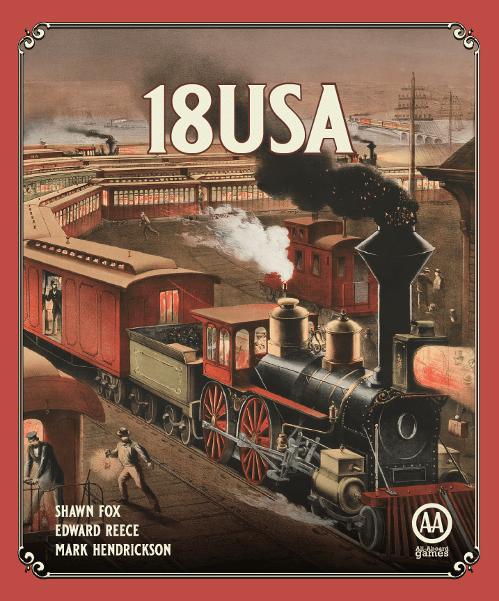
18USA: The Railways of the United States of America
Designer: Edward Reece, Mark Hendrickson, Shawn Fox
1817's financial engine (loans, short selling, mergers) applied to the whole USA map, with random setup every game.
18USA — Summary
Capitalization type
- Incremental capitalization, inherited from 1817: the treasury only receives the money actually paid as each share is sold, not a fixed amount on floating.
Floating percentage and per-player share limits
- Floats once 20% of shares are sold, for every corporation
- No real cap: a player may hold up to 100% of a single corporation, for every corporation
- Certificate limit per player: 2 players — 32; 3 players — 21; 4 players — 16; 5 players — 16; 6 players — 13; 7 players — 11
Starting cash by player count
- 2 players: $630 starting cash
- 3 players: $420 starting cash
- 4 players: $315 starting cash
- 5 players: $300 starting cash
- 6 players: $250 starting cash
- 7 players: $225 starting cash
- Unlimited bank (never the game-end trigger)
End game triggers
- A company goes bankrupt and can't complete a mandatory payment: immediate end
- The first 8-train is bought: one more full set of rounds is played through the end of the phase
- The bank never runs dry (it has unlimited money), unlike 1830
Number of phases
- 10 phases (2, 2+, 3, 3+, 4, 4+, 5, 6, 7, 8), with the maximum corporation size (2/5/10 shares) growing as the game progresses
- With the optional "1817 trains" variant, 1817's 8 phases and train manifest are used instead
Train list and prices
- 2 train — $100 (40 units; rusts on the first 4-train)
- 2+ train — $100 (5 units; becomes obsolete with the first 4-train, but isn't removed the same way rusting removes a train)
- 3 train — $250 (12 units; rusts on the first 6-train)
- 3+ train — $250 (2 units; obsolete with the first 6-train)
- 4 train — $400 (8 units; rusts on the first 8-train)
- 4+ train — $400 (1 unit; obsolete with the first 8-train)
- 5 train — $600 (6 units)
- 6 train — $750 (5 units)
- 7 train — $900 (3 units)
- 8 train — $1,100 (unlimited; triggers the end of the game)
- P train (Pullman) — $200 (unlimited; available from phase 5; attaches to an existing route, doesn't count as a normal train)
List of private companies
- 30 privates numbered P1-P30, priced between $30 and $120; each game only about 15 are drawn (P1-P4 are always in, P10 only with 5+ players, the rest split by value tier)
- Resource privates (coal mines, oil, ore): tile discount plus a fixed revenue bonus at the hex (e.g. P1 Lehigh Coal Mine $30, P3 Reece Oil and Gas $30, P4 Hendrickson Iron $40, P12 Standard Oil $60, P18 Peabody Coal $60, P24 Anaconda Copper $90, P28 Consolidation Coal $90)
- Construction and tile privates: P7 Track Engineers $40 (two extra yellow tiles), P9 Boomtown $40 (upgrades a yellow city to green), P11 Pettibone & Mulliken $40 (two upgrades in one turn), P16 Regional Headquarters $60 (upgrades non-metropolis cities from phase 5), P26 Rural Junction $90 (three rural junctions), P27 Company Town $90 (company town tile)
- Financial and train privates: P13 Pennsy Boneyard $60 (saves a train from rusting), P15 Western Land Grant $60 (extra loan), P20 Suem & Wynn Law Firm $80 (extra token in a full city), P25 American Locomotive Co. $90 (10% train discount)
- Others: P2 Fox Bridge Works $40 and P21/P22 (bridge tokens for rivers), P6 Import/Export Hub $30 and P8 Express Freight Service $40 (bonuses for red areas), P17 Great Northern Railway $60 (Fargo-Helena-Chicago bonus), P19 Union Switch & Signal $80 (skip a blocked city), P23 Bailey Yard $80 (extra token), P29 Bankrupt Railroad $120 (free 2-train), P30 Double Heading $120 (extend a route)
List of corporations
- 21 fixed railroad companies, all floating at 20% and with no fixed home on the map (the starting city is chosen during the selection auction, as in 1817): Atchison-Topeka & Santa Fe (ATSF), Baltimore & Ohio (B&O), Chesapeake & Ohio (C&O), Denver & Rio Grande (DRG), Great Northern (GN), Illinois Central (IC), Kansas City Southern (KCS), Milwaukee Road (MILW), Missouri-Kansas-Texas (MKT), Missouri Pacific (MP), New York Central (NYC), Norfolk & Western (N&W), Northern Pacific (NP), Pennsylvania (PRR), Southern Pacific (SP), Southern Railway (SR), St. Louis-San Francisco (SLSF), Texas & Pacific (TP), Union Pacific (UP), Western Pacific (WP)
- As in 1817, every company starts as a 2-share "minor" and can grow to 5 and then 10 shares through conversion
Game-specific mechanics
- Inherited from 1817: corporate loans with variable interest, short selling of shares, and friendly or hostile mergers/acquisitions between operating companies
- Continental USA map, supporting up to 7 players, with up to three additional metropolises randomly chosen from six possible locations each game
- City subsidies: each subsidized hex gets a different random subsidy (cash, revenue bonus, free tile, or free token) to incentivize founding companies there
- No more than two trains may run to Mexico at once; there's a dedicated off-map area for that region
Emergency sell
Follows the standard order — company treasury, then the president's personal cash, then a forced sale of the president's personal shares — but widens a protection 1830 only applies narrowly: a forced sale here can never change the presidency of any corporation, not just the one buying the train. Corporations can also take out voluntary bank loans as an ordinary financing tool, separate from this emergency sequence, and one that still can't get a train simply enters a formal liquidation and is closed off the stock market, rather than triggering the 1830-style bankruptcy/game-end.
Comparison with 1830
1. Not a 1830 variant — it's an expansion/application of 1817
Unlike most titles on this list, 18USA does not build directly on 1830: it inherits almost all of 1817's
financial rules. Because of this, every way that 1817 already differs from 1830 (loans, short selling, hostile
mergers) also applies here, amplified by a much larger map.
2. Map: the entire continental USA, up to 7 players
While 1830 is limited to the Northeastern USA for 2-6 players, 18USA covers the whole continental United
States, supporting up to 7 players.
3. Loans, short selling and hostile mergers (inherited from 1817)
As in 1817, and unlike 1830, companies can take out loans to pay for trains or upgrades, players can sell
shares they don't own, and operating companies can merge or absorb one another, either friendly or hostile.
None of these three mechanics exist in 1830.
4. Companies with no fixed home: chosen during a selection auction
In 1830 each company has a home city printed on the map. In 18USA, as in 1817, the 21 companies have no fixed
home: each player picks the starting city when buying control of a company during the selection auction.
5. Randomized map and private companies every game
Unlike both 1830 and 1817 (fixed maps), 18USA randomly selects which private companies enter play (roughly 15
out of 30 available), randomly picks up to three additional metropolises from six possible locations, and
randomizes the value of several off-map areas.
6. City subsidies to incentivize less attractive routes
The game introduces specific subsidies (cash, revenue bonus, free tile, or free token) to encourage founding
companies in locations that would otherwise be economically unattractive. This incentive mechanism exists in
neither 1830 nor 1817.
7. Even higher financial risk than 1817
The combination of loans, short selling and hostile mergers from 1817, applied over a much larger map with
randomized setup, makes 18USA one of the riskiest and least predictable titles to compare against 1830, which
by comparison is the most conservative game of the series.
8. Designed for groups already experienced with 1817
Because of its dependence on 1817's rules, 18USA is best understood as a "large-scale expert mode" for groups
that already know 1817 well, rather than as an entry point coming from 1830.
A term you do not recognise? They are all explained in the 18xx glossary. Glossary →