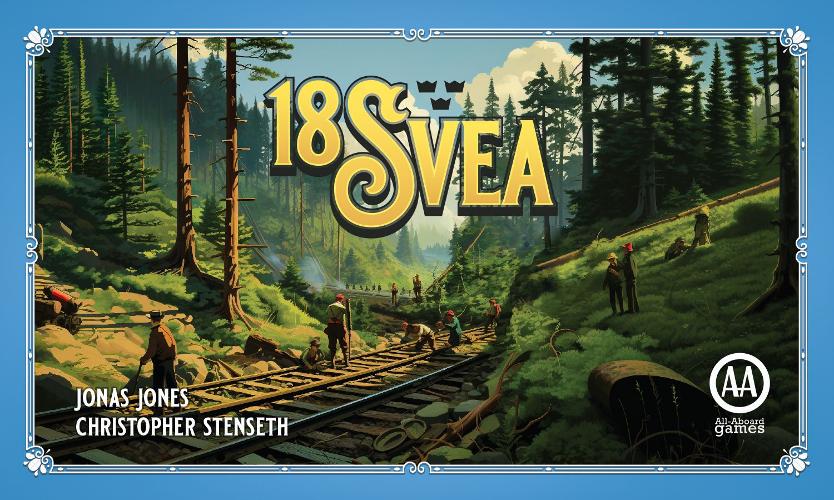
18Svea
Designer: Jonas Jones
A Swedish micro 18xx with just ten hexes, playable in under two hours.
18Svea — Summary
Capitalization type
- Incremental capitalization: when a company is founded, its treasury only receives the payment for the CEO's share (not all five shares at once); every time an additional share is bought directly from the company's treasury, the treasury receives that payment too.
Floating percentage and per-player share limits
- A company doesn't "float" in the classic sense: it's founded the moment its CEO share (one of five 20% shares, i.e. just 20% of the company) is bought, and it begins operating the very next operating round
- There is no fixed cap on how much of a single company one player may hold (a player could buy all five shares, i.e. 100%); however, holding 3 or more shares of the same company triggers a tax every stock round (10/20/30 kr for 3/4/5 shares)
- Overall share limit per player (called "share limit" in the rulebook, counting all companies combined, not per corporation): 2 players — 12 shares; 3 players — 8 shares (the only player counts the game supports)
Starting cash by player count
- 2 players: 120 kr starting cash per player (240 kr split between both)
- 3 players: 80 kr starting cash per player (240 kr split between the three)
- The game is designed only for 2 or 3 players; the bank has no fixed size, but a minimum of 2,000 kr is recommended
End game triggers
- Ends at the completion of the seventh operating round (OR7)
- Ends immediately at the end of any operating round in which a share price token reaches the blue top-right space of the stock market
- Ends immediately if a player goes bankrupt during emergency money raising
Number of phases
- 5 phases, named after the latest train type purchased: Phase 2, Phase 3, Phase 4, Phase 6, and Phase 6+S
- Quirk: there is no 5-train at all; Phase 4 is followed directly by Phase 6
- Each phase unlocks a new tile color (yellow, green, brown, gray, and finally black in phase 6+S)
Train list and prices
- 2-train — 45 kr (4 copies) — never rusts on its own
- 3-train — 75 kr (3 copies)
- 4-train — 110 kr (2 copies) — buying the first one rusts all 2-trains
- 6-train — 145 kr (2 copies) — buying the first 6-train or 6+S-train rusts all 3-trains
- 6+S-train — 190 kr (5 copies) — can also be obtained by exchanging a 4-train for 110 kr; counts the revenue of its first or last stop twice
- Each company may own a maximum of 3 trains at any time
List of private companies
- 18Svea has no private companies: instead it uses 12 "strategy cards," which combine passive income, a one-time special action, or a permanent effect, and determine stock round turn order (via initiative). They're distributed in two waves: six dealt for free during setup (DSC), and the other six, plus any leftovers, sold in a blind auction between OR3 and OR4 (SCA).
- Blue Off-Board Contract — income 5 kr, initiative 10/3 — +10 kr bonus per stop at a blue off-board connection
- Central Station — income 5 kr, initiative 15/6 — special token that doubles the station bonus or adds an extra one
- City Station Owner — income 5 kr, initiative 14.5/2.5 — charges 5 kr per train to other companies passing through a randomly chosen city
- Delayed Permit — income 5 kr, initiative 1/8 — delays a company's start, or lets you swap the card at the auction
- Ferry Contract — income 5 kr, initiative 12.5/8 — earns 15 kr for every new water connection built by any company
- Financial Planning — income 5 kr, initiative 12/1 — allows a one-time partial dividend payout
- Infrastructure Push — income 5 kr, initiative 14/5 — allows one extra tile lay, once
- New Railroad Connection — income 5 kr, initiative 9/7 — creates a permanent new connection at one of the map's three dead ends
- Political Influence — income 10 kr, initiative 13/2 — direct purchase of a share from the Open Market, or exemption from water crossing costs
- Raising Funds — income 0 kr, initiative 8/0 — one-time payment of 25 kr (DSC) or 40 kr (SCA) to the treasury
- Tax Haven — income 5 kr, initiative 8.5/0 — reduces a tax payment once for holding many shares of a company
- Yellow Off-Board Contract — income 5 kr, initiative 11/4 — +10 kr bonus per stop at a yellow off-board connection
List of corporations
- Stockholm — home at Stockholm
- Göteborg — home at Göteborg
- Norrköping — home at Norrköping
- Jönköping — home at Jönköping
- Örebro — home at Örebro
- Each company has 5 20% shares (one CEO share and four regular shares); these five companies are the only ones in the game
Game-specific mechanics
- No private companies: their functions (passive income, special powers, turn order) are handled by the 12 strategy cards
- Taxes: owning 3 or more shares of the same company costs a fee every stock round (10/20/30 kr for 3/4/5 shares)
- Emergency money raising that can end in immediate bankruptcy and a sudden game end
- A more flexible tile-upgrade rule than most 18xx games: a track segment connected at only one end can be redirected when upgrading it
- Three possible simultaneous end-game triggers: a fixed round (OR7), a share price reaching the top of the market, or a player going bankrupt
Emergency sell
A genuinely different sequence from 1830: the company treasury pays first, and if that's not enough, the company must sell its own treasury shares onto the open market before anyone's personal money comes into play. Only once that's exhausted does the CEO have to contribute personal cash — and only the exact amount needed, no more. If even that falls short, the CEO conducts formal Emergency Money Raising, selling personal shares of any company they choose, in any order, though — unlike 1830 — this specific kind of forced sale can never cost them the presidency of the company trying to buy the train. If the CEO still can't raise enough, they're declared bankrupt, and uniquely, the whole game ends immediately for everyone, not just that one corporation.
Comparison with 1830
1. Tiny map and a Swedish setting
1830 covers the northeastern US with a large map. 18Svea takes place in central Sweden (Svealand) on a
board with just five companies — one of the smallest maps in the whole 18xx family.
2. A much shorter game, for small groups
While 1830 shines at its best with 3 or more players (often up to 6), 18Svea is designed only for 2 or 3
players and wraps up in under 2 hours thanks to a fixed length of 7 operating rounds, making it an ideal
18xx "filler" for a weeknight session.
3. Strategy cards instead of privates
1830 distributes six private companies through classic open-bid auctions. 18Svea drops privates entirely:
instead, 12 numbered strategy cards provide income, special powers, and determine stock round turn order,
dealt out in two waves (six for free at the start, the rest sold in a blind auction around the midpoint of
the game).
4. Taxes for holding too many shares
1830 has no penalty for concentrating shares in a single company. In 18Svea, owning 3 or more shares of the
same company forces you to pay taxes every stock round, a mechanism absent from the original design.
5. Every decision counts far more given the small size
With such a tiny map, every tile and track-laying decision in 18Svea carries proportionally much more weight
than in 1830, where the map's size allows more room for error and recovery.
6. Recognizable 1830 game structure
Despite its size, 18Svea keeps the basic 1830 framework: stock rounds alternating with operating rounds,
share and train purchases, and phase progression — a compressed, accessible version of the same system
rather than a reinvention.
7. Self-published and very recent design
Unlike 1830, a classic design by Francis Tresham with decades of history, 18Svea is a much more recent
creation by Jonas Jones (published by All-Aboard Games), designed from scratch for the modern era of short,
direct 18xx games.
A term you do not recognise? They are all explained in the 18xx glossary. Glossary →