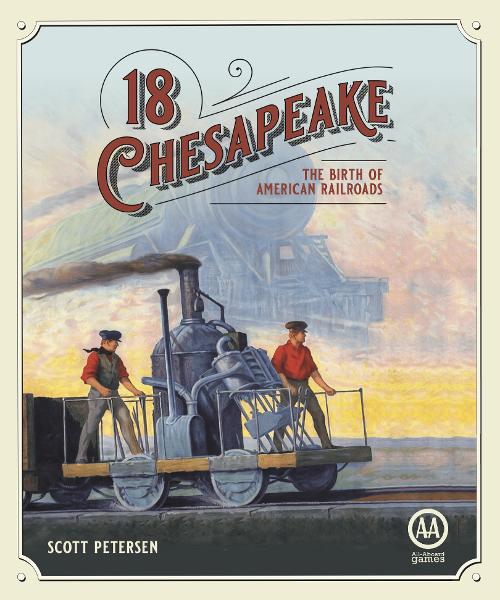
18Chesapeake
Designer: Scott Petersen
1830 simplified and polished to learn the genre without losing its depth.
18Chesapeake — Summary
Capitalization type
- Full capitalization: upon floating (60% sold), the company receives its entire capital (par price × 10) into the treasury at once, just like in 1830.
Floating percentage and per-player share limits
- Floats at 60% of shares sold (single threshold for all corporations)
- No player may hold more than 60% (6 out of 10 certificates) of a single corporation
- Certificate limit per player: 2 players — 20; 3 players — 20; 4 players — 16; 5 players — 13; 6 players — 11
Starting cash by player count
- 2 players: $1,200 starting cash
- 3 players: $800 starting cash
- 4 players: $600 starting cash
- 5 players: $480 starting cash
- 6 players: $400 starting cash
- The bank always starts with $8,000, regardless of player count
End game triggers
- The bank runs out of money: the current full operating round set is finished
- A company goes bankrupt: immediate end
Number of phases
- 6 phases (2, 3, 4, 5, 6, D), triggered by the purchase of the first train of each type
- At the end of each block of operating rounds, one non-permanent train (2, 3, or 4) is automatically removed from the pool, as if it had been bought
Train list and prices
- 2 train — $80 (7 units; rusts with the first 4-train)
- 3 train — $180 (6 units; rusts with the first 6-train)
- 4 train — $300 (5 units; rusts with the first Diesel)
- 5 train — $500 (3 units; buying it closes the private companies)
- 6 train — $630 (2 units)
- Diesel (D) — $900, unlimited, available from the first 6-train; allows trading in an old train for a $200 discount
List of private companies
- Delaware and Raritan Canal (D&R) — $20, revenue $5 — blocks hex K3 while owned by a player
- Columbia - Philadelphia Railroad (C-P) — $40, revenue $10 — the owning corporation may lay two connected tiles on hexes H2 and I3
- Baltimore and Susquehanna Railroad (B&S) — $50, revenue $10 — the owning corporation may lay two connected tiles on hexes F4 and G5
- Chesapeake and Ohio Canal (C&OC) — $80, revenue $15 — the owning corporation may lay a tile on hex D2 (no connection required) and may place a free token there immediately
- Baltimore & Ohio Railroad (B&OR) — $100, no revenue — the buyer immediately takes a 10% share of the B&O
- Cornelius Vanderbilt (CV) — $200, revenue $30 — comes with the president's certificate of a randomly chosen corporation; closes when that corporation buys its first train; cannot be bought by a corporation
List of corporations
- Pennsylvania Railroad (PRR) — home at F2
- Pittsburgh and Lake Erie Railroad (PLE) — home at A3
- Strasburg Rail Road (SRR) — home at H4
- Baltimore & Ohio Railroad (B&O) — home at H6
- Chesapeake & Ohio Railroad (C&O) — home at G13
- Lehigh Valley Railroad (LV) — home at J2
- Camden & Amboy Railroad (C&A) — home at J6
- Norfolk & Western Railway (N&W) — home at C13
Game-specific mechanics
- Explicitly designed to simplify 1830: fewer available par prices and a stock market without odd values (like 67)
- Simplified tiles and upgrade rules compared to 1830 (for example, how "OO" cities merge upon reaching the brown phase)
- One non-permanent train is automatically removed from the pool at the end of each block of operating rounds
- 5-trains cost more than in 1830 ($500 instead of $450) and Diesels cost less ($900 instead of $1,100)
Emergency sell
Matches the 1830 baseline exactly, with no changes of any kind: treasury first, then the president's personal cash, then a forced sale of any shares the president holds, ignoring the normal stock-round-only and pool-limit restrictions — fitting for a game explicitly designed as a simplified, beginner-friendly take on 1830.
Comparison with 1830
1. A design explicitly meant to simplify 1830
18Chesapeake doesn't try to differentiate itself thematically from 1830 (in fact, it keeps the same
northeastern US spirit), but instead trims and polishes its rulebook to make it much more accessible to new
players, without diluting its strategic depth.
2. One fewer train available at the end of each block of operating rounds
A mechanic that doesn't exist in 1830: at the end of each set of operating rounds, one non-permanent
train is removed from the available pool. This doesn't necessarily speed up the game (there are more
non-permanent trains than in 1830), but it completely eliminates the possibility of deliberately "stalling"
train purchases to hold out longer without upgrading.
3. Fewer available par prices and a cleaner stock market
In 1830 there's a whole grid of possible par prices, and the stock market includes unintuitive values (like
67). In 18Chesapeake this grid is reduced and those values are cleaned up, simplifying the initial founding
decision and making it clearer for new players to track each company's share price, without removing its
importance.
4. Simplified tiles, with adjusted upgrade rules
18Chesapeake's tile set reduces the number of special cases compared to 1830, for example with
specific rules on how "OO" cities merge upon reaching the brown phase, eliminating ambiguities that can
arise in certain 1830 situations.
5. More expensive 5-trains
In 18Chesapeake, 5-trains cost $50 more than in 1830. This prevents a company with the highest share
price from being able to afford buying two permanent trains in a row right away, a play that is indeed
possible in some 1830 games.
6. Cheaper Diesel trains
Conversely, Diesel trains cost $200 less than in 1830, reducing the risk of bankruptcy during the
final train rush and softening one of 1830's most financially tense moments.
7. Less extreme financial tension
As a consequence of the points above, the risk of bankruptcy and treasury pressure are noticeably softer in
18Chesapeake than in 1830, where the real possibility of going bankrupt is a constant threat for experienced
players.
8. A rulebook designed for self-teaching
18Chesapeake stands out for having a very clear and well-structured rulebook, designed so a group can
learn to play without needing an experienced 1830 player to teach them beforehand.
A term you do not recognise? They are all explained in the 18xx glossary. Glossary →