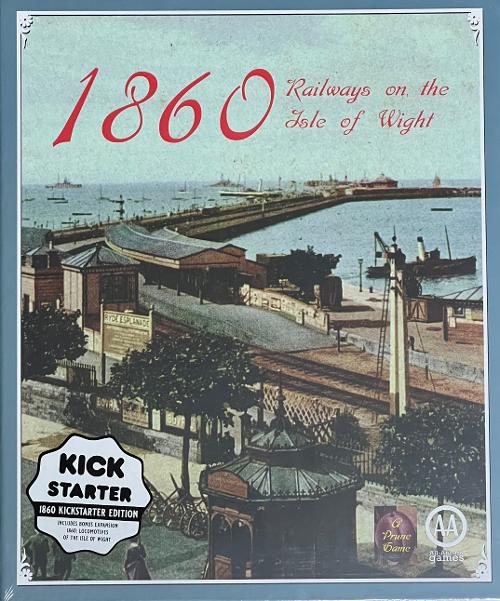
1860: Railways on the Isle of Wight
Designer: Mike Hutton
The Isle of Wight in an 18xx designed for 2 players, with no bankruptcies and progressive nationalization.
1860 Railways on the Isle of Wight — Summary
Capitalization type
- Full capitalization: when it floats (50% sold), the company receives its entire capital (par price × 10) in the treasury at once.
Floating percentage and per-player share limits
- Floats once 50% of shares are sold (the same threshold for every corporation)
- No player may hold more than 100% of a single corporation (there's no real ownership cap)
- Certificate limit per player: 2 players — 32; 3 players — 21; 4 players — 16
Starting cash by player count
- 2 players: £1,000 starting cash
- 3 players: £670 starting cash
- 4 players: £500 starting cash
- The bank has £10,000 (plus £10,000 more in company credits, £20,000 total), regardless of player count
End game triggers
- A share price hits the highest space on the market: the game ends at the conclusion of the current operating round
- The bank runs out of money (breaks): the game ends at the conclusion of the current operating round
- Nationalization completes (only two non-nationalized companies remain): immediate end
Number of phases
- 8 phases (2, 3, 4, 5, 6, 7, 8, 9), triggered by the purchase of the first combined train of each level
Train list and prices
- 2+1 train — £250 (5 units; rusts once the first 4+2-train is bought)
- 3+2 train — £300 (4 units; rusts once the first 6+3-train is bought)
- 4+2 train — £350 (3 units; rusts once the first 7+4-train is bought)
- 5+3 train — £400 (2 units; rusts once the first 8+4-train is bought)
- 6+3 train — £500 (2 units; never rusts; buying it puts the Fishbourne Ferry Company up for sale)
- 7+4 train — £600 (1 unit; never rusts)
- 8+4 train — £700 (1 unit; never rusts; buying it removes the certificate limit and selling shares no longer lowers their price)
- 9+5 train — £800 (unlimited; buying it sets up the formation of the Southern Railway, and once every company owns a train, nationalization begins)
List of private companies
- BHC - Brading Harbour Company — £30, revenue 5, exchangeable for a share of BHI&R
- YHC - Yarmouth Harbour Company — £50, revenue 10, exchangeable for a share of FYN
- CMH - Cowes Marina and Harbour — £90, revenue 20, exchangeable for a share of C&N
- RPSC - Ryde Pier & Shipping Company — £130, revenue 30, exchangeable for a share of IOW
- FFC - Fishbourne Ferry Company — £200, revenue 25, cannot be bought until the first 6+3 train is bought; buying it closes every other remaining private
List of corporations
- C&N - Cowes & Newport — home at F2 (layer 1)
- IOW - Isle of Wight — home at I3 (layer 1)
- IWNJ - Isle of Wight, Newport Junction — home at G7 (layer 2)
- FYN - Freshwater, Yarmouth & Newport — home at B4 (layer 2)
- NGStL - Newport, Godshill & St. Lawrence — home at G9 (layer 3)
- BHI&R - Brading Harbour Improvement & Railway — home at L6 (layer 3)
- S&C - Shanklin & Chale — home at F12 (layer 4)
- VYSC - Ventor, Yarmouth & South Coast — home at E9 (layer 4)
Game-specific mechanics
- All 8 corporations unlock in 4 layers of two, as the game progresses
- There is no bankruptcy: a company without a train becomes "insolvent" and rents a train of the current phase, withholding revenue until it buys one of its own
- A player can own up to 100% of a single company
- The president's certificate can be sold directly back to the bank
- Progressive nationalization: once the first 9+5 train is bought and every company already owns a train, the two lowest-earning companies are nationalized each round, until only two remain
Emergency sell
Differs sharply from 1830: a corporation is only forced to buy a train at all if its own treasury cash already covers the cheapest one on offer — if it can't, it's simply not required to buy. The president is never asked for personal cash and shares are never forced onto the market. A corporation left without a train instead becomes "Insolvent": it may still run routes as if it owned the cheapest available train (for route-length purposes) but must withhold all its earnings, staying that way until its own treasury can eventually afford a real one. This is separate from 1860's Receivership (triggered by the president selling their own president's certificate) and Bankruptcy (triggered by the share price sliding into the market's closing zone).
Comparison with 1830
1. Setting and map: a small, very enclosed island
1830 covers the northeastern United States with a large map. 1860 takes place on the Isle of Wight, a very
small map full of "chines" (small coastal valleys) that force tracks to wind around them. The reduced size
forces direct contact between companies from very early on, and the game is known as one of the best 18xx
options for just 2 players, something 1830 doesn't specifically aim for.
2. No one is ever left without a train: insolvency instead of bankruptcy
In 1830, if a company cannot pay for a mandatory train, it may end up bankrupt and be liquidated, and the
president must cover the difference from personal funds if the treasury falls short. In 1860 companies are
never required to own a train: if they don't have one, they simply become "insolvent" and must rent a train
corresponding to the current phase, withholding all their revenue until they eventually buy one of their
own, without the president ever having to put up personal money.
3. A player can own 100% of a company
In 1830 the individual ownership limit for a company is 60%. In 1860 a player can own up to 100% of the
shares of a single company, without the limit that applies in 1830.
4. Progressive nationalization of the lowest-earning companies
A mechanic completely absent from 1830: when the first "9+5" train is purchased and every company already
has at least one train, a nationalization process begins. From that point on, the two companies with the
lowest revenue progressively stop operating (are nationalized), and the game continues until only two active
companies remain — an ending determined by this chain, not by the bank running dry as in 1830.
5. Topography that forces winding routes
The "chines" (coastal inlets) on the Isle of Wight map force tracks to zigzag around the terrain, a
geographic restriction far more pronounced than that of 1830's relatively open map.
6. A game designed and balanced for 2 players
While 1830 shines best with 3 or more players, 1860 is specifically designed and highly regarded as a
2-player experience, preserving the tension and interaction typical of 18xx games in a smaller format.
A term you do not recognise? They are all explained in the 18xx glossary. Glossary →