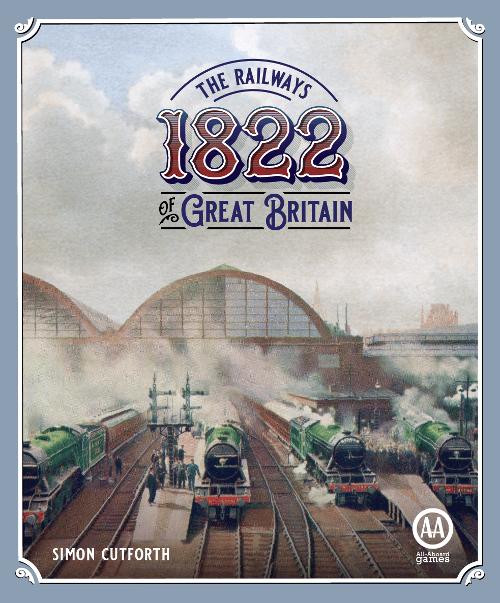
1822: The Railways of Great Britain — North Regional Scenario
Designer: Simon Cutforth
North regional version of 1822: from Birmingham northward, the shortest scenario in the family.
1822NRS North Regional Scenario — Summary
Capitalization type
- Incremental capitalization for all majors: each share pays its par price into the treasury at the moment it's actually sold, not all at once when floating.
- Once the first 6-train is bought (phase 6), any major that hasn't floated yet switches to full capitalization (receiving its whole capital at once) for the rest of the game.
Floating percentage and per-player share limits
- Floats at 20% of shares sold for most majors (CR, MR, LYR, NBR, NER), except LNWR, which floats at just 10%; minors float at 100% (they start operational right away)
- No player may hold more than 60% (6 of 10 certificates) of a single major, except minors, which have no limit (100%)
- Certificate limit per player: 2 players — 27; 3 players — 16; 4 players — 13; 5 players — 10; 6 players — 9; 7 players — 8
Starting cash by player count
- 2 players: £750 starting cash — played with a reduced set of privates (only P1-P12, without P5 or P10)
- 3 players: £500 starting cash
- 4 players: £375 starting cash
- 5 players: £300 starting cash
- 6 players: £250 starting cash
- 7 players: £215 starting cash
- The bank always starts with £12,000, regardless of the number of players
End game triggers
- The bank runs out of money: if it breaks during an operating round, the current full OR set is finished; if it breaks during a stock round, it ends at the next complete operating round set
- A share price reaches one of the cells marked "e" at the top of the stock market grid: the game ends at the close of the current operating round
- If nobody sells a share in the game's first stock round, that fact is locked in as the final trigger even if other conditions occur later
- There's no bankruptcy end condition (unlike other 18xx titles): in 1822, company bankruptcy simply isn't enabled
Number of phases
- 7 phases (1 through 7), triggered by the purchase of the first train of each type (2/L, 3, 4, 5, 6, 7) respectively
- From phase 2 onward, upgrading an L-train to a 2-train only costs £70 instead of the usual £80, a quirk specific to the NRS and MRS scenarios that doesn't exist in full 1822GB
Train list and prices
- L / 2 train — the L-train costs £50 (14 available) and can be upgraded into a 2-train, or a 2-train can be bought directly for £120; the L rusts with the first 3-train, the 2 with the first 4-train
- 3 train — £200 (6 available; rusts with the first 6-train)
- 4 train — £300 (4 available; rusts with the first 7-train)
- 5 train — £500 (2 available); buying it closes all remaining concessions without compensation
- 6 train — £600 (3 available); buying it switches any major that hasn't floated yet to full capitalization
- 7 train (or E variant, distance 99, price £1,000) — £750 (unlimited); buying it closes privates P15 and P20 if no major owns them yet
- Special trains not bought from the depot: 2P (permanent 2-train, from P3/P4), LP (permanent L-train, from P19), and 5P (permanent 5-train, from P1); a "Pullman" (P+, from P13/P14) converts another train into a + train
List of private companies
- All privates and concessions are distributed by auction through bidding boxes, not at a fixed price: they start with a minimum bid of £0 and each player has a limited number of bidding tokens
- P1 (5-Train, phase 5) — grants a permanent 5-train
- P2 (Remove Town, phase 2) — lets you remove a small station by laying a plain track tile directly on it
- P3 and P4 (Permanent 2T, phase 2) — each grants a permanent 2-train that doesn't count against the train limit
- P6 and P7 (Mail Contract, phase 3) — pay half the base value of the start and end stations of one of the trains operated
- P8 (Hill Discount, phase 3) — gives a free discount token for one mountain/hill terrain tile, or a permanent flat discount
- P9 (Double Cash, phase 3) — lets a player declare double their cash on hand to set turn order (if held by a player), or generates growing variable revenue (if held by a company)
- P11 (Advanced Tile Lay, phase 2) — lets you lay a tile color one step ahead of when it becomes available by phase
- P12 (Extra Tile Lay, phase 3) — grants an extra tile during the track-laying step
- P13 and P14 (Pullman, phase 5) — convert a train into a + train able to include extra towns
- P15 (£10x Phase, phase 2) — pays revenue and accrues treasury credit proportional to the current phase number
- P16 (Tax Haven) — can't be acquired; lets a player buy extra shares that don't count against the 60% limit
- P18 (Station Swap, phase 5) — lets you move a token between the company's exchange area and its available slot
- P19 (Perm. L Train, phase 1) — grants a permanent L-train
- P20 (£5x Phase, phase 3) — same as P15 but at half the value
- P21 (Grimsby/Hull Bridge, phase 2) — lets you connect Grimsby and Hull with free tiles at no terrain cost
- Six concessions (LNWR, CR, MR, LYR, NBR, NER) — £100 face value each; when converted, they become the 10% president's certificate of the corresponding major
List of corporations
- London and North Western Railway (LNWR) — home at N29 (specific to NRS; it's London in full 1822GB), with destination I22 and 4 exchange tokens
- Caledonian Railway (CR) — home at E6 (Glasgow), destination G12, 3 exchange tokens
- Midland Railway (MR) — home at J29, destination L19, 3 exchange tokens
- Lancashire & Yorkshire Railway (LYR) — home at G22, destination I22, 3 exchange tokens
- North British Railway (NBR) — home at H5 (Edinburgh), destination H1 (Aberdeen), 3 exchange tokens
- North Eastern Railway (NER) — home at L19, destination H5 (Edinburgh), 3 exchange tokens
- 16 single-token minors (50% director's certificate): 1 Aberdeen (H1), 2 Highlands (E2), 3 Edinburgh (H5), 4 Newcastle (K10), 5 Darlington (J15), 6 Barrow (G16), 7 Warrington (H23), 8 Sheffield (K24), 9 Grimsby (N23), 10 Birmingham (I30), 15 and 16 (NRS-specific homes, N29 and M30), 26 Hull (N21), 27 Glasgow (E6), 28 Carlisle (G12), and 29 (NRS-specific home, E26)
Game-specific mechanics
- Simultaneous auction of privates, minors, and concessions, with bidding tokens limited per player (between 7 and 3 depending on player count, 3 tokens spent per action)
- Minors float at a fixed price of 50 in phase 1, between 50 and 100 based on the bid in phase 2, and at the full winning bid value from phase 3 onward
- Minors merge into any major that traces an unblocked route to them; concessions convert directly into the corresponding major's president's certificate
- Stock round buying priority by cash on hand, not a cyclical turn order
- Certificate limit varies by player count: from 27 (2 players) down to 8 (7 players)
- With exactly 2 players, a reduced set of privates is used (only P1-P12, without P5 or P10)
- Map trimmed to the northern half of 1822GB, with Wales and London treated as off-map destinations; the English Channel mechanic isn't used
Emergency sell
Shares the same rule sheet as 1822MRS, and by extension the same four-tier Emergency Money Raising system as 1822GB, entirely unchanged.
Comparison with 1830
1. The full 1822 engine, not a simplified one
The NRS uses exactly the same engine as full 1822GB (auctions, minors, concessions, L-trains), none of which
exist in 1830. What changes compared to 1822GB isn't the engine, just the scope of the map: the northern
half, with Wales and London off-map.
2. Simultaneous auction of three categories, not a sequential single-lot auction
In 1830 privates go up one at a time in a classic open-bidding auction. In the NRS, privates, minors, and
concessions are all auctioned simultaneously through bidding boxes, and each player only has a limited number
of bidding tokens to spend.
3. Mergeable minors, a concept 1830 doesn't have
1830 only has major companies, born and grown independently. In the NRS, minors float early at a low price
and, at any point, can merge into any major that traces an unblocked route to them, handing over their track
and treasury.
4. Initial L-trains instead of the standard 2-city train
In 1830 the first generation of trains is already the standard 2-city train. In the NRS the game starts with
"L" trains (essentially 1(+1) city/town trains) that must be upgraded into 2-trains for a fee, reduced to
£70 from phase 2 onward.
5. Priority by cash on hand, not cyclical turn order
In 1830 stock round turn order is always cyclical. In the NRS, as in the rest of the 1822 system, whoever has
the most cash on hand goes first in each new stock round, which rewards holding cash instead of spending it
all.
6. Designed to match 1830's length, not full 1822GB's
A complete 1822GB game usually runs past 5 hours. The NRS trims the map and the number of active companies
specifically to offer a length (3.5-4.5 hours) comparable to an 1830 game among experienced players, without
giving up the full 1822 engine.
A term you do not recognise? They are all explained in the 18xx glossary. Glossary →