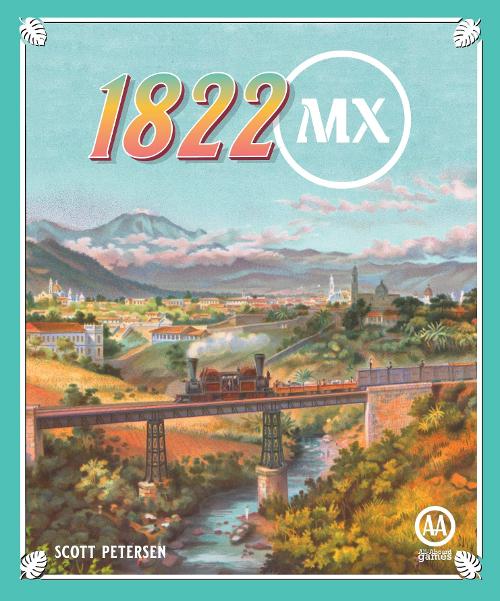
1822MX
Designer: Scott Petersen
1822 evolved and shortened for Mexico, with a collectively-managed national railroad (NdeM) and builder cubes.
1822MX: The Railways of Mexico — Summary
Capitalization type
- Incremental capitalization by default, same as base 1822: the company collects the par price each time one of its shares is actually sold.
- Once the first 6-train is bought (phase 6), majors that float from then on switch to full capitalization (they receive all their capital at once, 10 times the par price).
Floating percentage and per-player share limits
- Minors float once their single share (100%) is sold; majors float at 20%, except NDEM (Ferrocarriles Nacionales de Mexico), a special nationalization corporation that isn't floated by normal share purchase and uses the default 60%
- No player can hold more than 100% of a minor, since it only has one share; the remaining majors (including NDEM) use the classic default 60% cap
- Certificate limit per player: 2 players — 27; 3 players — 16; 4 players — 13; 5 players — 10 (with the optional "Higher Certificate Counts" rule: 3 players — 18; 4 players — 14; 5 players — 11)
Starting cash by player count
- 2 players: $750 starting cash
- 3 players: $500 starting cash
- 4 players: $375 starting cash
- 5 players: $300 starting cash
- The bank always starts with $12,000, same as 1822GB, regardless of player count
- Certificate limit: 27/16/13/10 (2/3/4/5 players), or 27/18/14/11 with the "Higher Certificate Counts" optional rule
End game triggers
- The bank runs out of money: the current full operating round set is finished (or the next operating round, if it happens during a stock round)
- A share price reaches the market cell marked "e" (600e): the game ends at the next end of an operating round
- Bankruptcy as such is disabled in this game; instead, a player can take an interest-bearing loan from the bank if they can't pay for a mandatory train
Number of phases
- 7 phases (1 through 7), with the same structure as 1822GB (concessions convertible from phase 2, pending concessions close on the first 5-train, full capitalization on the first 6-train)
- Phase 7: instead of closing phase-revenue privates (as in 1822GB), buying the first 7/E-train privatizes the NdeM: it operates one last time, then its shares are cashed out and its station tokens are auctioned off among players with available exchange tokens
Train list and prices
- L train — $60 (22 units; rusts once the first 3-train is bought); convertible into a "2" train for $80 before it rusts (own variant, distance 2, $120, available from phase 1, rusts once the first 4-train is bought)
- 3 train — $200 (7 units; rusts once the first 6-train is bought)
- 4 train — $300 (4 units; rusts once the first 7-train is bought)
- 5 train — $500 (2 units; buying it closes all pending concessions)
- 6 train — $600 (3 units; buying it triggers full capitalization for new majors)
- 7 train — $750 (unlimited; express variant "E", unlimited distance, ×2 multiplier, $1,000; buying it privatizes the NdeM)
- Special trains granted by privates: 2P (permanent 2-train, free, 1 unit), LP (permanent L-train, free, 1 unit), 5P (extra 5-train, $500, 1 unit), P+ (Pullman car, free, 2 units), 3/2P (special permanent 3-train that only pays half its value, free, 1 unit)
List of private companies
- 18 privates (P1-P18), with no fixed price: they're won in a simultaneous auction with limited bidding tokens.
- P1 (5-train), P2 (permanent 2-train), P3 (permanent 3/2-train), P4 (permanent L-train), P5 and P6 (Pullman cars), P7 (declares double cash on hand), P8 (advances access to the next tile color), P9 (extra tile or additional upgrade), P10 and P11 (builder cubes that prepay terrain cost), P12 and P13 (removes a town), P14 and P15 (mail contracts), P16 (drops a rival company's share price), P17 (small port bonus), P18 (large port bonus)
List of corporations
- 7 major companies (10 shares each), each founded by converting a concession (C1-C7) won at auction: Ferrocarril Mexicano (FCM) — N23; Mexican Central Railway (MC) — N23; Chihuahua-Pacific Railway (CHP) — F15; Ferrocarriles Nacionales de Mexico (FNM) — N23; Mexican International Railroad (MIR) — F21; Ferrocarril del Pacifico (FCP) — D9; Interoceanic Railway of Mexico (IRM) — N23
- The NdeM (Ferrocarriles Nacionales de Mexico, sym NDEM) — already present on the map from the start, with 10 station tokens but only 3 shares (30%) in play; it never has a single director: all shareholders take turns making track-building decisions, until it's privatized in phase 7
- 24 single-token "minor" companies with 2 shares each (M1-M24), also won at auction and scattered across the Mexican map. Minors can eventually merge into a major.
Game-specific mechanics
- The NdeM (national railway) has no president: shareholders take turns making track decisions each operating round, until it's privatized at auction when the first 7/E-train is bought
- Builder cubes: instead of directly laying a tile, a company can leave a cube on a hex to prepay its terrain cost, then build there later at no extra cost
- Interest-bearing loans: if a company can't pay for a mandatory train, the player can take a loan from the bank that accrues 50% interest each stock round if not repaid
- Mexico City occupies a double hex with its own upgrade cycle: every improvement there costs a fixed $20 (no cube discounts)
- Selling the director's certificate drops the share price twice as much as selling a normal share
- Unconverted concessions pay a fixed $10 dividend every operating round, and are lost without compensation if not converted before phase 5
Emergency sell
Reuses 1822GB's Emergency Money Raising system almost word for word, just in dollars instead of pounds: the company treasury pays first, then the director's personal cash, then a forced sale of the director's own shares (any company, at the pre-sale market price, own certificate always protected), and finally a bank loan at 50% interest if the shortfall still isn't covered.
Comparison with 1830
1. Heir to the 1822 engine, not directly to 1830
1822MX builds on the same engine as 1822: everything is bought at auction (privates, 2-share minors, and
major concessions); there's no free company founding like in 1830.
2. A national company with no president: the NdeM
1822MX's big novelty: the NdeM (Mexico's National Railways) never has a single director. All players who own
at least one share take turns, in turn order, making track-building decisions each operating round. In 1830
every public company always has a single president who decides alone.
3. Builder cubes as an alternative to laying tiles
Instead of laying a full tile, a company can leave a "builder cube" on a hex to prepay its terrain cost
(river, hill, mountain), and lay the tile there later at no extra cost. This planning tool doesn't exist in
1830.
4. Interest-bearing loans if a company can't pay for a train
In 1830, if a company can't afford a mandatory train, the president covers the gap with personal funds. In
1822MX, in the same situation, the player can take a loan from the bank that accrues 50% interest each stock
round if not repaid — a personal-debt mechanic that doesn't exist in 1830.
5. Smaller scale and shorter games than full 1822
1822MX deliberately trims the number of major companies (7) compared to original 1822, keeping the varied
terrain (mountains, rivers) but making it playable faster, helped by builder cubes so you don't get stuck on
terrain costs.
6. Mexico City: a megacity with its own rules
Mexico City occupies a double hex with its own upgrade cycle, where every improvement costs a fixed $20 (no
cube discounts). No city gets such special treatment in 1830.
7. Final privatization of the NdeM at auction
When the first 7/E-train is bought, the NdeM operates one last time, then its shares are cashed out. Players
with available exchange tokens bid against each other for the NdeM's station tokens. This choreographed final
closure has no equivalent in 1830.
A term you do not recognise? They are all explained in the 18xx glossary. Glossary →