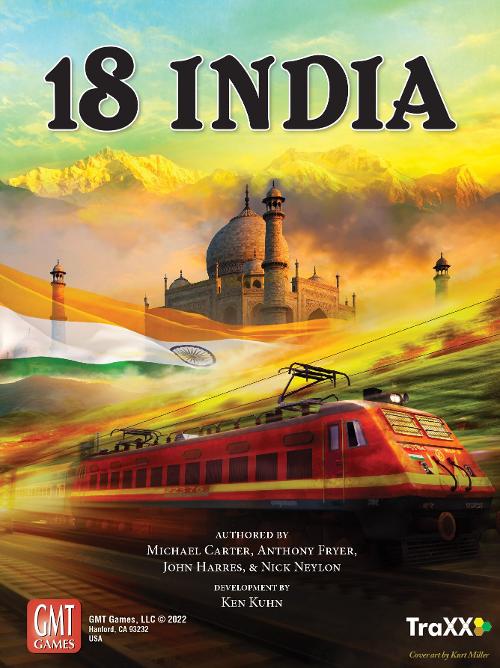
18 India: The Railways of India
Designer: Michael Carter, Anthony Fryer, John Harres, Nick Neylon
Descended from 1829 Mainline: permanent trains, "managed" companies without a fixed president, and royal bonds — for 2-5 players in about 3 hours.
18 India — Summary
Capitalization type
- Incremental capitalization: the company doesn't receive its full capital at once when it floats; instead it collects the par price each time one of its shares is actually sold.
- Companies float with only 30% sold, instead of the 60% common in other titles in the series.
Floating percentage and per-player share limits
- Companies float with 30% of shares sold (single threshold for all corporations)
- No player may hold more than 100% of a single corporation, except the Great Indian Peninsula Railway (GIPR), which may reach up to 200%
- Certificate limit per player (varies with the number of active corporations in the game — 8, 9, or 10, set at the start by region draft): 2 players — 29 to 37; 3 players — 19 to 23; 4 players — 15 to 18; 5 players — 12 to 15
Starting cash by player count
- 2 players: ₹1,100 starting cash
- 3 players: ₹733 starting cash
- 4 players: ₹550 starting cash
- 5 players: ₹440 starting cash
- The bank always starts with ₹9,000, regardless of player count
End game triggers
- The bank runs out of money: the current full operating round set is finished
- A share price reaches one of the market cells marked "e" (400e/420e/440e/460e): the game ends at the next end of an operating round (no need to finish the whole set)
- Bankruptcy is not an end-game trigger in this game: it's disabled outright (no company can go bankrupt)
Number of phases
- 5 phases (I, II, III, III', IV)
- Phase I: the Great Indian Peninsula Railway (GIPR) cannot operate yet
- Phase II: triggered by the purchase of the first 3-train
- Phase III: triggered by the purchase of the first 4-train
- Phase III': triggered by the purchase of the second 4-train; from here all multiplier trains (3x2, 3x3, 4x2, 4x3) are simultaneously available
- Phase IV: triggered by the purchase of any multiplier train; Guaranty Warrants expire, Railroad Bonds may be converted to a GIPR share, and gauge-change markers are no longer placed (and existing ones may start to be removed)
Train list and prices
- 2 train — ₹180 (6 units)
- 3 train — ₹300 (4 units), available from Phase II
- 4 train (express variant 4E, same price, skips towns) — ₹450 (3 units), available from Phase III
- 3x2 train — ₹700 (3 units) and 3x3 train — ₹900 (3 units), available from Phase III'
- 4x2 train (express variant 4Ex2) — ₹800 (3 units) and 4x3 train (express variant 4Ex3) — ₹1,100 (3 units), available from Phase III'
- Trains never rust: they remain permanent for the whole game. Each company can hold a maximum of 2 trains at a time.
List of private companies
- Swedish EIC (P1) — ₹25, revenue ₹5 — no special ability
- Portuguese EIC (P2) — ₹35, revenue ₹5 — one extra yellow tile placement; closes when used
- Dutch EIC (P3) — ₹60, revenue ₹10 — one extra track upgrade; closes when used
- French EIC (P4) — ₹75, revenue ₹15 — ₹40 discount on total terrain cost during an operating round; closes when used
- Danish EIC (P5) — ₹115, revenue ₹20 — one free token even if the city is full; closes when used
- British EIC (P6) — ₹150, revenue ₹25 — receives the jewelry concession (a bonus assignable to a hex); closes when used
List of corporations
- Great Indian Peninsula Railway (GIPR) — no fixed home (can be founded in any open city); always "managed" (no president's certificate), can grow up to 200% in circulation through convertible Royal Bonds, and cannot operate before Phase II
- East region (3 of the 6 are kept at random each game): Bengal Nagpur Railway (BNR) — Nagpur/I20; Darjeeling-Himalayan Railway (DHR) — Q10 (China border); East India Railway (EIR) — Kolkata/P17; Eastern Bengal Railway (EBR) — Kolkata/P17; North Central Railway (NCR) — Allahabad/K14; Tirhoot Railway (TR) — M10 (Nepal border)
- West region (3 of the 5 are kept at random each game): Bombay Railway (BR) — Mumbai/D23; Northwestern Railway (NWR) — Delhi/G8; Punjab Northern State Railway (PNS) — Lahore/D3; Sind Punjab & Delhi Railroad (SPD) — Delhi/G8; Western Railway (WR) — Ahmedabad/D17
- South region (3 of the 6 are kept at random each game): Ceylon Government Railway (CGR) — Colombo/K40; Kolar Gold Fields Railways (KGF) — Bengaluru/H31; Madras Railway (MR) — Chennai/K30; Nizam State Railway (NSR) — Hyderabad/H25; South Indian Railway (SIR) — Kochi/G36; West of India Portuguese Railway (WIP) — Pune/E24
- One "Guaranty" company is randomly picked per region, guaranteeing a minimum 5% dividend if the company fails to pay one
Game-specific mechanics
- Commodity system: companies pick up commodities on hexes and deliver them to their destinations for revenue bonuses
- "Managed" companies can operate without a president's certificate; there's never a forced train purchase and the president never contributes personal money
- No 60% ownership limit per shareholder (the GIPR can reach 200% in circulation)
- Fixed initial deal of certificate hands + a draft of the discards, instead of a private company auction
- A single Selling Turn per player at the start of each stock round; only purchases are allowed afterward
- Track gauge changes on the map: crossing one counts as a zero-value stop for the train
- Final share value is increased by 10% of the company's assets (trains, treasury, bonds and certificates it owns), not just the market price
Emergency sell
There is no emergency sell mechanic at all. Rule 8.4.5.8 states it outright: since no company is ever required to own a train, "the concept of emergency fund raising... does not exist" in 18 India, and a player may never put personal cash into a company's treasury for any reason. If an operating round ends with a company holding no train, the only consequence is that its share price drops one space on the market — which can eventually close the company, but never forces a sale of anyone's shares.
Comparison with 1830
1. Different lineage: comes from 1829 Mainline, not directly from 1830
18 India (GMT Games, 2022) is not derived from 1830, but from Francis Tresham's 1829 Mainline, with influences
from 18Africa. It's for 2-5 players, and games typically last about 3 hours — noticeably shorter than a typical
1830 game.
2. Trains never rust — they are permanent
The most drastic difference from 1830: in 18 India, trains are never retired for obsolescence. The pressure
doesn't come from losing old trains, but from the "train rush" to get better trains before your opponents do.
3. There is never a "forced" train purchase
In 1830, if a company can't afford a mandatory train, the president has to cover the gap with personal funds.
In 18 India this doesn't exist: no company is ever required to own a train, and the president or manager never
contributes personal money to the company's treasury.
4. "Managed" companies with no president's certificate
In 1830, every public company always has a president from the moment it's founded. In 18 India, a company can
operate as a "Managed Company" (with no Director's Certificate in play at all) simply once at least three 10%
certificates are held, with no need for anyone to hold a majority.
5. No 60% ownership limit per shareholder
A key and somewhat counter-intuitive difference: in 18 India there is no limit at all on the percentage of a
company a single player may control. In 1830 the limit is strictly 60% (6 certificates).
6. Final value includes company assets, not just market price
At the end of the game, each share's value in 18 India is increased by 10% of the company's assets (trains,
treasury, bonds and certificates it owns). In 1830, a share's value at final settlement is simply its market
price.
A term you do not recognise? They are all explained in the 18xx glossary. Glossary →