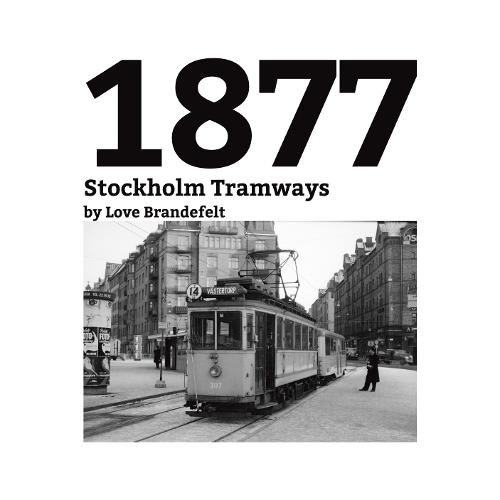
1877: Stockholm Tramways
Trams (not trains) through Stockholm, built around the risk of losing control of your own companies.
1877: Stockholm Tramways — Summary
Capitalization type
- Full capitalization: upon floating, the corporation receives all of its capital at once. Unlike 1830, though, corporations aren't founded through a par-price auction: they all start with their shares distributed to the market and are obtained by winning an entry auction once they reach their assigned phase.
Floating percentage and per-player share limits
- Floats once 50% of its shares are sold (same threshold for every corporation)
- No player may hold more than 60% of one corporation (default threshold, no exceptions)
- Certificate limit per player: 3 players — 16; 4 players — 12; 5 players — 10; 6 players — 9
Starting cash by player count
- 3 players: 600kr starting cash
- 4 players: 450kr starting cash
- 5 players: 360kr starting cash
- 6 players: 300kr starting cash
- The bank is unlimited (no fixed amount of money)
End game triggers
- A share reaches the top of the market grid (price 400e): the game ends at the end of the current round
- The SL (Storstockholms Lokaltrafik) forms after the first 10H train is bought: one more full set of operating rounds is played before the game ends
Number of phases
- 6 phases (2, 3, 4, 6, 8, 10), triggered by the purchase of the first 3H, 4H, 6H, 8H and 10H train respectively
- Green tiles unlock in phase 3 and brown tiles in phase 6
Train list and prices
- 2H train — 80kr (rusts with the first 4H train) — 6 units
- 3H train — 180kr (rusts with the first 8H train) — 5 units
- 4H train — 280kr (rusts with the first 10H train) — 4 units
- 6H train — 500kr (never rusts) — 2 units
- 8H train — 600kr (never rusts) — 2 units
- 10H train — 700kr, unlimited — buying it triggers the SL's formation and the game-end sequence
- Train distance is measured in track hex edges traveled, not in stops
List of private companies
- This game has no private companies at all: all of the players' starting capital goes directly into the corporations.
List of corporations
- AB Stockholms Spårvägar (SS) — home at F6 (city 0)
- AB Södra Förstadsbanan (SF) — home at H4
- Djursholms AB (D) — home at C7
- Järnvägs AB Stockholm-Saltsjön (JSS) — home at I13
- Lidingö Trafik AB (LT) — home at D10 (city 0)
- Råsunda Förstads AB (RF) — home at D4
- Stockholm-Rimbo Järnvägs AB (SRJ) — home at A9
- Stockholms Nya Spårvägs AB (SNS) — home at F6 (city 1)
- Stockholms Stads Spårväg (SSS) — home at G1
- Stockholms Södra Spårvägs AB (SSB) — home at G7
- Södra Spårvägarnes Trafik AB (SST) — home at H8
- Trafik AB Stockholm-Södra Lidingön (TSSL) — home at D10 (city 1)
Game-specific mechanics
- All 12 corporations enter play staggered and randomly: 5 available from phase 2, 4 from phase 3, and 3 from phase 6, obtained by auction rather than direct founding
- Mergers and hostile takeovers between corporations with different presidents, limited so that, combined, they don't exceed six hexes with a station
- The merged corporation's president may buy shares in it at half price
- A share just bought cannot be resold within the same stock round
- No emergency stock sale to pay for trains: the president only contributes personal cash
- Trainless corporations can still buy one when the game-end trigger fires
Emergency sell
No forced sale of personal shares happens here at all. Instead, when a trainless corporation still can't afford one after spending its own treasury, the owning player's entire available personal cash — not just the shortfall — is automatically poured into the corporation. If even that combined total still isn't enough for the cheapest train, the corporation simply isn't forced to buy; there's no bankruptcy trigger for this specific situation. Used trains can only be bought from another corporation controlled by the very same player.
Comparison with 1830
1. Setting, map and number of players
1830 covers the northeastern USA for 2-6 players. 1877: Stockholm Tramways moves the action to Stockholm and
spans a very long historical period, from 1877 to 1966, on a smaller, denser map built for urban trams rather
than intercity trains. It's designed for 3-6 players (best with 4) and games of 3-4 hours.
2. No private companies
1830 starts with six private companies that can be bought and sold between players and that grant income or
special powers. 1877 drops privates entirely -a direct borrow from 1862-: there are none at all, and all of
the players' starting capital goes straight into operating companies.
3. Corporations aren't all available from the start
In 1830 all eight operating companies can be founded from the very first stock round. In 1877 each corporation
enters play on a staggered schedule based on the color of its home station: yellow-station companies appear in
phase 2, green ones in phase 3, and brown ones in phase 6, and they're won at auction rather than simply
founded by buying shares.
4. Mergers and hostile takeovers between different players' companies
In 1830 companies never merge with or absorb one another. In 1877, by contrast, one company can acquire
another even when they're controlled by different presidents: that's a hostile takeover, and it's exactly the
mechanism by which you can end up losing control of your own company. The only constraint is that, combined,
the two companies can't have stations on more than six hexes. The resulting company's president may buy
shares in it at half the usual price, a way of rebuilding control right after the takeover.
5. You can't resell a share you just bought
In 1830, within a single stock round you can buy and sell shares of a company in either order. In 1877
(another inheritance from 1862) a share can't be sold in the same stock round in which it was bought: you have
to wait at least one round, which slows down a raided president's ability to buy back control immediately.
6. Trains measured in hexes, not stops
In 1830 a train's size is defined by how many cities and towns it can visit (a "4-train" makes 4 stops, for
example). In 1877, following 18Ireland, trains are defined by the number of track hexes they can travel
through rather than the number of stops -a design better suited to a dense urban tram network.
7. No emergency stock sale to pay for trains
In 1830, if a company can't afford a mandatory train, the president must contribute personal money and, as a
last resort, the company can end up liquidated. In 1877 there's no emergency stock-sale mechanism at all: the
president simply contributes the minimum cash needed (or everything they have) to complete the purchase,
without the personal-bankruptcy spiral found in some other 18xx titles.
8. Trainless companies can still buy a train right at game end
Normally a company needs to operate to earn the cash for a train. 1877 relaxes that requirement exactly when
the endgame trigger fires: even a trainless company can still buy one at that point, a one-off exception with
no equivalent in 1830.