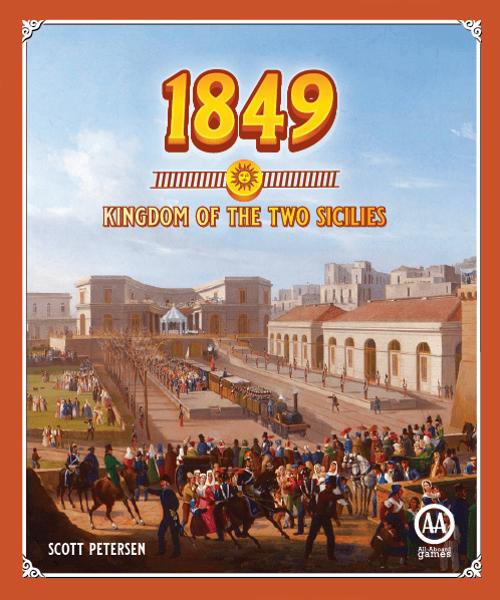
1849: Kingdom of the Two Sicilies
Federico Vellani's 1849 taken further south, to the former Kingdom of the Two Sicilies, in a revision by Scott Petersen.
1849: Kingdom of the Two Sicilies — Summary
Capitalization type
- Incremental capitalization with no free par value: when founded, the company chooses its starting price from a fixed menu (L.68 or L.100 from the start; L.144 from the green phase onward; L.216 from the brown phase onward), and the Treasury only receives money from actual share sales, never from shares resold from the bank pool.
Floating percentage and per-player share limits
- Floats once 20% of shares are sold for every corporation
- No player may hold more than 60% (6 of 10 certificates) of a single corporation
- Certificate limit per player: 4 players — 14; 5 players — 12; 6 players — 10
Starting cash by player count
- 4 players: L.375 starting cash
- 5 players: L.330 starting cash
- 6 players: L.300 starting cash
- The bank always starts with L.7,760, regardless of player count
End game triggers
- A player goes bankrupt: immediate end
- The bank runs out of money: the current full operating round set is finished
- A corporation reaches the highest space on the stock market (L.377): the game ends right after that corporation finishes operating
Number of phases
- 6 phases (4H, 6H, 8H, 10H, 12H, 16H), triggered by the purchase of the first train of each type
Train list and prices
- 4H train — L.100 (4 units; rusts once the first 8H-train is bought)
- 6H train — L.200 (4 units; rusts once the first 10H-train is bought; unlocks parring at L.144)
- 8H train — L.350 (3 or 4 units depending on player count; rusts once the first 16H-train is bought)
- 10H train — L.550 (2 or 3 units depending on player count; unlocks parring at L.216)
- 12H train — L.800 (1 unit; buying it closes the privates and triggers the Avezzano earthquake)
- 16H train — L.1,100 (6 units)
- R6H train — L.600 (2 units, available from Phase 16H; the only train able to run on both track gauges)
- Every train counts hexes of track traveled, not cities visited
List of private companies
- SCE - Società Corriere — L.20, revenue 5, blocks Caserta (F8) while owned by a player
- SIGI - Studio di Ingegneria Giuseppe Incorpora — L.45, revenue 10, the owning corporation builds or upgrades at half cost on mountain, hill, or rough terrain (standard gauge)
- CNM - Compagnia Navale Mediterranea — L.75, revenue 15, the owning corporation may close it to place a permanent +L.20 marker on any port
- SMS - Società Marittima Siciliana — L.110, revenue 20, the owning corporation may close it to "teleport" to any coastal city (except Foggia, Campobasso, L'Aquila, and Potenza) and build and/or token there
- RSA - Reale Società d'Affari — L.150, revenue 25, cannot be sold to a corporation; comes with the first president's share of the associated corporation; closes when that corporation buys its first train (or otherwise at the start of Phase 12H)
List of corporations
- SFR - Società per le Strade Ferrate Romane — no fixed home; the president chooses on floating among E11, H8, I13, I17, J18, K19, L12, L20, O9, or P2
- SFCS - Società per le Strade Ferrate Calabro-Sicule — home at O9
- AL - Società Adami e Lemmi — home at N20
- SFM - Società Italiana per le Strade Ferrate Meridionali — home at B14
- IFP - Impresa Ferroviaria di Pietrarsa — home at G7
- PL - Società Anonima Pia Latina — home at G15
- FCU - Ferrovia Centrale Umbra — home at A9
- M&C - Società in Commandita E. Melisurgo & C. — home at L18
- All 8 corporations are always available, with none randomly removed (unlike the original 1849)
Game-specific mechanics
- No free par value: the starting price comes from a fixed menu of four figures, expanded as the game progresses
- Random, forced founding order via position cards: no player chooses which company to found
- Dual track gauge (standard and narrow) with different building costs; gauge can only change at a station
- Each company's train limit drops from 4 to 3 and finally to 2
- Corporate bankruptcy: permanent closure and total loss for shareholders, with no compensation
- The president's personal ruin: a L.500 loan from the bank with a L.750 penalty at final scoring
- Avezzano earthquake when the first 12H train is bought: removes the special tile on that hex
Emergency sell
Identical to 1849: treasury, then the president's personal cash, then a forced sale of the president's own shares — including the same restriction that a corporation's own shares can't be sold to fund itself until it has already operated once. 1849Boot only changes the map, market and trains, not this mechanic.
Comparison with 1830
1. Setting, map and number of players
1830 covers the northeastern USA for 2-6 players. This "Kingdom of the Two Sicilies" edition (based on the
original 1849 set in Sicily) moves the action to the mainland, to the old Kingdom of the Two Sicilies
(southern Italy, from Naples down), for 4-6 players, with 8 operating companies instead of the original base
game's 6.
2. No free par value: the starting price comes from a fixed menu
In 1830 whoever founds a company picks its par value from a wide price table, and shares trade afterward
relative to that value. Here there's no par value in the 1830 sense: every transaction happens at the
current market value, and the president can only choose the starting value from a very small fixed menu of
figures.
3. Random, forced founding order
In 1830 each player freely chooses which company to found and when. Here, position cards are randomly dealt
at the start of the game and determine the exact order in which presidential certificates become available;
a player who wants to found a company cannot choose one: they always take the next one available in that
predetermined order.
4. Dual-gauge track
Something that doesn't exist in 1830 at all: the map has both standard-gauge and narrow-gauge track, with
different building costs for each. Most trains can only run on one of the two gauges; only the special R6H
train can use both networks, though it counts standard-gauge hexes as twice as costly in distance.
5. Corporate bankruptcy: permanent closure with no compensation
In 1830, if a company can't pay for a mandatory train, the president covers it with personal funds and, as a
last resort, the company is liquidated but still exists with its shares. Here, if there's still not enough
money to pay for a train even after the president has dipped into their own pocket, the company is closed
entirely: all its tokens and any privates it owned are removed, and shareholders receive no compensation
whatsoever.
6. The president's personal ruin
Here, if the president also can't cover an emergency payment with personal money, they can take a L.500 loan
from the bank to keep playing, but L.750 is deducted from their final net worth. 1830 has no equivalent
mechanism for individual personal debt.
7. An earthquake tailored to the new map
The base game (1849 in Sicily) has an earthquake that downgrades Messina once the first 12H train is bought.
In this edition, the equivalent event hits Avezzano instead: the special tile on that hex disappears forever,
revealing a weaker printed town with no connection to Rome — a thematic mechanic with no equivalent in 1830
at all.