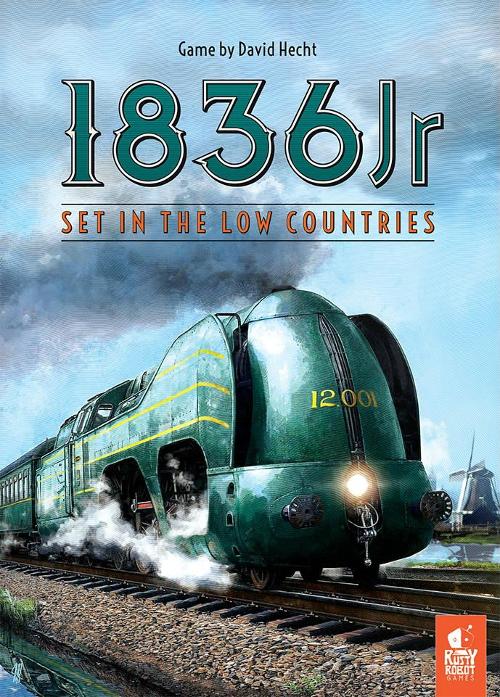
1836Jr30
A short, kid-friendly 18xx built from 1830's components, set in the Netherlands and Belgium.
1836Jr30 — Summary
Capitalization type
- Full capitalization, just like 1830: when it floats (60% sold), the company receives its entire capital (par price × 10) into its treasury at once.
Floating percentage and per-player share limits
- Floats once 60% of shares are sold (a single threshold for all corporations, like 1830)
- No player may hold more than 60% (6 of 10 certificates) of a single corporation, no exceptions
- Certificate limit per player: 2 players — 20; 3 players — 13; 4 players — 10
Starting cash by player count
- 2 players: 900 F starting cash
- 3 players: 600 F starting cash
- 4 players: 450 F starting cash
- The bank always starts with 6,000 F, regardless of the number of players
End game triggers
- The bank runs out of money: the current full operating round set is finished, then the game stops
- A company goes bankrupt and can't complete payment for a mandatory train: immediate end
Number of phases
- 6 phases (2, 3, 4, 5, 6, D), triggered by the purchase of the first train of each type
- Green tiles are enabled in phase 3, brown tiles in phase 5
Train list and prices
- 2 train — 80 F (5 copies; rusts on the first 4-train)
- 3 train — 180 F (4 copies; rusts on the first 6-train)
- 4 train — 300 F (3 copies; rusts on the first Diesel)
- 5 train — 450 F (2 copies; buying it closes any private companies still owned by players)
- 6 train — 630 F (2 copies; the last type before the Diesel, permanent, never rusts)
- Diesel (D) — 1,100 F (only 5 copies, not unlimited; available from phase 6; allows trading in old trains for a 300 F discount each)
List of private companies
- Amsterdam Canal Company (ACC) — 20 F, revenue 5 F — no special ability; blocks hex D6 while owned by a player
- Enkhuizen-Stavoren Ferry (E-SF) — 40 F, revenue 10 F — lets its owner lay a free tile on hex B8 (the old Zuiderzee water crossing), in addition to the normal tile lay for the turn
- Charbonnages du Hainaut (CdH) — 70 F, revenue 15 F — lets its owner lay a tile and station token on hex J8 for just the mountain terrain cost, with no need to connect to the existing network (a "teleport" effect)
- Grand Central Belge (GCB) — 110 F, revenue 20 F — can be exchanged for a 10% certificate of company B (from the bank or the pool), closing the private when it happens
- Chemins de Fer Luxembourgeois (CFL) — 160 F, revenue 25 F — buying it also gives the player a 10% certificate of the GCL
- Chemin de Fer de Lille à Valenciennes (CFLV) — 220 F, revenue 30 F — comes with the President's Certificate of the Chemin de Fer du Nord (forcing its par price to be set immediately), can never be sold to a corporation, and closes when the Nord buys its first train
- All privates close, at the latest, once the first 5-train is bought
List of corporations
- Chemins de Fer de l'État Belge (B) — home at H6
- Grande Compagnie du Luxembourg (GCL) — home at I9
- Chemin de Fer du Nord (Nord) — home at I3
- Noord-Brabantsch-Duitsche Spoorweg-Maatschappij (NBDS) — home at E11
- Hollandsche IJzeren Spoorweg Maatschappij (HSM) — home at D6
- Noord-Friesche Locaal (NFL) — home at A9
Game-specific mechanics
- A private with a "teleport" effect: tile-and-token placement with no connection to the existing network (Charbonnages du Hainaut)
- Two privates that convert directly into shares (Grand Central Belge and Chemins de Fer Luxembourgeois)
- Ports (Harwich, Dover, Paris) that pay no revenue of their own: they add +20 F (green phase) or +30 F (brown phase) to a route that already includes at least two other stops
- Reuses 1830's stock market grid and some tile types (NY at Amsterdam, OO at several cities, B at Brussels and Lille)
- Optional rule: allow buying more than one brown share from the IPO in a single operation
Emergency sell
Matches the 1830 baseline exactly: company treasury first, then the president's personal cash, then a forced sale of the president's shares in any corporation he holds, at full market price, exempt from the normal stock-round-only and pool-limit restrictions, with bankruptcy as the final backstop.
Comparison with 1830
1. Setting, map and number of players
1830 covers the northeastern USA for 2-6 players. 1836Jr30 moves the action to the Netherlands and Belgium
(Amsterdam, Rotterdam, Brussels, Antwerp, with off-board destinations toward Paris, Cologne, Hamburg and
Strasbourg), designed for 2-4 players only. It's literally a "junior" game: it reuses physical components
from 1830 (trains, the stock market, and some tile types) but with a map and numbers built for much shorter,
simpler games.
2. Six companies and an economy cut exactly in half
1830 has eight operating companies and a $12,000 bank; 1836Jr30 has only six, and its bank holds 6,000 F,
exactly half. Starting cash and certificate limits scale down proportionally too (for example, at 4 players
the limit drops from 16 in 1830 to 10 in 1836Jr30). Interestingly, the six privates keep exactly the same
price and revenue scale as 1830's own privates (20/40/70/110/160/220 F), just with different names and
abilities.
3. Charbonnages du Hainaut: the only private with "teleport" power
It lets its owning company lay a tile and a station token on hex J8 for just the mountain terrain cost,
without needing the track to connect to any existing tile of that company (or any company at all). None of
1830's six privates ever allows such a disconnected placement.
4. Two privates that convert directly into shares
The Grand Central Belge can be exchanged for a 10% certificate of company B (from the bank or the pool),
closing the private when it happens. The Chemins de Fer Luxembourgeois comes bundled, from the moment it's
bought, with a 10% certificate of the GCL. None of 1830's six privates behaves this way.
5. A "B&O-style" private
The Chemin de Fer de Lille à Valenciennes comes bundled with the President's Certificate of the Chemin de Fer
du Nord (forcing its par price to be set immediately), can never be sold to a corporation, and closes when
the Nord buys its first train. It's exactly the same concept as 1830's B&O private.
6. Train prices identical to 1830's, but with limited Diesels
The price and rust schedule for every train type (2/3/4/5/6/Diesel) follows the exact same progression as
1830: 80/180/300/450/630/1,100 F, with the same 300 F trade-in discount per old train when buying a Diesel.
The difference is that 1830 has unlimited Diesels, while 1836Jr30 has only 5 copies.
7. Ports that add a bonus instead of paying their own revenue
Harwich, Dover and Paris don't work like 1830's off-board destinations (which pay their own value when a
route ends there): a route can never end at these ports, but if it passes through one — as long as it
includes at least two other real stops — it adds a flat bonus (+20 F in the green phase, +30 F in brown). In
1830 off-board destinations simply pay their own value just like any other city.