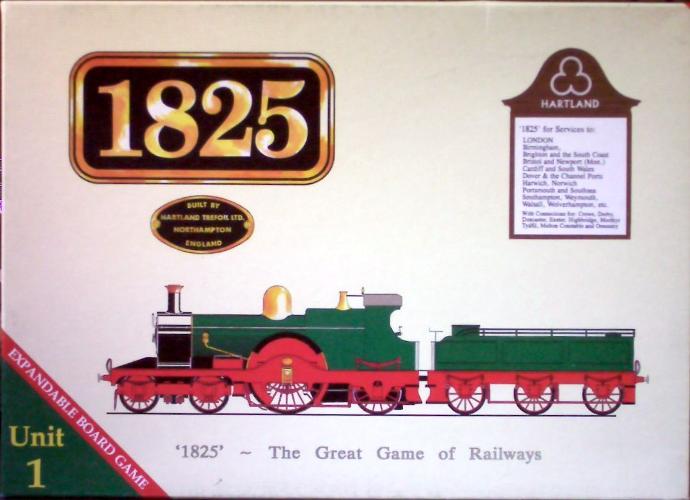
1825
The modular successor to 1829: maps split into Units (1, 2 and 3) that can be combined depending on player count.
1825 — Summary
Capitalization type
- Full capitalization for the fourteen historic companies (LNWR, GWR, Midland, Caledonian, GER...): when they float they receive their entire capital at once, calculated on their printed par value (not chosen by the founder).
- The three "minor" companies in Unit 3 (Great North of Scotland, Highland Railway and Maryport & Carlisle) use incremental capitalization (they float at 40%, with shares split 40/20/20/20): instead of a normal IPO, they "form" once they have enough treasury to pay for their required train (a 5-train, U3-train or 3T-train respectively).
Floating percentage and per-player share limits
- The fourteen base historical companies (Units 1-3) float at 60% (the standard threshold); the additional Regional and Kit companies (GNoS, HR, M&C, Cam, TV, S&DR, M&GN, FR, NS, LT&S) float at 40%
- No corporation has a real per-player ownership limit: all of them have the threshold set at 100% (a player could in theory end up holding every share of a company)
- 1825 doesn't define its own CERT_LIMIT, so it inherits the engine's default: 2 players — 28; 3 players — 20; 4 players — 16; 5 players — 13; 6 players — 11
Starting cash by player count
- Depends on which Unit(s) are being played, not just the player count:
- Unit 1 alone: 2p £1,200, 3p £830, 4p £630, 5p £504
- Unit 2 alone: 2p £1,200, 3p £800, 4p £600
- Unit 3 alone: 2p £750
- Units 1+2: 3p £840, 4p £630, 5p £504, 6p £420, 7p £360
- Units 2+3: 3p £840, 4p £630, 5p £504
- Units 1+2+3 (all three): 4p £630, 5p £504, 6p £420, 7p £360, 8p £315, 9p £280
- Bank: £5,000 when playing Unit 1 or Unit 2 alone, £4,000 with Unit 3 only; when combining Units without the optional BigBank rule, the bank uses the value of the first Unit chosen, while with BigBank the banks of each Unit are added together; £1,000 is added for every extra minor company brought in by optional kits or regionals (plus £2,000 more if Kits 2 or 3 are added), unless the StrictBank rule is used
End game triggers
- The bank runs out of money: the current operating round is finished
- A company's share price reaches the top square of the Share Price Index (SPI): immediate end once that company's turn is over, even if the bank still has money left
Number of phases
- 3 base phases: Phase 1 (yellow tiles only, 1 operating round), Phase 2 triggered by the first 3-train (yellow and green tiles, 2 operating rounds), Phase 3 triggered by the first 5-train (yellow, green and brown tiles, 3 operating rounds)
- The first 4-train, oddly, doesn't trigger a new phase at all
- With the optional Kit 3 (Phase Four) up to two more phases are added, triggered by 6-trains and 7-trains
Train list and prices
- 2 train — £180 (rusts once the first 5-train is bought)
- 3 train — £300 (never rusts, unless Kit 3 is used, in which case it rusts on the first 7-train)
- 4 train — £430 (never rusts; buying it triggers no new phase)
- 5 train — £550
- 6 train — £650 (only available with the optional Kit 3, or included outright if Unit 2 is played alone)
- 7 train — £720 (only available with the optional Kit 3)
- 3T — £370, available from Phase 2; a "minor"-only train (required by Maryport & Carlisle)
- U3 — £410, available from Phase 2; pays for up to 3 cities but runs through towns without limit (required by Highland Railway)
- 4T — £480, available from Phase 3; only with certain regional kits
- 2+2 — £600 (a doubled train), available from Phase 3; only with Kit 7
- 4+4E — £830 (a doubled train), only available with Kit 3, in its Phase 4a
- The exact quantity of each train type depends on which Unit(s) and kits are used; for example, Unit 1 on its own includes six 2-trains, four 3-trains, three 4-trains and four 5-trains
List of private companies
- The available privates depend on which Unit(s) are being played; there are eight possible companies in total, grouped into value tiers:
- Swansea & Mumbles Railway (S&M) — £30, revenue £5 (Unit 1)
- Leeds & Middleton Railway (L&MI) — £30, revenue £5 (Unit 2, replaces the S&M when Unit 1 isn't in play)
- Arbroath & Forfar (A&F) — £30, revenue £5 (Unit 3, replaces the above when played alone)
- Tanfield Wagon Way (TWW) — £60, revenue £10 (Unit 3)
- Cromford & High Peak Railway (C&HP) — £75, revenue £12 (Unit 1 and Unit 2)
- Stockton & Darlington (S&D) — £160, revenue £25 (Unit 2 and Unit 3)
- Canterbury & Whitstable Railway (C&W) — £130, revenue £20 (Unit 1)
- Liverpool & Manchester Railway (L&M) — £210, revenue £30 (Unit 1 and Unit 2)
- When Units are combined, if two privates share the same value only one is kept, so any given game only ever has four in play
List of corporations
- Unit 1 (South-East England) — six full-capitalization companies: London & North Western (LNWR), par £100, home at T16; Great Western (GWR), par £90, home at V14; Great Eastern (GER), par £76, home at V20; London & South Western (LSWR), par £76, home at V20; South Eastern & Chatham (SECR), par £71, home at W23; London Brighton & South Coast (LBSC), par £67, home at X20
- Unit 2 (the Midlands) — six full-capitalization companies: LNWR (par £100, home at Q11 when Unit 2 is played alone), Midland (MR), par £82, home at Q15; North Eastern (NER), par £82, home at L14; Great Central (GCR), par £71, home at O15; Great Northern (GNR), par £71, home at O15; Lancashire & Yorkshire (L&Y), par £71, home at O11
- Unit 3 (Northern England and Scotland) — three full-capitalization companies: Caledonian (CR), par £76, home at G5; North British (NBR), par £76, home at G5; Glasgow & South Western (GSWR), par £67, home at G5
- Unit 3 — three "minor" companies with incremental capitalization and no fixed par: Great North of Scotland (GNoS), home at B12, forms by paying for a 5-train; Highland Railway (HR), home at B8, forms by paying for a U3-train; Maryport & Carlisle (M&C), home at K7, forms by paying for a 3T-train
- With the optional kits and regionals, up to seven more companies can be added (Cambrian, Taff Vale, Somerset & Dorset, Midland & Great Northern, Furness, North Staffordshire, London Tilbury & Southend), all with incremental capitalization
Game-specific mechanics
- A modular game sold as three independent Units that can be combined, spanning 2 to 9 players depending on the combination
- Share price only changes based on company performance (dividend and earnings), never from player buying or selling in the stock round
- No personal bankruptcy: if no shareholder wants to be director, the company passes into Receivership (run by the banker), which always retains earnings and can lease a train from the bank for just £10 a turn instead of buying one
- Flat cost for extra station tokens across all companies: £40 for the first, £100 for each one after
- Privates sold in ascending price order during the first Share Dealing Round, with no auction
Emergency sell
There's no emergency sell mechanic in the ordinary sense: a company is never required to own a train, so president cash and forced share sales never come into play in normal operation. The only related safety net is receivership — a company that finishes an operating round with no train and can't run any route falls into receivership and is then auto-piloted, buying the cheapest depot train it can afford from its own treasury; if it can't even cover the minimum lease fee, the company itself takes on a receivership loan to lease a train from the bank. No player's personal cash or shares are ever touched.
Comparison with 1830
1. Setting, map and number of players
1830 covers the northeastern USA for 2-6 players on a single fixed map. 1825 — Tresham's modular successor to
his own 1829, the game that started the genre — moves the action to Victorian Britain and is sold as three
independent Units (Unit 1: South-East England, Unit 2: the Midlands, Unit 3: Northern England and Scotland)
that can be played alone or combined. Depending on the combination, player count ranges from 2 (Unit 3 on its
own, an unusually low count for the genre) up to 8-9 when all three Units are combined with the regional
kits.
2. Historic companies with a printed par value, not chosen
In 1830 the player who founds a company chooses its opening price. In 1825 each of the fourteen historic
British companies already has its par value printed on the certificate — between £67 and £100 — and no player
can choose it: shares always sell at that fixed price.
3. Privates sold in price order, not auctioned
In 1830 the six private companies are distributed through a blind auction at the start of the game. In 1825
there is no auction: privates go on sale in ascending price order during the first Share Dealing Round, and
each player, on their turn, can only buy the one currently on offer at its marked price or pass.
4. Share price is moved by company performance, not by players
In 1830 every buy or sell during the stock round immediately shifts the share price up or down. In 1825 buying
or selling shares never changes the price at all: it's only reassessed once, at the end of the company's
operating turn, based on whether it paid a dividend and how much it earned relative to its value.
5. No personal bankruptcy: Receivership replaces a struggling president
In 1830, if a company can't pay, the burden eventually falls on the president's personal cash. In 1825
players' money and companies' "Company Credits" are completely separate pools: no player ever puts in their own
money. If no shareholder is willing to hold the two shares needed to become director, the company instead
passes into the hands of a Receiver (usually the banker itself), who always retains earnings and can lease
trains from the bank for just £10 a turn.
6. Two capitalization systems coexist in the same game
In 1830 every company capitalizes the same way (full, on floating at 60%). In 1825 the fourteen major historic
companies capitalize fully at a printed value, while Unit 3's "minor" companies capitalize incrementally and
don't even float the usual way: they simply "form" once they have enough cash to pay for their required
train.