More details
Corporations, Market Tokens, Family Legacies, fleet, eras, tiles and map
Four Majors and Two Minors
Every corporation is capitalised incrementally: when a certificate is bought from the corporation's own supply, the money goes straight into its treasury. Nothing is paid in up front when it floats.


The three local minors
There are three, but each game uses only two, drawn at random during setup; the third goes back in the box. The two in play are available from the first turn, operate only on land and supply goods to the foreign trading networks. Neither survives the Era 3 transition: at that moment they merge compulsorily to form the RADM.

Home at Es Mercadal · Land routes only · Up to 2 wagons · 5 × 20% certificates, each placing one cheese token · Earns 10 R. per token whenever a maritime corporation reaches that offboard · Home station token only.

Home at Ferreries · Land routes only · Up to 2 wagons · 5 × 20% certificates, each placing one footwear token · Earns 10 R. per token whenever a maritime corporation reaches that offboard · Home station token only.
Home at Alaior · Land routes only · Up to 2 wagons · 5 × 20% certificates, each placing one gin token · Earns 10 R. per token whenever a maritime corporation reaches that offboard · Home station token only.
Each minor hands out five tokens of its own goods, one per certificate sold. When the merger creates the RADM, the tokens already on the map stay where they are and pay double from Era 3 onwards.
The Market Tokens
This is the system that sets 1713 Menorca apart from the rest of the 18xx family. Offboard markets begin the game with no corporate presence at all: shareholders create it by buying certificates, and presidents gradually earn the right to reorganise it as the eras advance. They are not station tokens: they never occupy or block route spaces.
Five of each maritime major's eight certificates are marked. The first time one of them is bought from the corporation, the buyer places a Market Token on a legal offboard. Later sales and transfers create no further tokens.
When that same corporation runs a legal route to the offboard, it adds +10 R. for each of its own tokens there. Rival tokens give nothing. A corporation may have at most 3 of its own tokens on one offboard.
These work the other way round: whenever RNC, RCC or CCM reaches an offboard holding RADM goods, the bank pays the RADM — 10 R. per token in Eras 1–2 and 20 R. in Eras 3–4 — without changing the maritime corporation's own revenue.
RNC
RCC
CCM
Cheese
Footwear
Gin
20 mm tokens. Each maritime corporation has five, and only the marked certificates place one, the first time they are bought from the corporation. The three goods work the other way round: the bank pays them.
Example. If Barcelona is worth 50 R. and RCC has two of its own Market Tokens there, an RCC route reaching Barcelona values that destination at 70 R. (50 + 10 + 10). Every other corporation still values it at 50 R.
Who may move them, and when
| Era | Phases | Presidential movement |
|---|---|---|
| I | 4H | No movement |
| II | 5H · 6H | No movement |
| III | 7H · 8H | 1 token at the start of each of its ORs |
| IV | 9H | 1 token at the start of each of its ORs |
Nine Family Legacies
These are the game's private companies and they are auctioned before the first Stock Round. The base game uses one per player; the faster-economy variant uses two per player, selected from these nine. Each pays its printed income once per Operating Round and closes at the era stated on its own card.
+10 R. on any route connecting Ciutadella with Barcelona, Mallorca or Marseille. Closes in Era 4.
+15 R. on any route starting at s'Albufera des Grau. Only the owning corporation may lay the initial tile of that hex. Does not close.
The owning corporation ignores the additional building cost of the Camí d'en Kane hexagons during Eras 1 and 2. Closes in Era 3.
In RADM's hands, the corporation ignores blocking by other corporations' factories and can trace longer routes. In any other corporation the ability is inactive. Does not close.
The owner learns the event cards one round before they are triggered. It only matters with the hidden-event setup variants. Does not close.
20 R. discount on the first ship of any phase. May build the Illa de l'Aire Tower at no additional cost. Closes in Era 4.
Once per game, the owner may block one access route to the port of Maó for a full OR, preventing a rival from entering or leaving. It must be announced at the start of the OR. Closes in Era 4.
On acquiring it, the owner starts the RCC: they receive its Trust Family certificate (20%) and choose an Initial Market Value no higher than half the price paid. The price goes into the RCC treasury, not to the bank. Does not close.
During Era 2, the owner may exchange this legacy for an RNC contract at the current market price, without it counting as a Stock Round action. Closes in Era 3, when the first Ship of the Line appears.
Ships and Wagons
Instead of running from steam locomotives to diesel, the fleet runs from coastal xebecs to ships of the line. The number gives the range in hexes, not in stops: a 6H crosses at most six hexes, and the number of revenue nodes it meets along the way is not limited.
| Code | Name | Range | Price | Rusts at |
|---|---|---|---|---|
| S4H | Xebec | 4 hexes | 90 R. | First Frigate (6H) |
| S5H | Polacre | 5 hexes | 180 R. | First Ship of the Line (7H) |
| S6H | Frigate | 6 hexes | 360 R. | First Escorted Convoy (9H) |
| S7H | Ship of the Line | 7 hexes | 540 R. | Never · permanent |
| S8H | Convoy | 8 hexes | 720 R. | Never · withdraws nothing |
| S9H | Escorted Convoy | 9 hexes | 900 R. | Never · permanent |
| W3H | Wagon | 3 hexes | 40 R. | First Frigate (6H) |
| W4H | Cargo Wagon | 4 hexes | 100 R. | Never · permanent |
| W5H | Road Convoy | 5 hexes | 180 R. | Never · from the 6H phase |
Two separate networks. Ships run sea routes only and wagons run land routes only; they are two independent supplies, and each vehicle counts hexes only on its own network. A corporation may own both and run both kinds of route in the same Operating Round. Only three transitions withdraw vehicles, so every investment has time to operate before it is lost.
Four Eras, Six Fleet Phases
An era fixes the historical events and the closure of Family Legacies. A fleet phase fixes vehicle availability and withdrawal, the tile colours available, fleet limits and the number of Operating Rounds in each set. A phase changes the moment a corporation buys the first vehicle of the next fleet step.
| Era | Phase | ORs per set | Tiles | Ships limit | Wagons limit |
|---|---|---|---|---|---|
| I | 4H | 2 OR | yellow | 4 | 4 |
| II | 5H | 2 OR | + green | 4 | 4 |
| II | 6H | 2 OR | + green | 3 | 3 |
| III | 7H | 3 OR | + brown | 3 | 3 |
| III | 8H | 3 OR | + brown | 2 | 2 |
| IV | 9H | 3 OR | + grey | 2 | 2 |
Hexes that Grow
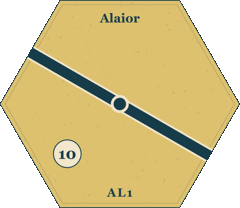
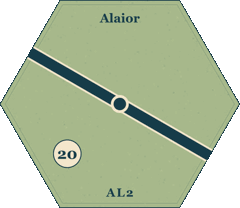
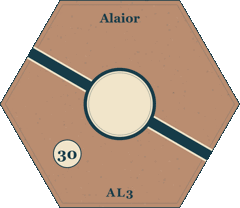
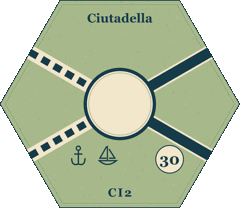
Every town on the island has its own tile series, with the name printed on it and the value it pays. As the phases advance, the next colour goes on top: the place gains route slots, more value and more room for station tokens. Each series runs as far as its town does.
The towns, one by one
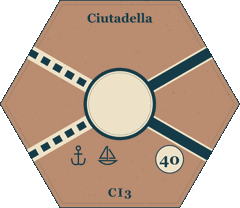
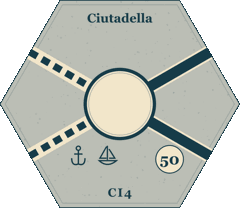
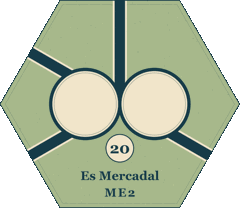
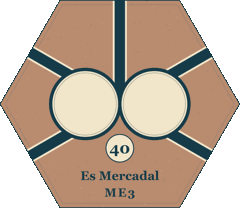
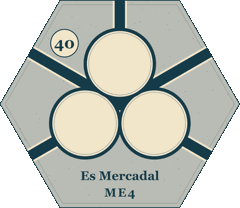
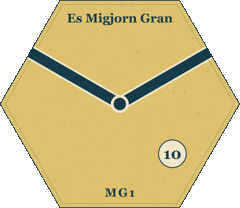
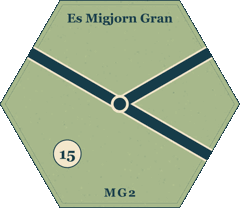
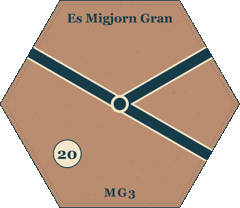
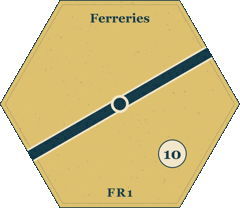
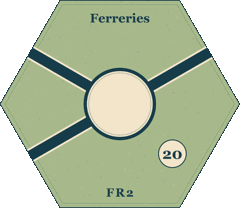
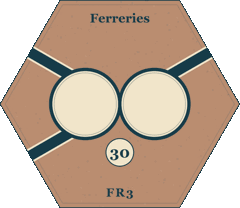
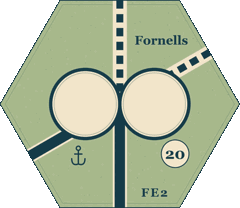
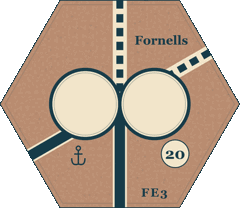
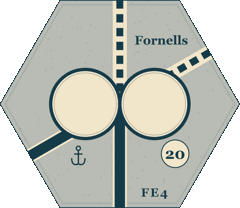
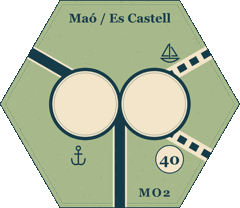
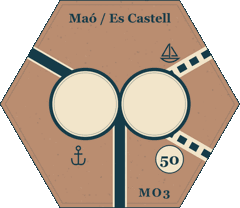
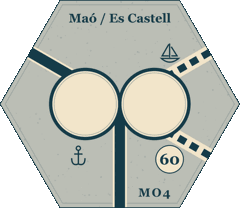
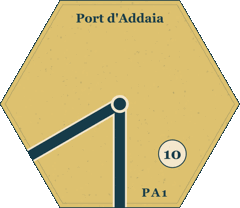
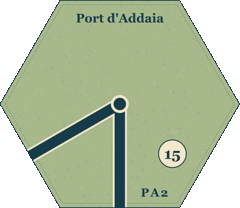
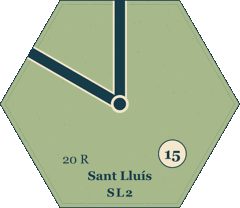
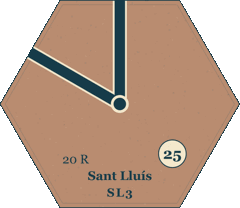
Track, sea and lighthouse examples
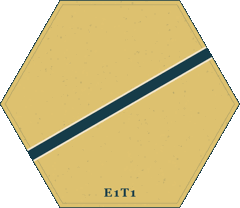
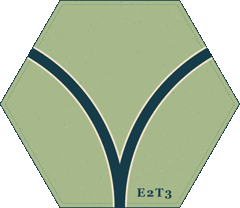
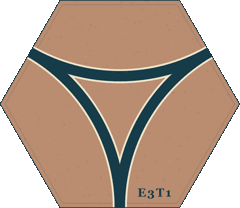
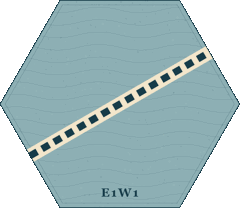
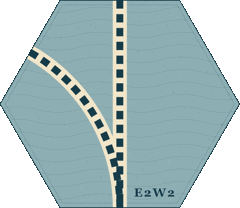
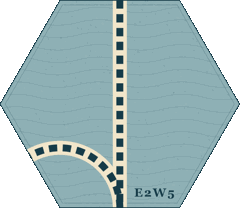
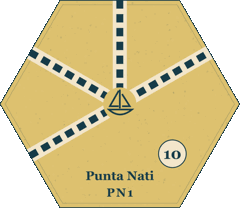
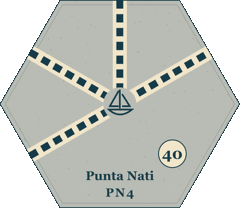
Two networks, two sets of tiles. Track tiles are for land routes and sea tiles only take ship routes. Sea tiles cannot be turned freely: the ones along the island draw the coastline, and the route has to carry on where the neighbouring hex leaves it. Lighthouses are coastal nodes and have a series of their own, from yellow to grey.
Map of Menorca
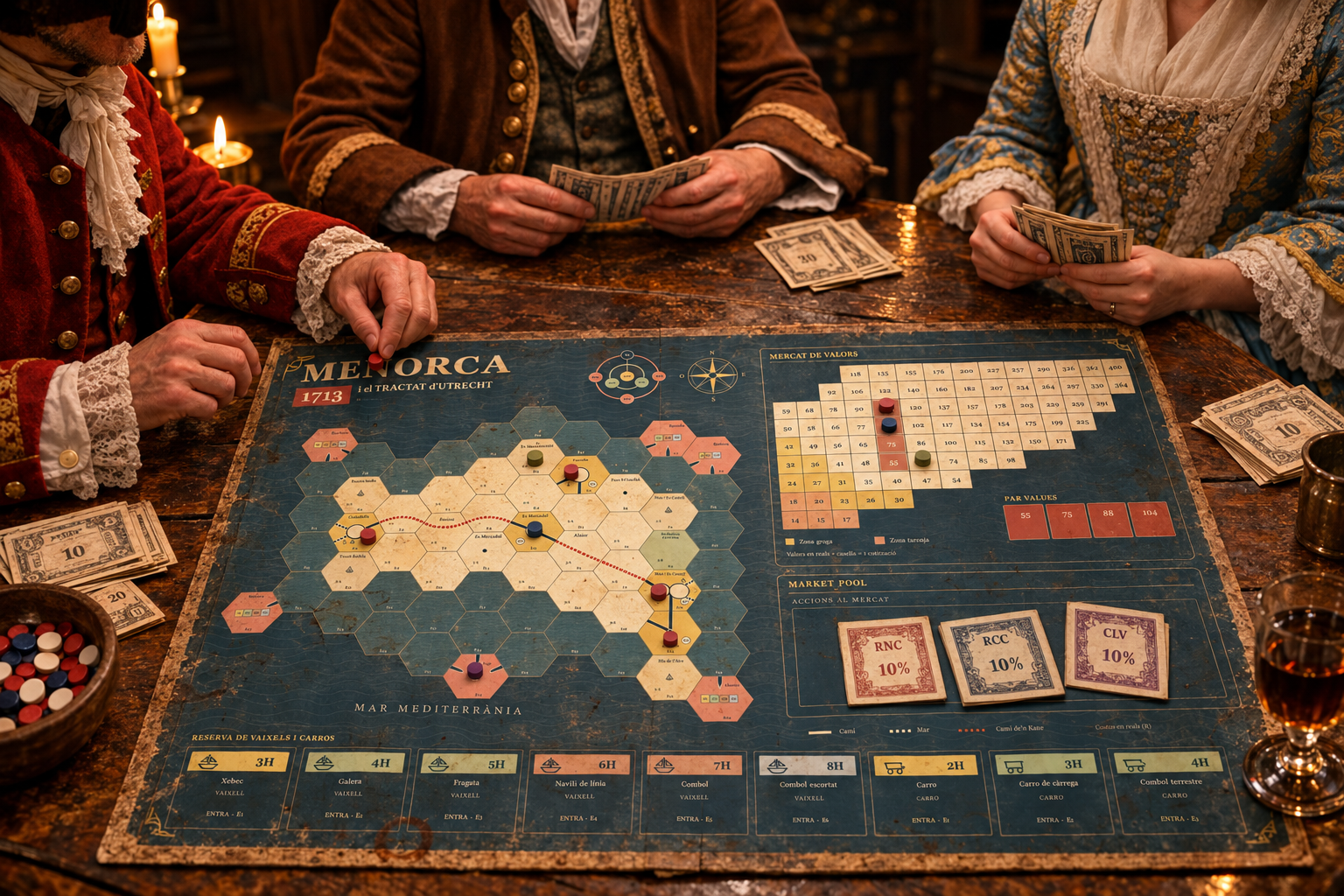
The hex board recreates the geography of Menorca: ports, roads, towns and the trade routes that connected the island with the Mediterranean under British rule. The building cost is printed on each hexagon.