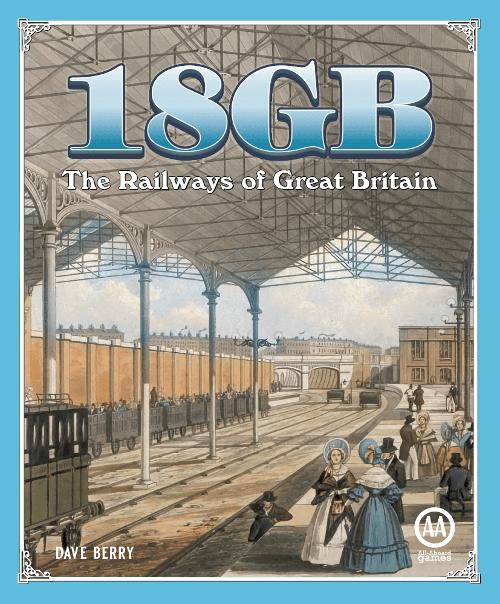
18GB: The Railways of Great Britain
Designer: Dave Berry
Great Britain with companies randomly split into two tiers, blending ideas from 1825 and 1860.
18GB — Summary
Capitalization type
- Full capitalization: on floating (40% sold initially), the company receives all the capital for its initial shares at once (4 × par price). Companies start as 5-share companies (40/20/20/20) and can later convert into 10-share companies, at which point they receive additional capital equal to share price × 5.
Floating percentage and per-player share limits
- Floats once 40% of shares are sold (a single threshold for all corporations)
- There is no per-player ownership cap: a player may hold up to 100% of a single corporation
- Certificate limit by player count (set per scenario, not a single fixed table): 2 players — 19; 3 players — 14; 4 players — 14; 5 players — 14; 6 players — 12
Starting cash by player count
- 2 players: £375 starting cash (certificate limit: 19)
- 3 players: £330 starting cash (certificate limit: 14)
- 4 players: £330 starting cash (certificate limit: 14)
- 5 players: £320 starting cash (certificate limit: 14)
- 6 players: £305 starting cash (certificate limit: 12)
- The bank has unlimited money
End game triggers
- The depot runs out of trains (the last train leaves the bank's supply): the game ends once the current operating round is finished
- A share price reaches a marked end-game space on the stock chart: the game ends once the current operating round is finished
- Bankruptcy doesn't exist as such (BANKRUPTCY_ALLOWED = false): an underfunded company becomes "Insolvent" or goes into "Receivership" (managed by the bank) instead of being liquidated
Number of phases
- 7 phases (2+1, 3+1, 4+2, 5+2, 4X, 5X, 6X), triggered by the purchase of the first train of each type
- Buying the first 3+1 train makes new companies float at 60% instead of 40%
- Buying the first 5+2 train converts every company that hasn't started yet into a 10-share company
- Buying the first 6X train removes any company that still hasn't started, retiring one 6X train from the depot for each one removed
Train list and prices
- 2+1 train — £80 (rusts once the first 4+2 train is bought) — pays for 2 cities/off-board plus 1 town
- 3+1 train — £200 (rusts once the first 4X train is bought) — buying it raises the float threshold to 60%
- 4+2 train — £300 (rusts once the first 6X train is bought)
- 5+2 train — £500 — buying it converts every unstarted company into a 10-share company
- 4X train (express) — £550 — ignores towns and counts only cities/off-board locations; adds a £10 bonus per hex of straight-line distance between the route's start and end
- 5X train (express) — £650
- 6X train (express) — £700 — the last available type; buying it removes any unstarted companies
- The quantity of each train type depends on the number of players (it varies by the chosen scenario)
List of private companies
- The exact set of privates in play depends on the number of players (the scenario picks between 6 and 9 of the 9 possible ones). All of them block a hex while open, and once closed, the owner keeps the special ability for any company they control
- London & Birmingham (LB) — £40, revenue £10 — the owner has priority to start the LNWR; can't buy shares in another company until they do
- Arbroath & Forfar (AF) — £30, revenue £10 — grants an extra tile action in Perth once closed
- Great Northern (GN) — £70, revenue £25 — grants an extra station token in York (free if a route can be traced there, £50 otherwise) and enables an early green tile in York
- Stockton & Darlington (SD) — £35, revenue £12 — £10 bonus at Middlesbrough
- Liverpool & Manchester (LM) — £45, revenue £15 — £30 bonus at Liverpool
- Leicester & Swannington (LS) — £30, revenue £10 — grants an extra tile action in Leicester once closed
- Taff Vale (TV) — £60, revenue £25 — allows laying the Severn Tunnel tile (C22) for free
- Maryport & Carlisle (MC) — £50, revenue £20 — grants an extra station token in Carlisle (free if a route can be traced there, £50 otherwise) and enables an early green tile in Carlisle
- Chester & Holyhead (CH) — £30, revenue £10 — £20 bonus at Holyhead
List of corporations
- Caledonian Railway (CR) — home at G4
- Great Eastern Railway (GER) — home at J25
- Glasgow and South Western Railway (GSWR) — home at F5
- Great Western Railway (GWR) — home at D23
- London and North Western Railway (LNWR) — home at F21
- London and South Western Railway (LSWR) — home at D25
- Lancashire and Yorkshire Railway (LYR) — home at H15
- Midland Railway (MR) — home at H19
- Manchester, Sheffield and Lincolnshire Railway (MSLR) — home at H17
- North British Railway (NBR) — home at I6
- North Eastern Railway (NER) — home at J13
- South Wales Railway (SWR) — home at A20
- All start as 5-share companies; the game's scenario (based on player count) picks a subset of between 6 and 12 of them
Game-specific mechanics
- Fully variable setup: different scenarios depending on player count (2-player games even have two possible maps, North-South or East-West, depending on the chosen variant), each with its own map, set of companies and privates, certificate limit, and starting cash
- Companies randomly split into two tiers at setup: tier-2 companies can only be started from the second stock round onward
- 5-share to 10-share conversion (via a phase event, or during an emergency recapitalization), with additional capital coming in and, often, extra tokens
- A player can own up to 100% of the shares of a single company (no 60% cap)
- A player can sell any number of their own shares on the market, including the director's certificate
- Express (X) trains: ignore towns and add a £10 bonus per hex of straight-line distance between the route's start and end
- "Compass" bonuses (north/south, east/west) and estuary bonuses (Severn, Forth) for routes connecting specific parts of the map
- No bankruptcy: underfunded companies become Insolvent or go into Receivership instead of being liquidated
Emergency sell
A fundamental departure from 1830: the president is never asked for personal cash, and personal shares are never forced onto the market at all — the corporation raises the money itself instead. A trainless 5-share corporation that can't afford one converts into a 10-share corporation: its price drops three steps on the market, five new 10% shares are issued to the pool, and the bank pays the treasury directly for them — real fresh capital, not a sale of anyone's personal holdings. The president can then choose to buy back one of those freshly issued shares. A corporation that's already the larger, 10-share size and still can't afford a train has no more room to convert, and is instead expected to fall into insolvency/receivership rather than face bankruptcy, since bankruptcy itself is disabled in this game.
Comparison with 1830
1. Setting and map
1830 covers the northeastern USA. 18GB takes place in Great Britain, but should not be confused with 1822
(which carries the subtitle "Railways of Great Britain"): 18GB is a different design, by Dave Berry, that
combines elements of 1825 and 1860 with the classic base of 1830 and its descendants.
2. Companies grouped into two random tiers
In 1830 all companies are available from the start on equal terms. In 18GB, during game setup, the railway
companies are randomly split into two tiers: tier-2 companies can't be started until the second stock round.
Which companies end up in each tier varies from game to game, so the map develops differently each time it's
played.
3. You can own 100% of a company, and freely sell the director's certificate
In 1830 the individual ownership limit is 60%, and the president's certificate is normally not freely sold on
the market but rather transferred. In 18GB a player can buy up to 100% of the shares of a single company, and
can sell any number of their own shares on the open market, including the director's certificate.
4. Companies are born with 5 shares and convert into 10
In 1830 every company shares the same 10-share structure from the start. In 18GB companies are born as
5-share companies (40/20/20/20) and convert into 10-share companies later on -via a phase event or during an
emergency recapitalization- receiving additional capital in the process. This two-stage structure has no
equivalent in 1830.
5. No bankruptcy: Insolvency and Receivership instead
In 1830 a company that can't pay for a mandatory train can end up liquidated if the president also can't
cover the shortfall. In 18GB bankruptcy doesn't exist as such: an underfunded company becomes "Insolvent" or
is placed into bank "Receivership," staying in the game but under restrictions, rather than disappearing.
6. Fully variable setup depending on player count
In 1830 the map and the set of companies are fixed, regardless of player count. In 18GB every player count
uses its own scenario, with its own map, its own subset of companies and privates, its own certificate limit,
and its own starting cash -including two possible different maps for 2 players (North-South or East-West)-
which gives it far greater game-to-game variability than 1830.
A term you do not recognise? They are all explained in the 18xx glossary. Glossary →