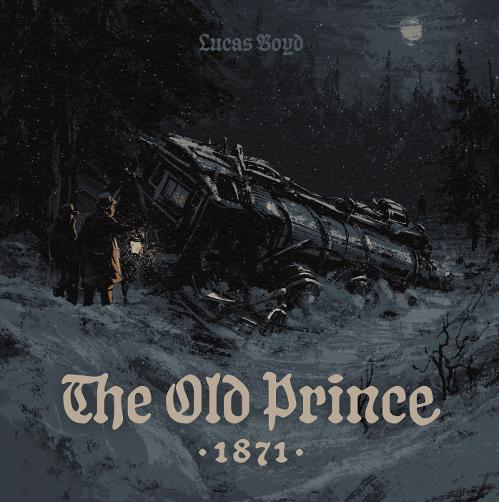
The Old Prince 1871
Designer: Lucas Boyd
Prince Edward Island and the PEIR, a ghost network that turns into a company live at the table.
The Old Prince 1871 — Summary
Capitalization type
- Full capitalization: when a company floats (60% sold), it receives all of its capital in its treasury at once. The Mainline is an exception: it starts already floated from the very beginning. "Branch" companies created via splitting switch to incremental capitalization the moment they're created.
Floating percentage and per-player share limits
- The seven starting railways float once 60% of their shares are sold, except whichever one is randomly designated the "Mainline" (ML), which floats at 50%; the PEIR (formed later by merging the majors) starts already floated (0%)
- No player may hold more than 60% of one corporation, except the PEIR, which has no limit (100%)
- Certificate limit per player: 3 players — 20; 4 players — 16 (the game only supports 3- or 4-player games)
Starting cash by player count
- 3 players: $580 starting cash (cert limit: 20)
- 4 players: $480 starting cash (cert limit: 16)
- The game only supports games of 3 or 4 players; the bank is unlimited in both cases
End game triggers
- A player goes bankrupt: immediate end
- The first Diesel (D) train is bought, triggering the game's final phase: one more full set of operating rounds is completed and the game ends
Number of phases
- 10 phases (2H, 3H, 4H, 5H, 6H, 2+, 3+, 4+, 7, D), each triggered by the purchase of the first train of the matching type
- Starting in phase 4H, corporations may buy the Hunslet Steam Engine private
- Available par prices close off progressively: $80 disappears in phase 5H, $74 in phase 3+, and $65 in phase 7, leaving only $58 available by the end of the game
- Buying the first 4+ train closes every private company still owned by a player
Train list and prices
- 2H train — $80 (4 available; rusts once the first 5H train is bought); distance is measured in hex edges crossed, not in stops
- 3H train — $100 (3 available; rusts once the first 6H train is bought); same hex-edge counting
- 4H train — $120 (3 available; rusts once the first 2+ train is bought); same hex-edge counting
- 5H train — $160 (3 available; rusts once the first 3+ train is bought; buying it removes the $80 par price)
- 6H train — $180 (2 available; rusts once the first 4+ train is bought)
- 2+ train — $220 (4 available; rusts once the first 7 train is bought); counts only cities and offboards visited (up to 2); towns are passed through for free with no limit
- 3+ train — $240 (3 available; rusts once the first Diesel is bought; buying it removes the $74 par price); counts up to 3 cities/offboards
- 4+ train — $200 (2 available; buying it closes every remaining private); counts up to 4 cities/offboards; if it still hasn't operated by the time the Diesel arrives, it becomes obsolete instead of rusting
- 7 train — $500 (4 available, never rusts; buying it removes the $65 par price); standard stop-based counting
- Diesel (D) train — $600 (unlimited, never rusts); standard stop-based counting
List of private companies
- Merchants and Co. (MC) — $40, revenue $5 — exchangeable for a Shortline exchange share during the stock round
- Vernon River Bridge Company (VR) — $40, revenue $5 — blocks hex N18 until exchanged; exchangeable for a Shortline exchange share
- Ice Boat Shipping (IB) — $40, revenue $5 — only available in 4-player games; exchangeable for a market share of any already-floated corporation other than the Mainline or Shortline
- Royal Agricultural Society (RA) — $110, revenue $10 — comes with a Mainline share
- Railcar Ferry: the Prince Edward Island (RF) — $120, revenue $15 — comes with a Mainline share
- Shipbuilding (SB) — $90, revenue $15 — exchangeable for a Shortline exchange share
- Hunslet Steam Engine (HSE) — $110, revenue $20 — may be sold to a corporation for between $1 and $200; the owning corporation may close it to buy a train from the bank at any point during its operation
- Mainline Concession (ML) — $160, revenue $20 — comes with the Mainline's (20%) president's certificate; closes once the Mainline operates; the Mainline may operate as soon as this private is sold
- Schreiber and Burpee Construction (SBC) — $100, revenue $30 — comes with a free yellow straight tile; its owner is the only one allowed to use the special "9" tile
- Short Line Concession (SL) — $160, revenue $30 — comes with the Shortline's (20%) president's certificate; closes once the Shortline operates
- Union Bank (UB) — $120, revenue $0 — comes with one Mainline share and one share of the randomly-chosen "Random" corporation; never closes; its owner may buy one share per stock round on the bank's behalf
- The King's Mail (KM) — $0, revenue $80 — always assigned to the PEIR, which starts with $200 in treasury thanks to this private; closes together with the other privates once the first 4+ train is bought
- PEIR shares (P1 through P7, but only 5 appear each game) — $80 each — exchange for a market share of the matching numbered corporation once it floats; they go directly into the initial auction (the other 2 numbered corporations are randomly chosen as the Mainline and Shortline before the auction)
List of corporations
- Souris (So) — home at T12
- Alberton (A) — home at D6
- Mount Stewart (MS) — home at M13
- Murray River (MR) — home at Q21
- Summerside (S) — home at F14
- Georgetown (Gt) — home at R16
- Charlottetown (C) — home at L16
- Of these 7 numbered corporations, two are randomly chosen each game as the Mainline and Shortline (which start already active); the other 5 remain PEIR companies until someone buys the matching private and floats them
- PEIR (Prince Edward Island Railway) — the "meta-company" holding the tokens and PEIR shares of corporations not yet floated; it has no fixed home and floats at 0%
- "Branch" companies (Cornwall, Stratford, Morel, Belfast, Wellington and Hunter River) — up to 6 additional corporations with no fixed home, which only exist if created by splitting an already-floated company
Game-specific mechanics
- Tranche system: companies open up in 4 successive tranches of 2, 1, 2 and 3 slots (8 companies total); a new tranche doesn't open until every company in the previous one has operated or sold out completely
- The PEIR as a ghost network: while a numbered corporation hasn't floated, its station shows up on the map as a generic PEIR token; once it floats, the token is replaced by the new corporation's own and the matching PEIR share disappears, redistributing the percentage among the remaining PEIR shares
- The Mainline is born already floated, with $920 in treasury and a fixed market price of 92 from the very start; the Shortline is born with a token on the map but unfloated, with a fixed price of 86 and its presidency up for auction
- Split ("Branch") mechanic: the president of a floated company who owns at least 40% of it and has 2 stations on the map may split it into a new "Branch" corporation with incremental capitalization, dividing shares and assets between the two
- Two train families coexist: "H" trains measure distance in hex edges crossed, while "+" trains count cities/offboards visited (towns are passed through for free with no limit)
- Two tile lays per turn: one free yellow lay plus, optionally, a second one for $20
- Strict sell restrictions: the president's certificate can't be sold directly (it only transfers when someone else surpasses your percentage), no more than 30% of the same company can be sold in a single stock round turn, and shares of a company that has never operated can never be sold
- The Union Bank: a player-controlled entity that, once per stock round, may buy a share or found a company by combining the bank's money with the owner's own; its shares don't count toward the 60% ownership limit
- Dynamic stock round turn order using two decks of numbered cards; after the initial auction, order is set by remaining cash (less cash goes first)
Emergency sell
Follows the same order as 1868 Wyoming — a mandatory issue of the corporation's own treasury shares comes first, before anyone's personal cash — but with a twist tied to 1871's unique split-ownership model: since a share can be jointly held between two players, it's whichever player is designated as "acting for" the corporation, not necessarily the nominal owner, who's on the hook for personal cash and shares. A corporation can dump its entire remaining treasury stake in one go during this step, bypassing the usual smallest-sufficient-bundle rule, though individual players stay capped at the game's normal 30%-per-sale limit even here. One exemption: the private-derived PEIR corporation is never forced to buy a train at all.
Comparison with 1830
1. Setting, scale, and design status
1871 takes place on Prince Edward Island (Canada), a much smaller, curving map than 1830's northeastern United
States. It's also a small design still in alpha/prototype status — not an established classic — built for only
3 or 4 players (versus 1830's 2 to 6), with much tighter starting cash ($580/$480 versus 1830's
$1,200/$800/$600/$480/$400), in keeping with a much smaller map.
2. Shared full capitalization, with one notable exception
Like 1830, 1871 uses full capitalization: when a company floats, it receives all of its capital in its treasury
at once. The difference is that the Mainline breaks this rule: it starts already floated from the very
beginning, with $920 in treasury and a station already on the map, never needing the usual 60% sold.
3. The PEIR: a meta-company with no equivalent in 1830
The PEIR is a ghost network of shares that never trade or sell; they represent the future right to found one of
the numbered corporations on the map. Until founded, their stations occupy the map as generic markers. 1830 has
nothing like it: every company there is founded (or not) independently, with no intermediate structure of this
kind.
4. Companies founded in tranches, not freely
In 1830, any available company can be founded at any time. In 1871 the game's eight companies open up in four
successive tranches (2, 1, 2 and 3 slots), and every company in the previous tranche must have operated or sold
out before the next one opens, artificially pacing the growth in the number of companies.
5. The split ("Branch") mechanic, absent from 1830
In 1871, the president of a large enough company can split it into a brand new "Branch" company, dividing
shares and assets between the two. It's a way to "clone" the growth of an established network that 1830 simply
doesn't have.
6. The Union Bank, an extra partner 1830 doesn't have
In 1871 a player can control a Union Bank with its own treasury that buys shares or founds companies by mixing
its own money with the bank's, without any of it counting toward the 60% ownership limit. In 1830, each player
can only invest with their own money.
7. Unlimited bank and a different game end
In 1871 the bank is unlimited and the game ends with one extra cycle of operating rounds after the first Diesel
train is bought (or if someone goes bankrupt). In 1830 the bank has a fixed size of $12,000 and the game ends
when it runs out, making the ending far less predictable than in 1871.
A term you do not recognise? They are all explained in the 18xx glossary. Glossary →