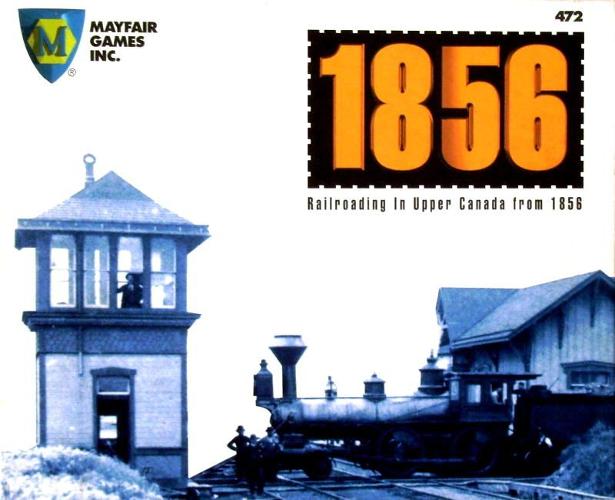
1856: Railroading in Upper Canada from 1856
Designer: Bill Dixon
Upper Canada and the risk of being nationalized by the government if loans aren't repaid in time.
1856 Railroading in Upper Canada — Summary
Capitalization type
- Evolving capitalization, not fixed: companies founded early use "escrow" capitalization (they receive the money from the first 5 shares sold right away, but the money from the last 5 stays held back until the company connects to its assigned destination city). Once the first 4-train is bought, newly founded companies switch to incremental capitalization; once the first 5-train is bought, newly founded companies switch to full capitalization.
- The percentage of shares that must be sold to start operating also rises over time: it begins at 20% and increases by 10 points with each new phase, up to a maximum of 60%.
Floating percentage and per-player share limits
- The floating threshold isn't fixed: it starts at 20% and rises 10 points with every new phase up to a 60% cap (see "Capitalization type" above); no corporation has its own value different from this general threshold
- No player may hold more than 60% (6 of 10 certificates) of a single corporation
- Certificate limit per player: 3 players — 20; 4 players — 16; 5 players — 13; 6 players — 11
Starting cash by player count
- 3 players: $500 starting cash
- 4 players: $375 starting cash
- 5 players: $300 starting cash
- 6 players: $250 starting cash
- The bank always starts with $12,000, regardless of player count
End game triggers
- The bank runs out of money: immediate end
- A company goes bankrupt and cannot complete payment for a mandatory train: immediate end
Number of phases
- 6 phases (2, 3, 4, 5, 6, D), triggered by the purchase of the first train of each type (the optional 8-train variant replaces phase D with a phase 8)
Train list and prices
- 2 train — $100 (6 units; rusts once the first 4-train is bought)
- 3 train — $225 (5 units; rusts once the first 6-train is bought)
- 4 train — $350 (4 units; rusts once the first Diesel is bought; buying it switches newly founded companies to incremental capitalization)
- 5 train — $550 (3 units; never rusts; buying it closes the privates and switches newly founded companies to full capitalization)
- 6 train — $700 (2 units; never rusts; buying it triggers nationalization: companies with outstanding loans must merge into the Canadian Government Railway (CGR), or their president pays off the debt out of pocket)
- Diesel (D) train — $1,100 (unlimited, available from phase 6; allows trading in old trains for a $350 discount each)
List of private companies
- FT - Flos Tramway — $20, revenue 5, no special ability (blocks L3 while owned by a player)
- WSRC - Waterloo & Saugeen Railway Co. — $40, revenue 10, the owning corporation may place a free station and green tile at Kitchener (I12); closes once used
- TCC - The Canada Company — $50, revenue 10, the owning corporation gets an extra free tile lay at hex H11; doesn't close when used
- GLSC - Great Lakes Shipping Company — $70, revenue 15, the owning corporation may place the port marker on a port hex (+$20 revenue there); closes on placement; the marker is removed once the first 6-train is bought
- NFSBC - Niagara Falls Suspension Bridge Company — $100, revenue 20, the owning corporation gets +$10 when reaching Buffalo; other corporations may buy this right for $50
- SCFTC - St. Clair Frontier Tunnel Company — $100, revenue 20, the owning corporation gets +$10 when reaching Sarnia; other corporations may buy this right for $50
List of corporations
- BBG - Buffalo, Brantford & Goderich Railway — home at J15
- CA - Canada Air Line Railway — home at D17
- CPR - Canadian Pacific Railroad — home at M4
- CV - Credit Valley Railway — home at N11
- GT - Grand Trunk Railway — home at P9
- GW - Great Western Railway — home at F15
- LPS - London & Port Sarnia Railway — home at C14
- TGB - Toronto, Grey & Bruce Railway — home at K8
- THB - Toronto, Hamilton and Buffalo Railway — home at L15
- WR - Welland Railway — home at O16
- WGB - Wellington, Grey & Bruce Railway — home at J11
- CGR - Canadian Government Railway — no fixed home; forms through nationalization once the first 6-train is bought, absorbing companies with outstanding loans
Game-specific mechanics
- Government loans of up to $100 per operating round, within each company's capitalization limit
- Nationalization once the first 6-train is bought: indebted companies merge into the CGR (shares exchanged at a rate of 2 for 1) or their president pays off the debt personally
- The president's certificate is worth double a normal share, but only counts as 1 certificate against the hand limit
- Every company is assigned a specific destination city at setup
- Bridge and tunnel rights can be bought between corporations for $50 once the original privates have closed
Emergency sell
Matches the 1830 baseline for an actual forced train purchase: treasury cash, then the president's personal cash, then a forced sale of the president's shares in any corporation. Separately, corporations also have access to a voluntary interest-bearing Loan they can take as ordinary financing — but that option only opens up after the Buy Trains step has already passed for the turn, so it can't replace the emergency sequence in the moment a train purchase is actually forced.
Comparison with 1830
1. Setting and map
1830 covers the northeastern United States. 1856 takes place in southern Ontario (formerly "Upper Canada"),
a smaller map centered on the corridor between the Great Lakes, with a game designed to last about 4 hours
among experienced players.
2. Government loans available to all companies
A mechanic absent from 1830: any company can take out a government loan of up to $100 per operating round
(always within its capitalization limit). This debt is tempting for speeding up construction, but it must be
repaid later.
3. Nationalization: the Canadian Government Railway (CGR)
This is 1856's central, defining mechanic. Once the first 6-train is bought, any company that still has
outstanding government loans must merge into the Canadian Government Railway (or its president pays off the
debt personally to save it). The absorbed company's shares are exchanged for CGR shares at a rate of 2
absorbed shares per 1 CGR share. In 1830 there is no concept of nationalization or of an absorbing
state-owned company.
4. The president's certificate is worth two shares but counts as a single certificate
In 1830 the president's certificate represents 20% of the company and counts as 2 certificates against the
certificate limit a player can hold. In 1856, the president's certificate also represents double the value
of a normal share, but for purposes of a player's certificate limit it counts as only 1, not 2. This makes
presidential control relatively "cheaper" in terms of hand limit.
5. Themed privates with active powers and staggered closure
In 1830 there are 6 privates with fixed revenue and, in some cases, small bonuses. In 1856 there are also six
themed privates, but with much more varied effects: for example, one private allows placing a free station
in a specific city, and another (the Niagara Falls Bridge) grants a fixed cash bonus when a route runs
through it.
6. A specific historical theme: Canadian railway consolidation
1856 directly simulates how many Canadian railway companies of the era became over-indebted to the
government and ended up absorbed to form what would later become the Canadian National Railway. 1830 has no
equivalent narrative of state consolidation.
A term you do not recognise? They are all explained in the 18xx glossary. Glossary →