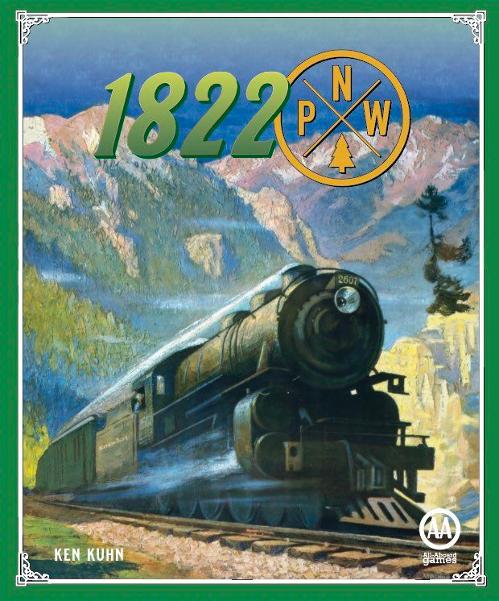
1822PNW
Designer: Ken Kuhn
1822 without concessions, with merging associated minors and a lumber market unique to the Pacific Northwest.
1822PNW — Summary
Capitalization type
- Incremental capitalization for all majors: each share pays its par price into the treasury at the moment it's actually sold, not all at once when floating.
- Once the first 6-train is bought (phase 6), any major that hasn't floated yet switches to full capitalization (receiving its whole capital at once) for the rest of the game.
Floating percentage and per-player share limits
- Floats at 50% of shares sold for all majors; minors and regionals (A, B, C) float at 100% (they start operational right away)
- No player may hold more than 60% (6 of 10 certificates) of a single major, except minors and regionals, which have no limit (100%)
- Certificate limit per player: 3 players — 21; 4 players — 15; 5 players — 12
Starting cash by player count
- 3 players: $500 starting cash
- 4 players: $375 starting cash
- 5 players: $300 starting cash
- The bank always starts with $12,000, regardless of the number of players
- 1822PNW is strictly for 3-5 players (no 2-player or 6+ mode)
End game triggers
- The bank runs out of money: if it breaks during an operating round, the current full OR set is finished; if it breaks during a stock round, it ends at the next complete operating round set
- A share price reaches one of the cells marked "e" at the top of the stock market grid: the game ends at the close of the current operating round
- Unlike 1822GB and 1822NRS, if a second end-game condition is triggered that would end the game sooner than the first, that second condition takes precedence (an explicit 1822PNW rule, overriding the usual "first trigger wins")
- There's no bankruptcy end condition: in 1822PNW, as in the rest of the 1822 family, company bankruptcy isn't enabled
Number of phases
- 7 phases (1 through 7), triggered by the purchase of the first train of each type (2/L, 3, 4, 5, 6, 7) respectively
- Unlike the NRS/MRS, 1822PNW doesn't reduce the cost of upgrading an L-train to a 2-train from phase 2 onward: it always stays at $80
Train list and prices
- L / 2 train — the L costs $60 (22 available) and can be upgraded into a 2-train, or a 2-train can be bought directly for $120; the L rusts with the first 3-train, the 2 with the first 4-train
- 3 train — $200 (7 available; rusts with the first 6-train)
- 4 train — $300 (4 available; rusts with the first 7-train)
- 5 train — $500 (2 available); unlike 1822GB/NRS, buying it has no special effect (1822PNW has no concessions to close)
- 6 train — $600 (3 available); buying it switches any major that hasn't floated yet to full capitalization
- 7 train (or E variant, distance 99, price $1,000) — $750 (unlimited); unlike 1822GB/NRS, buying it doesn't close any private (1822PNW has no phase-revenue privates)
- Special trains not bought from the depot: 2P (permanent 2-train, from P2), LP (permanent L-train, from P3 and P4, two units), 5P (permanent 5-train, from P1); two "Pullmans" (P+, from P5 and P6) convert another train into a + train
List of private companies
- All privates are distributed by auction through bidding boxes, not at a fixed price: they start with a minimum bid of $0 and each player has a limited number of bidding tokens
- P1 (5-Train, phase 5) — grants a permanent 5-train
- P2 (Permanent 2T, phase 2) — grants a permanent 2-train that doesn't count against the train limit
- P3 and P4 (Permanent LT, phase 1) — each grants a permanent L-train
- P5 and P6 (Pullman, phase 3) — convert a train into a + train able to include extra towns
- P7 and P8 (Remove Town, phase 1) — let you remove a town by laying a plain track tile directly on it
- P9 (Mail Contract, phase 3) — pays half the base value of the start and end stations of one of the trains operated
- P10 (Three Builder Cubes, phase 1) — when acquired, the private is exchanged for three builder cubes, each worth a $40 discount on the cost of upgrading a tile
- P11 (Extra Tile Lay, phase 3) — grants an extra tile (two for majors from phase 3 on) during the track-laying step
- P12 (Small Port, phase 2) — converts a water spike into a fixed stop worth 30/40 depending on tile color
- P13 (Large Port, phase 3) — same as P12 but worth 40/50/60 depending on color
- P14 (Lumber Baron, phase 3) — doubles the payout of every timber hex crossed by a train, from $10 to $20
- P15 (Paper Mill, phase 3) — closes to place a special token on a city adjacent to a timber hex, adding $10 (before phase 5) or $30 (phase 5+) to one train
- P16 (Pacific Portage, phase 2) — lets you place special water tiles; any other company crossing them pays a $10 toll per tile
- P17 (Ski Haus, phase 5) — closes to place a special token on a mountain-pass hex, adding $30 to a route running through it
- P18 (Boom Town, phase 3) — closes to upgrade a plain yellow tile into the special "boom town" tile (PNW3, worth $30), ignoring normal upgrade restrictions
- P19 (Rockport Coal Mine, phase 3) — lets you place a special mine tile on a mountain hex; only the owning company can stop there
- P20 (Backroom Negotiations, phase 1) — lets a non-associated minor take over the association of an inactive associated minor, inheriting its major and turning its own home into the major's new home
- P21 (Credit Mobilier, phase 2) — lets you move a private or minor to the top or bottom of its stack, or (if held by a major) move a token from the exchange area to the available slot
List of corporations
- Canadian Pacific Railway (CPR) — home at A8 (Vancouver, BC), destination A22, associated minor: 1 (Pacific Great Eastern)
- Great Northern Railway (GNR) — home at D23 (Newport), destination D11 (Bellingham), associated minor: 5 (Idaho & Washington Northern)
- Chicago, Milwaukee and Puget Sound (CMPS) — home at F23 (Spokane), destination H11 (Seattle), associated minor: 7 (Spokane Falls and Northern)
- Seattle and Walla Walla Railroad (SWW) — home at H11 (Seattle), destination O22, associated minor: 8 (Puget Sound Shore)
- Spokane, Portland, and Seattle Railway (SPS) — home at O8 (Portland), destination F23 (Spokane), associated minor: 17 (Oregon Central)
- Oregon Railroad and Navigation Company (ORNC) — home at O8 (Portland), destination O20 (Wallula), associated minor: 18 (Portland and Willamette Valley)
- Northern Pacific Railway (NP) — home at O20 (Wallula), destination I12 (Tacoma), associated minor: 20 (Walla Walla Valley)
- All majors have 3 exchange tokens each
- 21 numbered minors (50% director's certificate), seven of which are "associated" with a major (1, 5, 7, 8, 17, 18, and 20, listed above), the rest operating independently: 2 Republic (B19), 3 Bellingham (D11), 4 Brewster (D19), 6 Port Townsend (F9), 9 Leavenworth (H19), 10 Tacoma (I12), 11 Aberdeen (J5), 12 Sprague (J23), 13 Yakima (L19), 14 Lewiston Junction (L23), 15 Ilwaco (M4), 16 Astoria (N5), 19 Stevenson/Cascade Locks (O14), and 21 The Dalles (P17)
- Three additional "regional railways" (A, B, C), also minor-type but with no association to any major: A at Calgary (A22), B at Tacoma (I12), and C at Vancouver, WA (O10)
Game-specific mechanics
- No concessions: majors are born by merging two minors (one of which must be their "associated" minor), instead of converting a concession
- From phase 2 on, every set of operating rounds is followed by a dedicated Merger Round used exclusively for merging minors — a game phase that exists in neither 1822GB nor 1822NRS
- Lumber market: timber ("forest") hexes pay an extra $10 per hex crossed by a train (not applicable to E-trains); the Lumber Baron private doubles it to $20
- Portage toll: any company without the Pacific Portage private pays a $10 penalty for each special portage tile it crosses
- Builder cubes (from P10): each is worth a flat $40 discount on the cost of upgrading a tile, and can be spent separately across different turns
- Simultaneous auction of privates and minors with bidding tokens limited per player (between 4 and 5 depending on player count), as in the rest of the 1822 system
- Stock round buying priority by cash on hand, not a cyclical turn order
- Dedicated optional rules: "Starting Packet" (a quick initial distribution of minors and privates to jump straight into an operating round) and removing two or three L/2 trains from the game to shorten it
- Two additional variants included: the Short Scenario and the Southern Regional Scenario (2-3 players)
Emergency sell
Follows 1822's usual order — company treasury, then the director's personal cash, then a forced sale of the director's own shares — but if that still isn't enough, this scenario lets the director take a bank loan instead of being declared bankrupt: 1822PNW disables bankruptcy entirely, so the loan exists specifically to guarantee a train purchase never fails outright. One added restriction versus the wider 1822 family: a train can only ever be bought from the bank here, never from another corporation's holdings.
Comparison with 1830
1. Same engine as 1822, without an auction for concessions
1822PNW (Ken Kuhn) builds on the 1822 system (privates and minors bought at auction), but removes
"concessions" for founding majors. In 1830, major companies are freely founded by buying their president's
certificate; in 1822PNW, they're instead founded by merging two minors together.
2. Majors are born by merging two associated minors, in a dedicated round
Each major company has 7 possible "associated" minors. To found it, players must identify and successfully
merge two of these minors, and the game dedicates a whole Merger Round after every set of operating rounds
(from phase 2 on) exclusively to this process. This layer of planning is unique to 1822PNW and exists in
neither 1830 nor 1822GB (which uses concessions, not minor mergers).
3. A lumber market unique to the Pacific Northwest map
Hexes containing timber generate extra revenue when a train passes through them. This mechanic, absent from
1830, creates a whole secondary economy ("Lumber Baron") around hauling lumber to cities.
4. Privates that interact with the map in ways 1830 doesn't
Besides the Lumber Baron, privates like the Paper Mill (bonus for cities near timber) or the Ski Haus (bonus
at mountain passes) assign special tokens to specific map hexes. No private in 1830 interacts with a map
resource this way.
5. Half new, regionally-themed private companies
Alongside classic 1822-system privates (permanent "L" and 2-trains, etc.), half of 1822PNW's set of privates
is entirely new and specifically themed around the Pacific Northwest region.
6. Simpler tile design than other 1822 titles
Despite sharing an engine with 1822, 1822PNW's track design is deliberately kept simple — closer to the basic
1817/1822 style than to the tile complexity of titles like 18GB or 1860.
7. Built-in short variant, an option 1830 doesn't offer out of the box
The 1822PNW box includes a short-game variant (Short Scenario) and a southern regional scenario (2-3
players), designed so the group can pick the length before starting. 1830 includes no equivalent variant in
its base rulebook.
8. Still "1822" in spirit, despite the changes
The designer himself insists that, despite the novelties (mergers, lumber), 1822PNW remains fundamentally a
1822-system game with a fresh perspective, not a radical break from the engine — unlike 1830, which did
establish a genuinely new reference engine relative to its own predecessors.
A term you do not recognise? They are all explained in the 18xx glossary. Glossary →