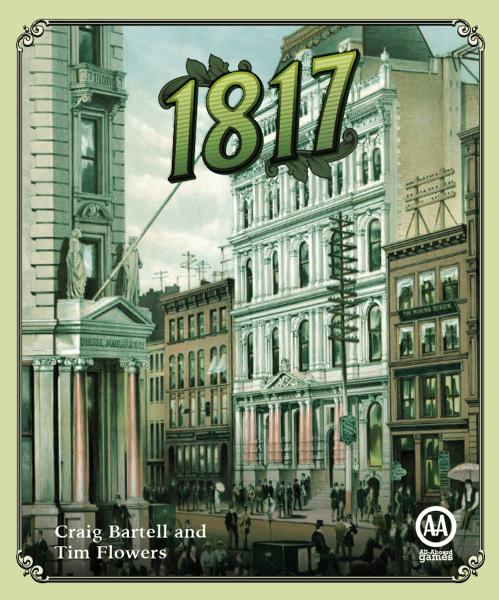
1817
Designer: Craig Bartell, Tim Flowers
An aggressive, finance-heavy 18xx for large groups, with loans, short selling, and hostile mergers between companies.
1817 — Summary
Capitalization type
- Incremental capitalization: the company collects the par price each time one of its shares is actually sold, instead of receiving its full capital at once when it floats.
Floating percentage and per-player share limits
- Companies float with 20% of shares sold (single threshold for all corporations)
- No player may hold more than 100% of a single corporation (the classic 60% cap doesn't apply)
- Certificate limit per player: 3 players — 21; 4 players — 16; 5 players — 13; 6 players — 11; 7 players — 9; 8 players — 8; 9 players — 7; 10 players — 6; 11 players — 6; 12 players — 5
Starting cash by player count
- 3 players: $420 starting cash
- 4 players: $315 starting cash
- 5 players: $252 starting cash
- 6 players: $210 starting cash
- 7 players: $180 starting cash
- 8 players: $158 starting cash
- 9 players: $140 starting cash
- 10 players: $126 starting cash
- 11 players: $115 starting cash
- 12 players: $105 starting cash
- The bank is practically unlimited (no fixed size): the end of the game never depends on it running dry
End game triggers
- The final phase is reached (phase 8, triggered by the purchase of the first 8-train): one more full set of operating rounds is played, then the game ends
- A player goes bankrupt: immediate end, but only once all players but one have gone bankrupt (not on the first individual bankruptcy)
Number of phases
- 8 phases (2, 2+, 3, 4, 5, 6, 7, 8), triggered by the purchase of the first train of each type
- Phases also set the maximum allowed corporation size: 2 shares in phases 2/2+, 2 or 5 in phase 3, 5 in phase 4, 5 or 10 in phase 5, and 10 from phase 6 onward
Train list and prices
- 2 train — $100 (40 units; rusts once the first 4-train is bought)
- 2+ train — $100 (4 units; becomes obsolete once the first 4-train is bought, but isn't removed)
- 3 train — $250 (12 units; rusts once the first 6-train is bought)
- 4 train — $400 (8 units; rusts once the first 8-train is bought)
- 5 train — $600 (5 units; never rusts)
- 6 train — $750 (4 units; never rusts)
- 7 train — $900 (3 units; never rusts)
- 8 train — $1,100 (unlimited; buying it triggers the game's final phase)
List of private companies
- P1 - Minor Coal Mine — $30 — one mine marker; lets the owner build a yellow "coal mine" tile ignoring mountain terrain cost and adding a $10 bonus to the route
- P2 - Ohio Bridge Company — $40 — one $10 bridge token at Louisville, Cincinnati, or Charleston; skips the $10 river fee when laying yellow tiles
- P3 - Mountain Engineers — $40 — the owning corp receives $20 after laying a yellow tile on a mountain hex
- P4 - Pittsburgh Steel Mill — $40 — may place a special yellow tile at Pittsburgh (F13) regardless of connectivity
- P5 - Coal Mine — $60 — two mine markers (same ability as P1)
- P6 - Minor Mail Contract — $60 — pays $10 at the start of each operating round while the corp has a train
- P7 - Train Station — $80 — an extra station marker for the owning corp
- P8 - Union Bridge Company — $80 — two $10 bridge tokens
- P9 - Mail Contract — $90 — pays $15 at the start of each operating round
- P10 - Major Coal Mine — $90 — three mine markers
- P11 - Major Mail Contract — $120 — pays $20 at the start of each operating round
List of corporations
- 20 corporations, all sharing the same format (floats at 20%, 100% of capital split into shares that can later be converted from 2 to 5, and from 5 to 10 shares), with no fixed home: each company chooses its starting city when it's founded
- Alton & Southern Railway (A&S), Arcade and Attica (A&A), Belt Railway of Chicago (Belt), Bessemer and Lake Erie Railroad (Bess), Boston and Albany Railroad (B&A), Delaware, Lackawanna and Western Railroad (DL&W), Elgin, Joliet and Eastern Railway (J), Grand Trunk Western Railroad (GT), Housatonic Railroad (H), Morristown and Erie Railway (ME), New York, Ontario and Western Railway (NYOW), New York, Susquehanna and Western Railway (NYSW), Pittsburgh, Shawmut and Northern Railroad (PSNR), Pittsburgh and Lake Erie Railroad (PLE), Providence and Worcester Railroad (PW), Rutland Railroad (R), Strasburg Railroad (SR), Union Railroad (UR), Warren & Trumbull Railroad (WT), West Chester Railroad (WC)
Game-specific mechanics
- Corporate loans with variable interest based on total outstanding debt (up to 2 loans for "minor" companies, up to 5 for large ones)
- Short selling: you can sell shares you don't own
- Dedicated merger and acquisition rounds (friendly or hostile) between operating companies
- 2-share "minor" companies that over time convert into 5-share, and later 10-share, companies
- Private companies never close: they keep generating revenue for the whole game
- Initial private auction with "seed" money ($200) and bids that must be multiples of a fixed increment
- A player who can't cover their own personal debts can be eliminated from the game
Emergency sell
There is no emergency sell for trains at all: companies are never required to own one, and the president can never contribute personal cash toward buying one. A company that ends its operating turn with no train is simply liquidated instead. 1817 does have a distinct forced personal-share-sale mechanic, called a "Cash Crisis," but it's only triggered by unpaid loan interest, an eliminated company's outstanding loans, or an unpaid short-sale obligation — never by trains. In a Cash Crisis the player sells shares of any company they hold (one at a time, at market price) until the debt is cleared or they go bankrupt themselves; the president's own certificate can never be forced onto the market this way.
Comparison with 1830
1. Setting, map and number of players
1830 covers the northeastern USA for 2-6 players. 1817 has a much bigger map that covers practically the
entire territory of the United States (or Canada, in the 1817NL variant), and is designed for large groups,
typically 5 to 7 players. Games tend to run much longer than 1830, often 6 to 12 hours or more.
2. 2-share "minor" companies that can be merged
In 1830 every company starts with 10 shares. In 1817 there are "minor" companies with only 2 shares, smaller
and cheaper to found, which over time can be merged or converted into 5-share companies, and those, later on,
into 10-share companies. This staged progression does not exist in 1830.
3. Loans and interest: corporate debt
A mechanic completely absent from 1830: companies in 1817 can take out loans to pay for tile lays, tokens, or
trains. The more loans circulating in the game, the higher the general interest rate climbs, making everyone's
debt more expensive. Loans must be repaid and accrue interest every operating round.
4. Short selling
In 1817 you can sell shares you don't own, betting that the price will drop so you can buy them back cheaper
later. If the price rises instead of falling, whoever sold short loses money and remains liable for any
dividends paid out in the meantime. In 1830 you can only sell what you actually own.
5. Mergers, hostile takeovers and liquidations
1817 has dedicated merger and acquisition rounds between operating companies. If two merging companies share
the same president, it's a friendly merger; otherwise, it's a hostile takeover and the "attacking" president
can take control without the rival's consent. None of this exists in 1830, where companies cannot merge with
or absorb each other.
6. Different round structure: SR + OR + mergers + OR + mergers
In 1830 the cycle is simple: a stock round followed by one or more operating rounds. In 1817 each complete
cycle is: stock round → operating round → merger & acquisition round → operating round → another merger &
acquisition round, and it all starts over. This means almost twice as many structural decisions per cycle
compared to 1830.
7. Personal consequences of bankruptcy
Because of short selling and loans, a player in 1817 can end up unable to cover their own debts (not just a
company's) and get eliminated from the game. In 1830 bankruptcy affects a company, but it doesn't directly
eliminate a player from the game in the same way.
A term you do not recognise? They are all explained in the 18xx glossary. Glossary →